Industrial Mixers
PerMix Applications
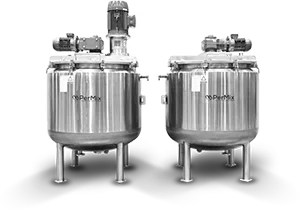
The global demand for premium hookah tobacco—commonly known as Shisha or Muʽassel—continues to grow rapidly across the Middle East, Europe, and North America. While consumers experience Shisha as a flavorful, aromatic smoking blend, manufacturers know that producing a consistent product is a complex mixing and material-handling challenge.
At its core, Shisha production is not simply tobacco processing. It is a high-viscosity paste manufacturing process involving fibrous solids, humectants, sugars, and delicate flavor systems. Achieving the right texture, moisture distribution, and flavor uniformity requires carefully engineered mixing technology.
Companies that master this process can produce Shisha with superior smoke density, flavor stability, and shelf life. Companies that don’t quickly encounter the challenges of sticky materials, uneven flavoring, and inconsistent batches.
This is where advanced industrial mixing systems—such as PerMix Sigma Extruder Mixers—play a critical role.
Traditional Shisha formulations consist of four primary components:
1. Tobacco Fiber
Tobacco leaves are typically washed, destemmed, and cut into small strips. The fiber acts as the structural backbone of the product, absorbing the liquid phase and holding flavor compounds.
2. Molasses or Sugar Syrup
Molasses, honey, or invert sugar gives Shisha its sweetness and contributes to the sticky texture that binds the mixture together.
3. Vegetable Glycerin
Glycerin is the key humectant in Shisha production. It retains moisture, produces dense vapor clouds when heated, and contributes significantly to the product’s viscosity.
4. Flavor Compounds
Flavor oils, fruit extracts, menthol, mint, and dessert profiles define the final product experience.
When combined, these ingredients create a highly viscous paste typically ranging from:
20,000 to 50,000 centipoise
To visualize this viscosity range:
This places Shisha firmly within the category of heavy paste mixing, similar to chewing gum, confectionery fillings, or dough systems.
Although individual producers maintain proprietary recipes, most commercial Shisha plants follow a similar process flow.
The process begins with raw tobacco leaves that are:
• washed to reduce harsh compounds
• destemmed
• chopped or shredded into small fibers
The goal is to produce a uniform tobacco matrix capable of absorbing the syrup phase.
Particle size control is critical. If fibers are too large, mixing becomes inconsistent. If too fine, the mixture becomes overly dense and difficult to process.
Separately, manufacturers prepare a syrup mixture consisting of:
• glycerin
• molasses or honey
• flavor concentrates
• optional stabilizers or sweeteners
This phase acts as the continuous liquid phase that coats the tobacco fibers.
Temperature control may be used to reduce viscosity and ensure homogeneous blending of the syrup components.
This stage represents the most critical step in Shisha manufacturing.
The tobacco fibers are introduced into a high-torque mixer while the syrup phase is gradually added.
During mixing, the equipment must accomplish several simultaneous goals:
• coat every tobacco fiber evenly
• distribute glycerin and sugar uniformly
• prevent agglomeration
• maintain controlled moisture content
• avoid damaging delicate flavor compounds
Conventional mixers often struggle at this stage because the material becomes too sticky and cohesive for low-shear systems.
Instead, Shisha production benefits from kneading action, which continuously folds and stretches the material to ensure uniform distribution.
Shisha is deceptively difficult to manufacture at scale. Producers face several common process challenges.
Molasses and glycerin make the mixture highly adhesive. The product tends to cling to vessel walls, shafts, and paddles.
Poorly designed mixers result in large material losses and difficult cleaning.
Tobacco fibers behave differently than powders or pastes.
They can:
• form clumps
• resist wetting
• create dead zones in low-shear mixers
Effective equipment must deliver both shear and folding action.
Flavor compounds must be dispersed evenly throughout the batch.
Inconsistent mixing leads to uneven smoking experience—one of the most common quality complaints in the industry.
The ratio of glycerin, molasses, and tobacco determines the final moisture level.
Too much liquid creates a sloppy mixture that is difficult to discharge and package. Too little moisture results in dry Shisha with poor smoke performance.
Many traditional mixers require operators to manually remove product.
With Shisha’s sticky consistency, this can significantly slow production.
For materials like Shisha, mixing technology must combine high torque, kneading motion, and controlled discharge.
PerMix Sigma Extruder Mixers are specifically engineered for this type of application.
These machines combine two critical functions:
Sigma blades rotate toward each other in a figure-eight motion that continuously folds the material.
This action:
• coats fibers uniformly
• distributes glycerin and syrup evenly
• prevents agglomeration
• produces a homogeneous paste
Once mixing is complete, the integrated extrusion screw pushes the product out of the trough.
This eliminates the need for manual product removal—an enormous advantage when processing sticky tobacco paste.
The extruder discharge allows Shisha to move directly to:
• packaging equipment
• conditioning containers
• downstream processing systems
PerMix has built a global reputation for solving some of the most difficult mixing challenges across multiple industries.
Our sigma extruder systems are widely used for materials including:
• confectionery pastes
• chewing gum
• adhesives
• battery slurries
• polymer compounds
• ceramic pastes
• pharmaceutical dough systems
Shisha manufacturing shares many of the same material characteristics.
PerMix systems deliver several key advantages:
Robust high-torque drive systems
Designed to process extremely viscous materials without loss of mixing efficiency.
Optimized blade geometry
Ensures uniform coating of fibrous solids with viscous liquids.
Efficient extruder discharge
Allows clean, controlled removal of sticky materials.
Jacketed temperature control options
Maintain ideal mixing conditions when processing syrup-based mixtures.
Custom engineering capability
PerMix systems can be designed specifically for the throughput and formulation needs of Shisha producers.
As global demand grows, Shisha producers are increasingly investing in modernized production plants that improve product consistency and manufacturing efficiency.
The next generation of Shisha production facilities will likely include:
• automated ingredient dosing
• controlled temperature mixing
• improved flavor dispersion systems
• continuous or semi-continuous processing
• advanced sanitation and cleaning design
Manufacturers that adopt modern mixing technology can dramatically improve:
• product quality
• batch consistency
• production efficiency
• labor requirements
Producing premium Shisha requires more than the right recipe—it requires the right mixing technology.
Because Shisha behaves as a high-viscosity fibrous paste, effective production depends on equipment capable of kneading, coating, and discharging sticky materials efficiently.
PerMix Sigma Extruder Mixers are uniquely suited to this challenge, delivering the torque, mixing dynamics, and discharge capability required for reliable Shisha production.
For manufacturers seeking to improve product consistency and increase production efficiency, advanced mixing technology can make all the difference.
Stay Connected