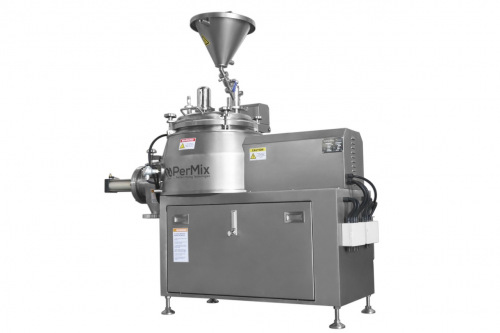
Industrial Mixers
PerMix High Speed Granulator Mixer
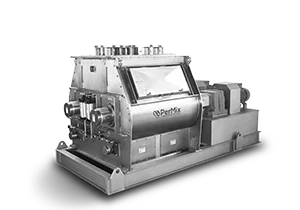
 PerMix High Speed Granulator Mixer
Best in Innovation • Best In Performance • Best In Quality • Best In Price • Best In Warranty
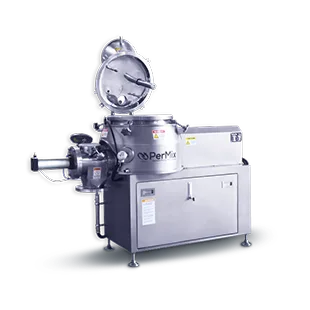
The PerMix High Speed Mixers, also called High Speed Granulators, Wet Granulator, or High Shear Mixer Granulator, is an efficient and versatile blending machine for mixing of dry powders, or granulating with the addition of liquid binder, within a very short time and with excellent cleaning abilities.
It is able to give perfect result for mixing due to the innovative design of a central impeller type mixer with a side vertical Chopper.
A high-speed granulator mixer is a batch processing system designed to mix powders and liquids rapidly while forming controlled granules through a combination of intense mechanical agitation and high-shear dispersion.
High-speed granulator mixers are widely used when a process requires:
Fast, uniform wetting of powders
Controlled granule formation
Repeatable particle size distribution
Short batch cycle times
Unlike ribbon, paddle, plow, or fluidized zone mixers—which primarily focus on blending—high-speed granulator mixers are material-transforming machines. Their purpose is not just to mix, but to convert powders into granules with defined physical properties.
A high-speed granulator mixer combines two primary mechanical actions:
Main Mixing Impeller
Rapidly circulates powders within the bowl
Creates intense particle movement and compression
Ensures uniform distribution of dry ingredients
High-Speed Chopper
Applies localized high shear
Breaks down wet agglomerates
Controls granule size and uniformity
During operation:
Powders are dry mixed
Liquid binders or solvents are added
The impeller distributes liquid throughout the batch
The chopper refines granule structure
The result is dense, uniform granules produced in minutes rather than hours.
High-speed granulator mixers are fundamentally different from conventional powder mixers.
They are designed to:
Operate at much higher rotational speeds
Generate localized shear for granule formation
Densify material during processing
Precisely control wet mass consistency
Rather than relying on fluidization or folding alone, high-speed granulators use controlled mechanical energy to shape the product.
High-speed granulator mixers are commonly used for:
Pharmaceutical powders and excipients
Nutraceutical blends
Specialty chemicals
Detergents
Catalyst and fine chemical formulations
They are especially effective when the end product requires consistent granule size, density, and flowability.
At a high level:
Ribbon and paddle mixers blend powders
Plow and fluidized zone mixers disperse liquids efficiently
High-speed granulator mixers form granules intentionally
If the process goal is granulation rather than blending alone, a high-speed granulator mixer is typically the correct technology.
Understanding how a high-speed granulator mixer works helps ensure:
Correct equipment selection
Predictable granule quality
Efficient scale-up
Reduced trial-and-error during formulation development
Granulation success starts with choosing the right mixing principle.
High-speed granulator mixers are selected when granule formation, density control, and rapid processing are core requirements. They are not general-purpose mixers; they are precision tools for transforming powders into controlled granules.
Knowing when this technology is right—and when it is not—prevents misapplication and costly reformulation.
A high-speed granulator mixer is typically the correct solution when one or more of the following conditions apply:
Granulation Is the Process Goal
If the objective is to convert powders into granules with defined size, density, and flow characteristics, high-speed granulation is purpose-built for this task.
Tight Control of Granule Size Is Required
The combination of impeller energy and high-speed chopper allows precise control over granule structure and distribution.
Fast Batch Cycle Times Are Critical
High-speed granulators complete mixing and granulation in minutes, supporting high throughput and efficient production schedules.
Uniform Wetting of Powders Is Essential
Liquid binders or solvents are distributed rapidly and evenly, minimizing over-wetting or dry pockets.
Downstream Processing Requires Dense, Free-Flowing Granules
Granules produced in high-speed mixers are well suited for:
Tableting
Encapsulation
Drying
Coating
Packaging
High-speed granulator mixers are commonly chosen for:
Pharmaceutical wet granulation
Nutraceutical granule formation
Specialty chemical granulation
Detergent and catalyst production
Applications with validated or regulated processes
These processes demand repeatability, control, and documentation.
Despite their capabilities, high-speed granulator mixers are not suitable for every application.
A high-speed granulator may be inefficient or inappropriate when:
Only Dry Blending Is Required
If no granulation or densification is needed, lower-energy mixers are often more cost-effective.
Materials Are Extremely Fragile
Very delicate particles may degrade under high mechanical energy.
Large, Low-Density Batches Are Required
High-speed granulators are optimized for controlled batch sizes rather than very large, low-energy blends.
Aggressive Drying or Solvent Removal Is the Primary Goal
Processes dominated by drying may require vacuum mixers or dryers instead of granulators.
At a high level:
Ribbon and paddle mixers blend powders
Plow and fluidized zone mixers disperse liquids efficiently
High-speed granulator mixers create granules intentionally
Choosing a granulator when granulation is not required often leads to unnecessary complexity.
Using a high-speed granulator when appropriate:
Improves granule consistency
Shortens batch cycles
Simplifies downstream processing
Reduces formulation variability
Using it when inappropriate can:
Damage materials
Increase operating costs
Complicate validation and scale-up
PerMix high-speed granulator mixers are engineered to withstand repeated high-energy batch cycles while delivering precise, repeatable granulation performance. Every design element—from the impeller profile to the chopper geometry and vessel finish—is focused on process control, durability, and cleanability.
The main impeller is responsible for bulk powder movement, densification, and uniform liquid distribution.
PerMix impeller design features:
Optimized blade geometry to promote rapid circulation and compression
High tip speeds for efficient wetting and granule growth
Rigid construction to resist deflection under load
Balanced assemblies for smooth, vibration-free operation
Impeller shape and speed are selected based on formulation behavior, binder viscosity, and desired granule characteristics.
The chopper applies localized high shear to control granule size and structure.
Key chopper design features include:
Independently driven high-speed motors
Precisely positioned chopper heads for effective agglomerate breakup
Adjustable speed control for fine tuning granulation
Wear-resistant blades for long service life
The interaction between the impeller and chopper defines final granule quality.
High-speed granulator mixers typically use a vertical, cylindrical bowl designed to support intense material movement.
Design considerations include:
Smooth internal contours to prevent material buildup
Optimized bowl-to-impeller clearance for consistent circulation
Heavy-duty construction to handle dynamic loads
Leak-tight design for liquid addition and containment
The vessel geometry ensures that all material passes repeatedly through the active mixing and granulation zones.
High-speed granulator mixers are frequently used in regulated and hygienic environments.
Available materials include:
304 stainless steel for general food and chemical use
316 / 316L stainless steel for pharmaceutical and corrosive applications
Polished internal finishes to reduce product adhesion and improve cleanability
Material selection impacts cleanability, corrosion resistance, and validation readiness.
Due to high rotational speeds, sealing and bearing design is critical.
PerMix granulator mixers can be equipped with:
Mechanical shaft seals
Flushable seal arrangements
Hygienic seal designs for pharmaceutical use
Bearings are isolated from the product zone to:
Prevent contamination
Improve service life
Simplify maintenance
High-speed granulator mixers require precise control over energy input.
PerMix drive systems include:
Independent drives for impeller and chopper
Variable frequency drives (VFDs) for speed control
High-torque motors designed for startup under load
Independent control allows operators to fine-tune granulation behavior during each phase of the process.
Discharge configuration affects batch consistency and cleanout efficiency.
Common discharge options include:
Bottom discharge valves
Tilting bowl designs (where applicable)
Assisted discharge for dense granules
Discharge systems are designed to empty the bowl completely while preserving granule structure.
For pharmaceutical and nutraceutical applications, PerMix offers GMP-compliant designs.
Sanitary features include:
Polished internal surfaces
Smooth, continuous welds
Minimal crevices and dead zones
CIP-ready configurations
These features reduce cleaning time and support validation and regulatory compliance.
Every structural and mechanical component of a PerMix high-speed granulator mixer is designed to handle:
Intense shear forces
Frequent batch cycling
Demanding production schedules
Long-term, repeatable operation
This engineering focus ensures consistent granulation performance over the life of the equipment.
PerMix high-speed granulator mixers are configured to support precise, repeatable granulation processes across a wide range of formulations and production environments. All options are engineered as part of the system to ensure control, consistency, and compliance—especially in regulated industries.
Liquid addition is central to granulation performance. PerMix designs liquid systems to ensure uniform wetting and repeatable granule growth.
Available options include:
Spray nozzles positioned directly in the active mixing zone
Metered dosing pumps for precise binder or solvent control
Multiple liquid injection points for staged addition
Heated liquid delivery for viscous binders
These systems prevent localized over-wetting and improve batch-to-batch consistency.
Granule structure is strongly influenced by shear intensity and timing.
Customization options include:
Independent VFD control of impeller and chopper
Programmable speed profiles by batch phase
Adjustable chopper engagement duration
This allows operators to fine-tune granule size, density, and morphology without reformulating.
Temperature can significantly affect binder behavior and granule formation.
Available thermal options include:
Jacketed bowls for heating or cooling
Hot water, steam, thermal oil, or chilled water service
Temperature monitoring and control via PLC
Thermal control improves reproducibility and protects temperature-sensitive materials.
High-speed granulator mixers can be configured for vacuum operation when required.
Vacuum options include:
Vacuum-rated bowl construction
Condensers and vapor recovery
Inert gas purge capability
Vacuum operation can assist with solvent control, oxygen reduction, or downstream drying integration.
Discharge configuration impacts throughput and product integrity.
Available discharge options include:
Bottom discharge valves
Pneumatically assisted discharge
Integration with downstream dryers, mills, or conveyors
Discharge systems are designed to minimize granule damage and product loss.
Granulator mixers are often used in hygienic or corrosive environments.
Available materials include:
304 stainless steel
316 / 316L stainless steel
Polished internal finishes for reduced adhesion
Material selection supports cleanability, durability, and regulatory compliance.
Seal systems are selected based on safety, cleanliness, and process requirements.
Options include:
Mechanical shaft seals
Flushable or barrier seals
Containment designs for potent or hazardous materials
Proper sealing protects both product and operators.
PerMix granulator mixers can be supplied with advanced automation for validated and production environments.
Control options include:
PLC and HMI systems
Recipe management and batch sequencing
Data logging and audit trails
Integration with upstream and downstream equipment
Automation improves repeatability and supports compliance requirements.
For regulated industries, cleanability is critical.
Available features include:
CIP spray systems
Wash-in-place bowl designs
Smooth welds and minimized crevices
These features reduce downtime and simplify validation.
Every option is engineered to support the granulator’s core function: controlled, repeatable transformation of powders into uniform granules.
High-speed granulator mixers are selected for processes where granule quality, density, and repeatability must remain consistent from development through full-scale production. Achieving this requires precise control of mechanical energy, liquid addition, and process timing—especially during scale-up.
PerMix high-speed granulator mixers are engineered to scale predictably and reproducibly, minimizing reformulation and revalidation.
Granulation performance is governed by the interaction of:
Impeller speed and torque
Chopper speed and engagement time
Liquid addition rate and viscosity
Powder properties and fill level
When these parameters are balanced, granule growth occurs uniformly, producing consistent size, density, and strength.
High-speed granulators are designed for short, highly controlled batch cycles.
Performance characteristics include:
Rapid dry mixing prior to liquid addition
Immediate binder distribution after dosing
Fast granule growth and consolidation
Minimal over-processing when parameters are controlled
Short, repeatable cycles improve throughput and reduce batch-to-batch variability.
Scaling a high-speed granulator is not a simple volume increase. Performance depends on maintaining equivalent mechanical and thermal conditions.
PerMix scale-up methodology focuses on:
Preserving impeller tip speed ranges
Maintaining similar power input per unit mass
Scaling liquid addition timing relative to mixing energy
Coordinating chopper shear with vessel size
This approach allows formulations developed at lab scale to translate directly to production.
As batch size increases, granule behavior becomes more sensitive to process deviations.
PerMix addresses this by:
Matching impeller and chopper geometry across sizes
Using programmable speed and time profiles
Maintaining consistent liquid spray patterns
This ensures granule size distribution and density remain within specification at all scales.
High mechanical energy can generate heat during granulation.
Thermal management strategies include:
Controlled impeller speeds
Jacketed bowls for heating or cooling
Temperature monitoring and feedback control
Proper thermal control protects temperature-sensitive formulations and improves reproducibility.
High-speed granulator output is often fed directly to:
Fluid bed dryers
Vacuum dryers
Mills or classifiers
Tableting or encapsulation systems
Consistent granule quality simplifies downstream processing and reduces overall process variability.
Repeatable performance is achieved through:
Rigid mechanical construction
Independent control of impeller and chopper
Automated liquid dosing
PLC-based recipe management
These features reduce operator dependency and support validated manufacturing.
Improper scale-up can result in:
Variable granule size
Inconsistent density
Over- or under-wetting
Increased rejection rates
PerMix high-speed granulator mixers are engineered to minimize these risks by applying proven granulation and scale-up principles from the earliest development stages.
High-speed granulator mixers are applied when powder transformation, not simple blending, is required. These systems are used across industries where granule size, density, flowability, and repeatability directly affect downstream processing and product performance.
Below are common high-speed granulator workflows, from formulation development through production.
Primary challenges:
Uniform distribution of active ingredients
Controlled granule size and density
Regulatory compliance and validation
Consistency across batches
Typical workflow:
Dry Mixing
APIs and excipients are blended uniformly.
Binder Addition
Liquid binders are sprayed into the moving powder bed.
Granulation Phase
Impeller and chopper work together to form controlled granules.
Discharge to Dryer
Wet granules are transferred to a fluid bed or vacuum dryer.
Downstream Processing
Dried granules move to milling, tableting, or encapsulation.
Why it works:
High-speed granulation produces dense, free-flowing granules ideal for tablet compression and dose uniformity.
Primary challenges:
Uniform nutrient distribution
Flowability for encapsulation or sachets
Short batch cycles
Cleanability
Typical workflow:
Ingredient Pre-Blend
Vitamins, minerals, and carriers are dry mixed.
Liquid or Binder Addition
Natural binders or oils are introduced.
Granulation & Densification
Granules are formed quickly with controlled structure.
Drying & Conditioning
Moisture is removed to stabilize product.
Packaging or Encapsulation
Why it works:
Granules improve flow, reduce dust, and enhance downstream filling accuracy.
Primary challenges:
Controlled particle morphology
Uniform coating or reaction initiation
High throughput requirements
Typical workflow:
Dry Mixing of Reactants or Carriers
Liquid Addition or Reaction Initiation
Granulation or Agglomeration
Discharge for Drying or Further Processing
Why it works:
High-speed granulators provide precise energy input for repeatable particle formation.
Primary challenges:
Uniform appearance
Rapid production cycles
Consistent granule strength
Liquid surfactant incorporation
Typical workflow:
Dry Ingredient Mixing
Surfactant or Binder Addition
Granule Formation & Growth
Drying & Cooling
Packaging
Why it works:
Granules produced are uniform, dust-reduced, and visually consistent.
Primary challenges:
Controlled porosity and density
Repeatable structure
Integration with downstream activation or coating
Typical workflow:
Powder Preparation
Granulation with Controlled Binder Addition
Drying & Conditioning
Activation or Coating Steps
Why it works:
High-speed granulation allows tight control over particle structure critical to performance.
High-speed granulator mixers deliver the best results when:
Granulation parameters are tailored to material behavior
Liquid addition is synchronized with mechanical energy
Downstream processing requirements are considered early
Application-driven workflows result in:
Better granule consistency
Improved downstream efficiency
Reduced rework and scrap
Faster scale-up
High-speed granulator mixers sit at the point where mixing ends and material transformation begins. Unlike conventional mixers, granulators do not exist to correct poor feedstock. Their performance depends on particle size discipline upstream and process intent downstream.
Understanding when to mill, when to mix, and when to granulate is essential for predictable granule quality and scalable production.
Milling is used before granulation to establish the physical conditions required for controlled granule growth.
Milling is typically required to:
Eliminate oversized particles that disrupt wetting
Narrow particle size distribution
Improve binder penetration and liquid absorption
Reduce granule size variability
Wide particle size distributions cause uneven wetting, inconsistent nucleation, and unstable granule growth during high-speed granulation.
Dry mixing ensures uniform distribution of actives and excipients before binder introduction.
Dry mixing is used to:
Homogenize formulation components
Prevent potency variation
Establish uniform powder bed behavior
High-speed granulators typically perform a dry mixing phase before liquid addition, but this assumes particle size is already controlled.
High-speed granulation is used to intentionally form dense, structured granules.
Granulators are used to:
Convert powders into free-flowing granules
Control granule size and density
Improve downstream flow, compression, and handling
Reduce dust and segregation
Granulators do not correct poor particle size—they amplify it.
Milling alone may be sufficient when:
Particle size is the final product specification
No granulation or densification is required
Material will be used directly downstream
Examples include:
Micronized powders
Size-controlled excipients
Pre-granulated raw materials
In these cases, granulation is unnecessary.
Mixing alone is appropriate when:
No particle transformation is required
Materials are already free-flowing
Uniform blending is the only objective
Granulation adds unnecessary complexity in these scenarios.
Most granulation processes require both milling and granulation.
A combined approach is recommended when:
Raw materials arrive with inconsistent particle size
Actives must be evenly distributed
Granule density and flowability are critical
Scale-up repeatability is required
In these cases:
Milling prepares the powder
Granulation transforms it
Each step is essential.
Integrating milling upstream of a high-speed granulator delivers:
More uniform granule nucleation
Narrower granule size distribution
Reduced over-wetting risk
Improved batch repeatability
Easier scale-up from R&D to production
Attempting to granulate poorly prepared powders leads to inconsistent results and formulation instability.
PerMix works closely with DP Pulverizers to provide complete milling and granulation solutions.
DP Pulverizers offers industrial size-reduction technologies including:
Hammer mills
Pin mills
Turbo mills
Air classifier mills
Jet mills
Fine grinding and conditioning systems
These mills prepare powders for optimal downstream high-speed granulation.
Learn more about industrial milling solutions here:
👉 https://www.dpmills.com
Understanding when to mill, when to mix, and when to granulate:
Reduces formulation risk
Improves granule consistency
Shortens development time
Protects capital investment
Simplifies validation and scale-up
High-speed granulators perform best when they are part of a properly engineered powder preparation strategy.
PerMix high-speed granulator mixers are engineered with a singular focus: deliver repeatable, scalable granulation with tight control over particle structure, density, and flowability. The difference between PerMix and many other granulator manufacturers lies not in speed alone, but in how energy, liquid addition, and process control are balanced.
Many granulators on the market are adapted from general-purpose mixers, resulting in inconsistent granule formation and difficult scale-up.
PerMix high-speed granulator mixers are:
Purpose-built for wet granulation
Designed to control nucleation, growth, and consolidation
Engineered to avoid over-shearing or smearing
Granulation performance is driven by process physics, not brute force.
Granule quality depends on how energy is applied—not how much.
PerMix advantages include:
Independently controlled impeller and chopper drives
Optimized impeller geometry for rapid circulation and densification
High-speed chopper design focused on granule refinement, not destruction
This allows operators to fine-tune granule size, density, and morphology without reformulating.
PerMix granulators are engineered for predictable scale-up.
Key advantages:
Consistent impeller tip speed ranges across sizes
Matched bowl geometry from lab to production
Programmable process profiles for dry mix, granulation, and discharge
This reduces development risk and shortens time to commercial production.
High-speed granulation places extreme demands on mechanical components.
PerMix designs include:
Rigid shafts and reinforced bowls
Heavy-duty bearings isolated from the product zone
Conservative motor and drive sizing for repeated batch cycling
The result is stable operation, longer service life, and predictable maintenance.
PerMix treats customization as part of the engineering process—not an add-on.
Available integrations include:
Precision liquid dosing systems
Heating, cooling, and vacuum configurations
GMP and hygienic designs
Advanced PLC/HMI automation with recipe control
Every option is engineered to support granulation quality, not disrupt it.
High-speed granulators are often used in regulated environments where downtime and validation matter.
PerMix supports this with:
Polished internal surfaces
Smooth, continuous welds
CIP-ready configurations
Designs that support GMP documentation and validation
This reduces cleaning time and simplifies regulatory compliance.
PerMix approaches granulation projects as process solutions, not equipment sales.
Support includes:
Granulation feasibility evaluation
Guidance on milling, mixing, and binder selection
Scale-up strategy from R&D to production
Integration with upstream milling and downstream drying
This reduces trial-and-error and improves first-batch success.
Lower-cost granulators often lead to:
Inconsistent granule quality
Longer development cycles
Higher rejection rates
Difficult scale-up
PerMix high-speed granulator mixers are designed to deliver:
Consistent granules
Faster development timelines
Reduced operating risk
Lower total cost of ownership
High-speed granulator mixers are chosen when granule quality defines product success.
PerMix high-speed granulator mixers deliver:
Controlled, repeatable granulation
Predictable scale-up
Robust mechanical design
Engineering support beyond installation
That is why manufacturers choose PerMix when granulation performance cannot be compromised.
PerMix is here to listen to your needs and provide sustainable solutions. Contact us to discover more.
PerMix High Speed Granulator Mixer Videos