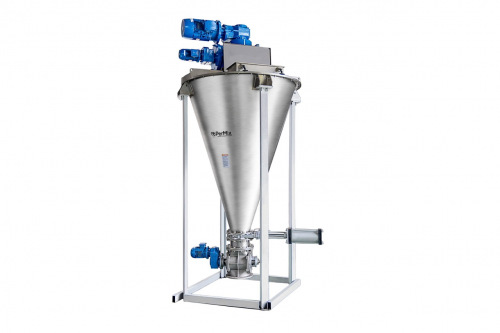
Industrial Mixers
PerMix Conical Mixer
 Conical Mixer - High-Quality Mixing with PerMix Conical Mixers
Best in Innovation • Best In Performance • Best In Quality • Best In Price • Best In Warranty
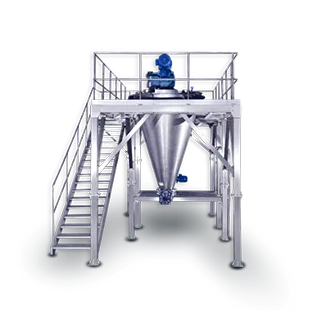
The PerMix PNA series Conical Auger Mixer, also known as a Nauta Mixer®, is a batch mixing equipment used widely in applications that require gentle mixing and minimal heat generation without any product distortion.
A conical mixer—often referred to as a conical screw mixer—is a low-shear, vertical batch mixer designed to achieve exceptional homogeneity while preserving particle integrity. It is widely used when materials are fragile, segregative, or sensitive to heat and shear.
Unlike horizontal mixers that rely on aggressive circulation, a conical mixer uses a slow-rotating screw inside a conical vessel to gently lift material upward while gravity causes it to cascade downward along the vessel walls. This creates a continuous, three-dimensional mixing loop with minimal mechanical stress.
The result is highly uniform blending with virtually no product degradation.
During operation:
The screw rotates and lifts material from the bottom of the cone
Material is transported upward along the screw
Gravity causes material to flow downward along the vessel wall
Particles repeatedly change position throughout the batch
This simultaneous upward and downward movement ensures full batch turnover without impact, compression, or high shear.
Conical mixers are fundamentally different from ribbon, paddle, plow, and fluidized zone mixers.
They are designed to:
Operate at very low rotational speeds
Minimize particle breakage and attrition
Eliminate dead zones
Prevent segregation during mixing
Generate negligible heat
Rather than forcing material to mix, conical mixers allow gravity and geometry to do the work.
Conical mixers are commonly used for:
Fragile powders and granules
Segregative blends with density differences
Fine powders prone to de-mixing
Heat-sensitive materials
Pharmaceutical, nutraceutical, and food ingredients
They are especially effective when uniformity must be achieved without altering particle structure.
At a high level:
Ribbon mixers prioritize throughput
Paddle mixers prioritize gentle horizontal blending
Plow mixers prioritize high energy and dispersion
Fluidized zone mixers prioritize speed and suspension
Conical mixers prioritize homogeneity with minimal shear
When product quality is defined by particle integrity, conical mixers are often the preferred technology.
Understanding the conical mixing principle explains why these mixers:
Deliver extremely consistent blends
Reduce fines generation
Minimize segregation risk
Scale reliably from lab to production
They are often selected when other mixers are “too aggressive” for the formulation.
Conical mixers are selected when product uniformity must be achieved without compromising particle integrity. They are not designed for speed or shear—they are designed for precision, gentleness, and repeatability.
Understanding when a conical mixer is the correct choice—and when it is not—ensures the technology is applied where it delivers the most value.
A conical mixer is typically the best solution when one or more of the following conditions apply:
Fragile or Breakable Materials
Powders, granules, crystals, or agglomerates that degrade under shear benefit from the gentle lifting and gravity-driven mixing action.
Segregative Blends
Formulations with differences in particle size, density, or shape are mixed uniformly without inducing separation during or after mixing.
Heat-Sensitive Products
Very low rotational speeds generate negligible frictional heat, protecting temperature-sensitive materials.
High Homogeneity Requirements
Conical mixers achieve excellent blend uniformity, even at low fill levels, making them ideal for precise formulations.
Pharmaceutical, Nutraceutical, and Food Applications
Processes that prioritize repeatability, validation, and product integrity often favor conical mixers.
Conical mixers are commonly chosen for:
Pharmaceutical powders and excipients
Nutraceutical blends
Specialty food ingredients
Fine chemicals
Formulations requiring gentle, extended mixing cycles
These applications value consistency over speed.
While highly effective for gentle mixing, conical mixers are not universal solutions.
A conical mixer may be inefficient or unsuitable when:
Fast Mixing Times Are Critical
Processes that require very short batch cycles may benefit more from fluidized zone or plow mixers.
Aggressive Liquid Dispersion Is Required
High liquid addition rates or rapid wetting often require higher-energy mixing technologies.
Granulation or Agglomeration Is Required
Conical mixers are not designed to intentionally form granules or agglomerates.
Very Cohesive or Sticky Materials Are Processed
Materials that do not flow easily may require higher-energy mixing action.
At a high level:
Choose a conical mixer when preserving particle integrity is critical
Choose a ribbon mixer when throughput and faster blending are acceptable
Conical mixers are often selected when ribbon mixers generate fines or segregation.
Paddle mixers provide gentle horizontal blending
Conical mixers provide gentle vertical blending with gravity-assisted circulation
Conical mixers often achieve superior homogeneity in segregative blends.
Choosing the correct mixer:
Protects product quality
Reduces fines and dust
Improves batch repeatability
Simplifies scale-up
Lowers long-term process risk
Using a mixer that is too aggressive can permanently alter a formulation.
PerMix conical mixers are engineered to deliver exceptional homogeneity with minimal mechanical stress. Every design element—from vessel geometry to screw configuration—is focused on gentle handling, predictable mixing, and long-term reliability, particularly for sensitive and segregative materials.
The defining feature of a conical mixer is its vertical, cone-shaped vessel.
Key design advantages include:
Gravity-assisted material flow for natural circulation
Elimination of dead zones common in cylindrical vessels
Uniform exposure of all particles to the mixing action
Efficient mixing across a wide range of batch fill levels
The conical shape allows material to continuously move downward along the vessel wall while being lifted upward by the screw.
The screw is the primary mixing element and is designed for lifting, not shearing.
PerMix screw design features:
Precisely engineered pitch to control material lift rate
Smooth surface finish to prevent product damage
Rigid construction to prevent deflection
Single or double screw configurations depending on application
Screw geometry is selected based on material flowability, bulk density, and homogeneity requirements.
PerMix conical mixers can be supplied with one or two mixing screws.
Single screw designs:
Ideal for most applications
Lower power consumption
Simple, proven mixing principle
Dual screw designs:
Increased mixing efficiency for larger vessels
Improved circulation for difficult or highly segregative blends
Enhanced performance at higher batch volumes
The choice is driven by material behavior and scale—not by vessel size alone.
Conical mixers use low-speed rotation to protect product integrity.
Drive design includes:
Independent screw rotation
Optional orbiting screw movement around the vessel
Variable frequency drives (VFDs) for speed control
The combination of screw rotation and orbital movement ensures full batch turnover without impact or compression.
Conical mixers are commonly used in hygienic and regulated industries.
Available materials include:
Carbon steel for general industrial use
304 stainless steel for food and non-corrosive applications
316 / 316L stainless steel for pharmaceutical and corrosive environments
Specialty alloys for demanding chemical processes
Material selection impacts cleanability, corrosion resistance, and lifecycle cost.
Seal integrity is critical, especially for hygienic or containment-sensitive processes.
PerMix conical mixers can be equipped with:
Mechanical seals
Air purge seals
Gas purge seals for inert or hazardous atmospheres
Bearings are positioned outside the product zone to:
Reduce contamination risk
Simplify maintenance
Extend bearing service life
Efficient discharge is essential for batch consistency and cleanout.
Common discharge options include:
Bottom discharge valves
Butterfly or slide gates
Screw-assisted discharge for poor-flowing materials
Discharge geometry is designed to empty the vessel completely with minimal residue.
Conical mixers can be configured for advanced processing beyond blending.
Design provisions support:
Heating or cooling jackets
Vacuum mixing and drying
Inert gas purging
These options expand the conical mixer’s role into conditioning and drying applications.
For food, nutraceutical, and pharmaceutical use, PerMix offers hygienic conical mixer designs.
Features include:
Polished internal finishes
Smooth, continuous welds
CIP-ready configurations
FDA-compliant seals and elastomers
These features reduce cleaning time and support regulatory compliance.
Every PerMix conical mixer is engineered to deliver:
Minimal shear and heat generation
Exceptional blend uniformity
Long service life
Reliable scale-up performance
This design philosophy makes conical mixers a preferred solution when product integrity defines success.
PerMix conical mixers are highly configurable to support gentle blending, precise process control, and advanced conditioning or drying operations. All options are engineered to preserve the low-shear nature of conical mixing while expanding process flexibility.
Conical mixers are well suited for controlled, gentle liquid addition, particularly when coating powders or introducing small amounts of binders.
Available liquid addition options include:
Spray nozzles positioned along the screw path or vessel wall
Metered dosing pumps for precise liquid control
Multiple injection points for staged addition
Heated liquid delivery for viscous oils or binders
Liquid systems are designed to distribute fluids evenly without creating wet clumps or damaging particles.
Thermal control can be integrated for processes requiring temperature conditioning.
Available options include:
Full welded heating or cooling jackets
Dimple jackets for enhanced heat transfer
Hot water, steam, thermal oil, or chilled water service
Multi-zone temperature control
Heating and cooling expand the conical mixer’s role into conditioning, crystallization control, or gentle drying.
Conical mixers are commonly configured for vacuum mixing and drying, combining blending and solvent or moisture removal in one system.
Vacuum options include:
Vacuum-rated vessel construction
Condensing columns and solvent recovery
Inert gas purge capability
Oxygen-reduced or oxygen-free processing environments
Vacuum operation allows drying at lower temperatures while protecting sensitive materials.
Conical mixers can be customized with one or two mixing screws.
Options include:
Single screw for most standard applications
Dual screw for larger vessels or difficult-to-mix materials
Dual screw configurations improve circulation while maintaining low shear.
Discharge configuration is selected to preserve product integrity and minimize residue.
Common options include:
Bottom discharge valves
Butterfly or slide gates
Screw-assisted discharge for poor-flowing powders
Proper discharge design improves batch consistency and reduces cleaning time.
Conical mixers are available in materials and finishes selected for cleanliness, corrosion resistance, and regulatory compliance.
Available options include:
Carbon steel
304 stainless steel
316 / 316L stainless steel
Polished internal finishes
Material selection impacts durability, cleanability, and lifecycle cost.
Seal systems are selected based on product sensitivity and safety requirements.
Available options include:
Mechanical seals
Air purge seals for dust containment
Gas purge seals for inert or hazardous atmospheres
Atmosphere control protects oxidation-sensitive or potent materials.
PerMix conical mixers can be equipped with automation systems ranging from basic to advanced.
Control options include:
Local operator control panels
PLC and HMI systems
Recipe management and batch sequencing
Data logging and traceability
Automation improves repeatability while preserving gentle mixing action.
Customization options are available to simplify plant integration.
Available options include:
Integrated support frames and access platforms
Load cells for batch weighing
Skid-mounted designs
Custom inlet and outlet configurations
These features improve ergonomics, safety, and process efficiency.
Every option is engineered to maintain the conical mixer’s core advantage: exceptional homogeneity with minimal shear and heat generation.
Conical mixers are selected when blend uniformity, particle integrity, and segregation control must remain consistent from lab and pilot batches through full-scale production. Their performance is driven by geometry and gravity—not shear—making scale-up highly predictable when properly engineered.
PerMix conical mixers are designed to scale reliably and repeatably across a wide range of batch sizes and industries.
Conical mixers achieve homogeneity through a continuous three-dimensional circulation pattern.
Performance is governed by:
Screw pitch and rotational speed
Orbital motion of the screw (when equipped)
Vessel geometry
Batch fill level
Material flow characteristics
Because particles move independently rather than in forced mass flow, uniformity improves over time without degradation.
Conical mixers typically operate with longer mixing times compared to high-energy mixers. This is intentional.
Performance benefits include:
Minimal particle breakage
Negligible fines generation
No compaction or smearing
Stable blend uniformity over time
Extended mixing does not harm the product, making conical mixers ideal for sensitive formulations.
Scale-up in conical mixers focuses on preserving mixing behavior, not increasing energy input.
PerMix scale-up methodology emphasizes:
Maintaining similar screw tip speed ranges
Preserving vessel geometry ratios
Matching batch fill percentages
Accounting for changes in bulk density
This allows formulations developed in small-scale conical mixers to translate directly to production units.
Conical mixers are especially effective at controlling segregation during scale-up.
Design features that support this include:
Vertical mixing geometry
Continuous upward and downward particle movement
Absence of centrifugal forces
Low rotational speeds
These characteristics prevent re-segregation during both mixing and discharge.
Gentle liquid addition remains effective even as batch size increases.
PerMix ensures this by:
Scaling spray nozzle placement
Matching liquid flow rate to screw circulation speed
Maintaining consistent wetting paths along the screw
This allows uniform coating without over-wetting or agglomeration.
Conical mixers generate minimal frictional heat, even at larger scales.
When temperature control is required, performance is enhanced through:
Heating or cooling jackets
Vacuum operation for lower-temperature drying
Controlled rotational speeds
This protects heat-sensitive materials and supports conditioning applications.
Vacuum conical mixers combine gentle agitation with reduced pressure for efficient drying.
Performance benefits include:
Lower drying temperatures
Uniform moisture removal
Reduced oxidation
Preservation of particle structure
Drying performance scales predictably when vessel geometry and agitation parameters are maintained.
Repeatable performance is achieved through:
Simple, robust mechanical design
Stable, low-speed operation
Optional automation and recipe control
Consistent circulation paths
These features reduce operator variability and support validated processes.
Poor scale-up can lead to:
Segregation in large batches
Inconsistent blend uniformity
Product degradation
Increased rework
PerMix conical mixers are engineered to minimize these risks by applying proven scale-up principles from the earliest development stages.
Conical mixers are selected when uniformity, gentleness, and segregation control are more important than mixing speed. Their gravity-driven mixing action makes them especially effective in applications where material integrity defines product quality and downstream success.
Below are common conical mixer workflows across industries.
Primary challenges:
Potency uniformity
Segregation of actives and excipients
Fragile particle structures
Validation and regulatory compliance
Typical workflow:
Particle Size Conditioning
APIs and excipients are milled or classified to controlled size ranges.
Conical Mixing
Ingredients are gently blended to achieve uniform potency without degradation.
Optional Vacuum Mixing or Drying
Moisture and oxygen exposure are minimized.
Downstream Processing
Blends move to encapsulation, tableting, or further blending.
Why it works:
Low-shear vertical mixing preserves particle structure and maintains uniformity over long cycles.
Primary challenges:
Segregation of vitamins and minerals
Heat sensitivity
Dust generation
Consistent dosing
Typical workflow:
Ingredient Preparation
Powders are screened or lightly milled for size consistency.
Conical Mixing
Vitamins, minerals, and carriers are blended gently.
Optional Liquid Coating
Oils or functional additives are introduced without clumping.
Packaging or Encapsulation
Why it works:
Gentle mixing improves homogeneity while protecting sensitive nutrients.
Primary challenges:
Fragile ingredients
Maintaining texture and appearance
Avoiding fines generation
Allergen control and cleanability
Typical workflow:
Raw Ingredient Conditioning
Ingredients are prepared for consistent flow.
Conical Mixing
Ingredients are blended without crushing flakes or crystals.
Optional Heating or Cooling
Temperature is conditioned for stability or downstream handling.
Discharge & Packaging
Why it works:
Gravity-driven mixing preserves product appearance and functional properties.
Primary challenges:
Segregation due to density differences
Fragile crystal structures
Heat sensitivity
Typical workflow:
Size Reduction or Classification
Materials are conditioned for uniformity.
Conical Mixing
Powders are blended evenly without inducing attrition.
Optional Inert or Vacuum Processing
Why it works:
Low mechanical stress maintains chemical and physical integrity.
Primary challenges:
Fine powders prone to segregation
Strict homogeneity requirements
Oxidation sensitivity
Typical workflow:
Micronization or Fine Milling
Active materials are prepared to tight specifications.
Conical or Vacuum Conical Mixing
Powders are blended under controlled atmosphere.
Downstream Processing
Why it works:
Gentle mixing avoids particle damage while maintaining uniform distribution.
Primary challenges:
Inconsistent feedstock
Fragile recovered materials
Segregation risk
Typical workflow:
Pre-Conditioning or Screening
Feedstock is stabilized for mixing.
Conical Mixing
Materials are homogenized gently.
Optional Conditioning or Drying
Why it works:
Conical mixers handle variability without over-processing.
Designing the process around material behavior, not just equipment type, delivers:
Higher blend uniformity
Reduced fines and dust
Improved scale-up reliability
Better downstream performance
Conical mixers perform best when they are part of a thoughtfully engineered workflow, not a rushed equipment decision.
Conical mixers excel at gentle, uniform blending, but their performance depends heavily on particle size discipline upstream. Unlike high-energy mixers, conical mixers are not designed to overcome poor particle size distribution—they preserve what they are given.
Understanding when to mill, when to mix, and when to do both is essential for predictable results.
Milling or size conditioning is often used before conical mixing to prepare materials for gentle blending.
Milling is typically required to:
Eliminate oversized particles that disrupt circulation
Narrow particle size distribution
Improve flowability and bulk density consistency
Reduce segregation risk during low-shear mixing
When particle size is inconsistent, even the most gentle mixer cannot achieve stable homogeneity.
Conical mixing focuses on uniform redistribution without particle damage.
Conical mixers are used to:
Blend powders and granules gently
Maintain particle shape and structure
Prevent fines generation
Minimize segregation during and after mixing
They perform best once particle size is already controlled.
Milling alone may be sufficient when:
Particle size is the final product specification
Only one material is being processed
No blending or coating is required
Examples include:
Size-conditioned excipients
Pre-blended intermediates
Standalone powder preparation
In these cases, a mixer may not be required.
Conical mixing alone is appropriate when:
Incoming materials already have consistent particle size
Ingredients are free-flowing
Gentle blending is the only objective
Examples include:
Blending pre-milled powders
Mixing fragile granules or crystals
Homogenizing segregative blends without size change
Here, the conical mixer delivers excellent results without added complexity.
Many precision applications benefit from a combined milling and conical mixing approach.
This is recommended when:
Raw materials arrive with variable particle size
Fine and coarse components must be blended together
Segregation control is critical
Scale-up repeatability is required
In these cases:
Milling prepares the material
Conical mixing preserves structure while achieving uniformity
Each step supports the other.
Integrating milling upstream of a conical mixer delivers:
Faster achievement of homogeneity
Reduced segregation risk
Shorter mixing cycles
More predictable scale-up
Improved batch-to-batch consistency
Trying to force a conical mixer to compensate for poor particle size control undermines its primary advantage.
PerMix works closely with DP Pulverizers to provide complete milling and conical mixing solutions.
DP Pulverizers offers industrial size-reduction technologies including:
Hammer mills
Pin mills
Turbo mills
Air classifier mills
Jet mills
These mills prepare materials for optimal downstream conical mixing.
Learn more about industrial milling solutions here:
👉 https://www.dpmills.com
Understanding when to mill, when to mix, and when to do both:
Protects fragile materials
Improves blend uniformity
Simplifies scale-up
Reduces rework and scrap
Protects capital investment
Conical mixers perform best when they are part of a properly engineered, low-shear process.
PerMix conical mixers are engineered with one overriding principle: achieve maximum blend uniformity while preserving particle integrity. The difference between PerMix and many other manufacturers is not cosmetic—it lies in how gently, predictably, and consistently the mixer performs across materials, batch sizes, and production environments.
Many conical mixers on the market are simplified adaptations of older designs or scaled versions without proper attention to material behavior.
PerMix conical mixers are:
Designed from the ground up for low-shear, gravity-assisted mixing
Engineered to eliminate dead zones and short-circuiting
Optimized to prevent segregation during mixing and discharge
This results in blends that remain uniform long after the batch is complete.
Unlike horizontal mixers that rely on repeated collisions, PerMix conical mixers:
Lift material gently
Allow gravity to redistribute particles naturally
Avoid compression, smearing, and attrition
The outcome is exceptional homogeneity without fines generation or particle damage, even during extended mixing cycles.
PerMix offers both single-screw and dual-screw conical mixers because material behavior—not marketing—drives design decisions.
Advantages include:
Single screw designs for most standard blending applications
Dual screw configurations for large vessels or highly segregative blends
Proper screw pitch and circulation paths selected per application
This ensures consistent performance without unnecessary complexity.
Where many competitors treat vacuum or drying as secondary features, PerMix integrates them into the core design.
PerMix conical mixers support:
Vacuum mixing and low-temperature drying
Solvent recovery and inert gas purging
Gentle conditioning of heat-sensitive materials
These capabilities expand the conical mixer from a blender into a multi-process system.
Low shear does not mean low engineering standards.
PerMix conical mixers feature:
Rigid screws that resist deflection
External bearings isolated from the product zone
Conservative drive sizing for long service life
Stable operation at low rotational speeds
This ensures predictable performance year after year.
PerMix conical mixers are widely used in regulated industries because they are designed with compliance in mind.
Features include:
Polished internal finishes
Smooth, continuous welds
CIP-ready configurations
FDA-compliant seals and elastomers
These design elements reduce downtime and simplify validation.
PerMix does not simply sell mixers—it supports processes.
Customers benefit from:
Guidance on when a conical mixer is the right technology
Assistance with upstream milling and downstream drying integration
Scale-up support from lab to production
Documentation support for internal approvals
This reduces risk and shortens time to production.
Lower-cost mixers often lead to:
Inconsistent blending
Segregation during discharge
Higher scrap rates
Process limitations as formulations evolve
PerMix conical mixers deliver:
Long service life
Stable, repeatable performance
Flexibility for future process changes
Lower total cost of ownership
Conical mixers are chosen when product integrity defines success.
PerMix conical mixers deliver:
Gentle, low-shear mixing
Exceptional homogeneity
Predictable scale-up
Engineering support beyond installation
That is why manufacturers choose PerMix when precision, consistency, and product quality matter most.
PerMix is here to listen to your needs and provide sustainable solutions. Contact us to discover more.
PerMix Conical Mixer Videos