Industrial Mixers
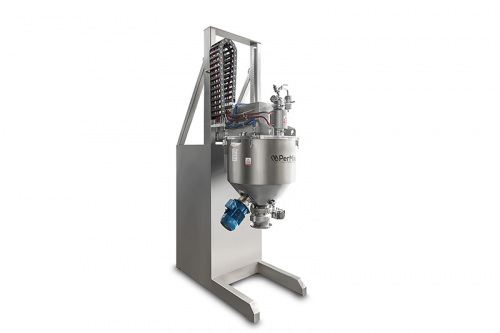
PerMix Vertical Paddle Mixer
 PerMix Vertical Paddle Mixer
Best in Innovation • Best In Performance • Best In Quality • Best In Price • Best In Warranty
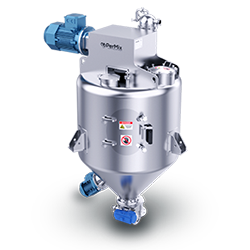
PerMix PAM series Vertical Mixer is a super innovation that combines all the advantages of precise mixing homogeneity, highly hygienic design, complete discharge with minimum residue, wide range of loading volume, robust design with long duty life and many others.
A vertical paddle mixer is a batch powder mixer designed to achieve gentle yet highly uniform mixing using a vertical vessel and centrally mounted paddle agitator. Unlike ribbon mixers that rely on horizontal convection or tumble mixers that depend on gravity alone, a vertical paddle mixer combines low-speed mechanical movement with controlled vertical circulation.
The result is excellent homogeneity with minimal shear, making vertical paddle mixers ideal for fragile, heat-sensitive, or segregative powders that require consistency without particle damage.
Vertical paddle mixers are widely used in food, nutraceutical, chemical, agricultural, and specialty material applications where blend quality and scalability matter more than brute force.
During operation:
A central vertical shaft rotates at low speed
Specially shaped paddles lift material upward from the bottom
Product gently cascades downward along the vessel walls
Continuous vertical circulation creates uniform redistribution
This controlled up-and-down movement ensures all particles pass through the mixing zone repeatedly, eliminating dead zones while avoiding high shear.
Vertical paddle mixers occupy a unique middle ground between tumble mixers and high-energy horizontal mixers.
They are designed to:
Provide gentle mechanical mixing without impact
Maintain low tip speeds to protect particles
Achieve consistent blending across a wide batch size range
Handle slightly broader material variability than tumble mixers
This makes them especially effective where tumble mixers are too passive and ribbon or plow mixers are too aggressive.
Vertical paddle mixers are commonly used for:
Food powders and dry blends
Nutraceutical formulations
Agricultural products (feeds, premixes)
Specialty chemicals
Fragile granules and crystals
They perform well with free-flowing to moderately cohesive materials and are especially valued when particle preservation is critical.
At a high level:
Ribbon mixers emphasize horizontal convection and speed
Plow mixers emphasize high-energy dispersion
Tumble mixers rely on gravity alone
Vertical paddle mixers provide gentle mechanical circulation
They are often selected when operators want controlled movement without shear or excessive energy input.
Understanding the vertical paddle mixing principle explains why these mixers:
Deliver excellent homogeneity without fines generation
Preserve particle structure
Handle moderate formulation variability
Scale reliably when properly applied
Vertical paddle mixers are chosen not for aggression—but for controlled, repeatable blending.
Vertical paddle mixers are selected when controlled mechanical mixing is needed without the aggression of high-shear systems. They are especially effective when gravity alone is insufficient, but particle preservation, low heat, and blend consistency remain top priorities.
Knowing when a vertical paddle mixer is the right tool—and when it is not—prevents misapplication and ensures predictable performance.
A vertical paddle mixer is typically the correct solution when one or more of the following conditions apply:
Fragile or Shear-Sensitive Materials
Low tip speeds and smooth paddle geometry protect crystals, flakes, and granules from breakage.
Moderate Differences in Particle Size or Density
Gentle mechanical circulation helps overcome limitations of tumble mixing without inducing segregation.
Heat-Sensitive Products
Low RPM operation minimizes frictional heat generation.
Wide Batch Size Flexibility
Vertical paddle mixers perform well across a broader working volume range than many tumble mixers.
Consistent, Repeatable Blending Requirements
The controlled vertical circulation delivers reliable homogeneity batch after batch.
Vertical paddle mixers are commonly chosen for:
Food powders and dry ingredient blends
Nutraceutical formulations
Agricultural premixes and feeds
Specialty chemicals
Fragile granular materials
These applications value uniformity, scalability, and particle integrity over speed.
Despite their versatility, vertical paddle mixers are not universal solutions.
A vertical paddle mixer may be inefficient or unsuitable when:
Very Cohesive or Sticky Materials Are Processed
Highly cohesive powders may require higher energy or different mixing mechanics.
Aggressive Liquid Addition or Wet Mixing Is Required
Vertical paddle mixers are not designed for intensive liquid dispersion or granulation.
Extremely Fast Mixing Times Are Required
High-energy plow or ribbon mixers may achieve faster blend times.
Ultra-Low Shear with Zero Mechanical Contact Is Required
Tumble mixers may be preferred for extremely delicate powders.
At a high level:
Choose a ribbon mixer for high throughput and faster mixing
Choose a vertical paddle mixer when gentler handling and vertical circulation are required
Vertical paddle mixers trade speed for control.
Tumble mixers rely solely on gravity
Vertical paddle mixers add gentle mechanical circulation
Vertical paddle mixers are often chosen when tumble mixers produce incomplete or inconsistent blends.
Choosing the correct mixer:
Preserves particle integrity
Improves blend uniformity
Reduces fines and segregation
Simplifies scale-up
Protects product quality and capital investment
Using excessive energy where it is not needed often causes more problems than it solves.
PerMix vertical paddle mixers are engineered to deliver controlled, low-shear mechanical mixing with exceptional consistency. Every design choice—from paddle geometry to drive alignment—is focused on uniform vertical circulation, particle protection, and long-term reliability across a wide range of batch sizes.
The vertical vessel is designed to support natural upward lift and downward cascade.
Key design advantages include:
Full-batch engagement with no dead zones
Efficient vertical circulation from bottom to top
Compact footprint with high working volume efficiency
The vertical configuration also supports gravity-assisted discharge and simplified cleaning.
The heart of the mixer is the central vertical shaft with carefully shaped paddles.
PerMix paddle designs:
Lift material upward gently rather than pushing aggressively
Promote even redistribution without compaction
Maintain low tip speeds to protect particle structure
Paddles are positioned to ensure all material passes through the active mixing zone repeatedly.
Vertical paddle mixers rely on torque, not speed.
Drive system features include:
Heavy-duty gear reducers
Low RPM operation for gentle mixing
Variable frequency drives (VFDs) for speed control
Smooth startup and shutdown to prevent material shock
This ensures stable mixing with minimal heat generation.
PerMix vertical paddle mixers are built for a wide range of industries.
Available materials include:
Carbon steel for general industrial applications
304 stainless steel for food and non-corrosive environments
316 / 316L stainless steel for pharmaceutical and corrosive products
Internal surfaces can be polished to improve cleanability and reduce product adhesion.
Proper sealing is critical for hygiene and mechanical longevity.
Design features include:
Robust shaft seals designed for powder applications
Bearing isolation from the product zone
Optional air purge or gas purge seals
These features reduce contamination risk and extend service life.
Discharge geometry plays a key role in maintaining blend integrity.
PerMix vertical paddle mixers offer:
Large bottom discharge openings
Slide gate or butterfly valves
Dust-tight discharge interfaces
Gravity-assisted discharge ensures complete emptying with minimal residue.
The mixer frame must support vertical loads and operational torque.
PerMix frames are designed with:
Heavy-duty welded steel construction
Reinforced base and mounting points
Stability for continuous industrial operation
This construction ensures safe, vibration-free performance over long service life.
For food, nutraceutical, and pharmaceutical applications, hygienic designs are available.
Features include:
Smooth internal welds
Minimal crevices
Clean-in-place (CIP) readiness where required
FDA-compliant materials and seals
These features support fast cleaning and validation.
Every component of a PerMix vertical paddle mixer supports:
Controlled mechanical movement
Low shear and low heat
Consistent batch-to-batch results
Long mechanical life
This design philosophy ensures dependable performance in demanding production environments.
PerMix vertical paddle mixers are intentionally engineered with a simple, gentle core mixing action, but they can be extensively customized to meet specific material behaviors, hygiene standards, automation needs, and plant layouts—without sacrificing low-shear performance.
Every option is evaluated against a single rule: it must improve control without increasing aggression.
Paddle geometry can be optimized based on material behavior.
Available options include:
Standard lifting paddles for most dry blends
Modified paddle profiles for fragile granules
Optimized spacing for improved circulation of light or bulky powders
Proper paddle selection improves homogeneity while preserving particle integrity.
Vertical paddle mixers are used across food, chemical, agricultural, and regulated industries.
Customization options include:
Carbon steel for general industrial use
304 stainless steel for food and non-corrosive applications
316 / 316L stainless steel for pharmaceutical and corrosive environments
Polished internal finishes to reduce adhesion and simplify cleaning
Material selection supports hygiene, corrosion resistance, and long-term durability.
Discharge configuration impacts cleanliness, speed, and downstream integration.
Available discharge options include:
Large bottom discharge openings
Slide gate or butterfly valves
Dust-tight discharge connections
Integration with hoppers, conveyors, or packaging systems
Gravity-assisted discharge minimizes residue and reduces re-segregation risk.
While vertical paddle mixers are primarily dry mixers, controlled liquid addition is possible in some applications.
Options include:
Spray nozzles for light coating
Metered liquid dosing systems
Staged liquid introduction during mixing
These systems are suitable for light wetting or coating—not high-shear dispersion or granulation.
For hygienic or dusty environments, advanced sealing options are available.
Options include:
Enhanced shaft seals for fine powders
Air purge or gas purge seals
Dust containment features
These options protect bearings, prevent contamination, and improve service life.
PerMix vertical paddle mixers can be supplied with a wide range of control systems.
Available control options include:
Simple start/stop and timer-based controls
Variable speed control via VFD
PLC and HMI systems with recipe management
Batch data logging and traceability
Automation improves repeatability and reduces operator dependency.
Customization options are available to support plant integration and operator safety.
These include:
Floor-mounted or platform-mounted designs
Load cells for batch weighing
Skid-mounted systems
Access platforms and safety guarding
These features improve ergonomics, accuracy, and operational efficiency.
For food, nutraceutical, and pharmaceutical use, hygienic upgrades are available.
Options include:
Smooth internal welds and crevice-free construction
CIP-ready designs
FDA-compliant seals and materials
These enhancements simplify cleaning and validation.
Every option offered on a PerMix vertical paddle mixer supports the same objective:
Gentle, controlled vertical circulation with consistent, repeatable results.
If a process requires more energy, a different mixer technology is recommended.
Vertical paddle mixers are selected when blend uniformity, particle protection, and predictable scale-up are required—without resorting to high shear or aggressive mixing energy. Because these mixers rely on controlled vertical circulation rather than turbulence, performance scales reliably when geometry, tip speed, and batch discipline are preserved.
PerMix vertical paddle mixers are engineered so that what works in pilot works in production.
Vertical paddle mixers achieve homogeneity through mechanical lifting and gravity-assisted cascading.
Performance is governed by:
Paddle geometry and spacing
Rotational speed (tip speed)
Batch fill level
Powder flowability
Degree of particle size and density variation
When these parameters are aligned, vertical paddle mixers deliver uniform blends with minimal particle stress.
Vertical paddle mixers operate at moderate mixing times, positioned between tumble mixers and high-energy horizontal mixers.
Key performance benefits include:
Consistent circulation without overworking the product
Minimal fines generation
Low heat input
Stable blends that hold uniformity after discharge
Mixing time is driven by circulation efficiency—not aggressive agitation.
Scale-up for vertical paddle mixers focuses on maintaining circulation patterns, not increasing speed.
PerMix scale-up methodology emphasizes:
Preserving paddle geometry and placement
Maintaining similar tip speeds
Operating within validated fill level ranges
Accounting for bulk density changes at scale
This ensures blending behavior remains consistent as vessel size increases.
Vertical paddle mixers tolerate a wider working volume range than many tumble mixers, but fill level still matters.
Best practices include:
Avoiding overfilling, which limits upward lift
Avoiding underfilling, which reduces circulation efficiency
Operating within recommended working volume windows
PerMix provides application guidance to define optimal batch size for each mixer.
Vertical paddle mixers handle moderate variability in particle size and density better than tumble mixers.
Design features that support this include:
Active mechanical circulation
Continuous engagement of the full batch
Reduced reliance on gravity alone
However, extreme material differences should still be addressed upstream.
For applications involving light liquid addition:
Liquids are introduced in controlled, metered amounts
Mixing speed remains low to prevent smearing
Scale-up focuses on proportional dosing and timing
Vertical paddle mixers are suitable for coating or light wetting—not high-shear dispersion.
Repeatable performance is achieved through:
Simple, robust mechanical design
Stable low-speed operation
Consistent paddle geometry
Optional automation and recipe control
This minimizes operator dependency and supports validated processes.
Improper scale-up can lead to:
Incomplete circulation
Over-mixing or under-mixing
Excessive mixing time adjustments
Misinterpretation of mixer capability
PerMix vertical paddle mixers are engineered to prevent these issues through disciplined design and application support.
Vertical paddle mixers are applied when gentle mechanical circulation is required to achieve uniform blends across a wide range of materials—without the shear, heat, or particle damage associated with high-energy mixers. Their vertical geometry and low-speed paddles make them especially effective where tumble mixing is too passive and horizontal mixers are too aggressive.
Below are common vertical paddle mixer workflows by industry.
Primary challenges:
Preserving fragile particles and inclusions
Avoiding fines and dust
Consistent batch quality
Hygienic design and cleanability
Typical workflow:
Ingredient Staging
Dry powders, spices, inclusions, or crystals are prepared for batching.
Vertical Paddle Mixing
Ingredients are gently lifted and redistributed through vertical circulation.
Optional Light Liquid Addition
Oils, flavors, or minor binders are added in controlled amounts (when equipped).
Gravity Discharge to Packaging or Downstream Processing
Why it works:
Low tip speed and full-batch circulation preserve texture and appearance.
Primary challenges:
Uniform distribution of vitamins and minerals
Preventing segregation
Protecting sensitive actives
Batch repeatability
Typical workflow:
Particle Conditioning
Ingredients are screened or lightly milled upstream.
Vertical Paddle Mixing
Gentle mechanical circulation ensures uniformity without degradation.
Discharge to Encapsulation or Packaging
Why it works:
Vertical circulation improves consistency over tumble mixers while remaining low shear.
Primary challenges:
Large batch sizes
Ingredient variability
Durability and uptime
Consistent nutrient distribution
Typical workflow:
Bulk Ingredient Loading
Vertical Paddle Mixing
Paddles ensure all material passes through the active mixing zone.
Bottom Discharge to Bags, Totes, or Conveying Systems
Why it works:
Vertical paddle mixers scale well and handle moderate variability without excessive energy input.
Primary challenges:
Density differences between ingredients
Heat sensitivity
Avoiding particle breakage
Typical workflow:
Upstream Size Conditioning
Vertical Paddle Mixing
Mechanical circulation overcomes gravity-only limitations.
Discharge to Downstream Processing
Why it works:
Gentle paddles maintain particle integrity while improving blend reliability.
Primary challenges:
Particle attrition
Shape preservation
Visual quality
Typical workflow:
Ingredient Preparation
Low-Speed Vertical Paddle Mixing
Careful Gravity Discharge
Why it works:
Paddle geometry lifts rather than impacts material, protecting fragile components.
Primary challenges:
Predictable scale-up
Batch flexibility
Process development
Typical workflow:
Pilot-Scale Vertical Paddle Trials
Parameter Optimization
Production-Scale Replication
Why it works:
Vertical paddle mixers scale reliably when tip speed and circulation patterns are preserved.
Vertical paddle mixers perform best when:
Gentle mechanical movement is required
Particle integrity must be preserved
Moderate formulation variability exists
Consistent circulation is more important than speed
Application-driven workflows result in:
Improved blend uniformity
Reduced fines and dust
Easier scale-up
Lower rework rates
Vertical paddle mixers sit in a strategic middle ground: they provide active mechanical circulation without the aggression of high-shear mixers. That makes them more forgiving than tumble mixers—but they still reward good particle preparation.
Understanding when to mill, when to mix, and when to do both is key to unlocking consistent performance.
Milling or particle conditioning is often used upstream to stabilize blend behavior.
Milling is typically applied to:
Reduce oversized particles that resist circulation
Narrow particle size distribution
Improve bulk density alignment
Enhance flowability and reduce dead zones
Vertical paddle mixers can tolerate moderate variability, but extreme differences still benefit from milling.
Vertical paddle mixing solves circulation and redistribution challenges without shear.
Vertical paddle mixers are used to:
Blend powders and granules uniformly
Handle moderate differences in particle size and density
Preserve fragile particles
Avoid fines generation and overheating
They provide controlled movement rather than turbulence.
Milling alone may be sufficient when:
Particle size is the final product specification
Only a single material is being processed
No blending or coating is required
Examples include:
Size-conditioned powders
Single-ingredient preparation steps
In these cases, a mixer adds little value.
Vertical paddle mixing alone is appropriate when:
Ingredients are already well sized
Powders are free-flowing to moderately cohesive
Dry blending is the primary goal
Examples include:
Food ingredient blends
Nutraceutical premixes
Agricultural formulations
Here, gentle circulation delivers uniformity efficiently.
Many industrial applications benefit from both milling and vertical paddle mixing.
This combined approach is recommended when:
Raw materials arrive with inconsistent particle size
Fine actives must be distributed through larger carriers
Segregation risk must be minimized
Scale-up repeatability is critical
In these cases:
Milling stabilizes the powder
Vertical paddle mixing ensures consistent redistribution
Each step reinforces the other.
Integrating milling upstream delivers:
Faster blend uniformity
Reduced segregation risk
Shorter mixing times
More predictable scale-up
Improved batch-to-batch consistency
Trying to compensate for poor particle preparation inside the mixer often leads to longer cycles and inconsistent results.
PerMix works closely with DP Pulverizers to provide complete milling and vertical paddle mixing solutions.
DP Pulverizers offers industrial size-reduction technologies including:
Hammer mills
Pin mills
Turbo mills
Air classifier mills
Jet mills
These mills prepare powders for optimal downstream vertical paddle mixing performance.
Learn more here:
👉 https://www.dpmills.com
Understanding when to mill, when to mix, and when to do both:
Improves blend reliability
Protects fragile materials
Simplifies scale-up
Reduces rework and scrap
Maximizes ROI on equipment
Vertical paddle mixers deliver their best performance when paired with intelligent process design.
PerMix vertical paddle mixers are engineered with a clear intent: deliver controlled mechanical mixing that is gentle, predictable, and scalable—without the shortcuts that compromise blend quality or long-term reliability. While many vertical paddle mixers appear similar externally, real performance is defined by paddle geometry, circulation discipline, and mechanical integrity.
PerMix focuses on how material actually moves, not just how fast it can be mixed.
The effectiveness of a vertical paddle mixer lives or dies with paddle design.
PerMix paddle systems are engineered to:
Lift material smoothly rather than pushing or smearing
Promote full-batch vertical circulation
Avoid localized compression or dead zones
Maintain low tip speeds to protect particles
Many competitors rely on oversized paddles or higher RPMs to mask poor circulation. PerMix designs eliminate the need for brute force.
Some vertical mixers drift into “almost ribbon mixer” territory.
PerMix vertical paddle mixers:
Operate at intentionally low RPM
Avoid aggressive sweeping or plowing action
Generate minimal frictional heat
Preserve particle size, shape, and surface integrity
This makes them ideal for fragile granules, crystals, and heat-sensitive formulations.
Scale-up failures often come from changing flow patterns at larger volumes.
PerMix advantages include:
Consistent paddle geometry across sizes
Preserved tip speed relationships
Predictable vertical circulation from pilot to production
This allows formulations developed in small mixers to transfer directly to large systems without reformulation or excessive parameter tuning.
Vertical paddle mixers must handle torque, vertical loads, and continuous operation.
PerMix designs feature:
Heavy-duty gear reducers sized for torque, not speed
Oversized bearings isolated from the product zone
Rigid support frames to prevent deflection
Smooth startup and shutdown profiles
This results in stable operation, low vibration, and long service life.
Many mixers claim “sanitary” but make cleaning difficult.
PerMix vertical paddle mixers offer:
Smooth internal surfaces and welds
Minimal crevices and ledges
Large bottom discharge openings
CIP-ready designs where required
FDA-compliant materials and seals
These details reduce downtime and simplify validation.
PerMix does not overload vertical paddle mixers with features that undermine their purpose.
Options are designed to:
Improve control and flexibility
Support light liquid addition when appropriate
Enhance automation and repeatability
If a process requires aggressive dispersion or wet granulation, PerMix recommends a different mixer—honestly.
PerMix does not force vertical paddle mixers into unsuitable applications.
Customers benefit from:
Straightforward guidance on material suitability
Recommendations when another mixer technology is a better fit
Integration support with upstream milling and downstream handling
Scale-up support from R&D through production
This prevents misapplication and protects long-term performance.
Lower-cost vertical paddle mixers often lead to:
Longer mixing times
Inconsistent circulation
Excessive fines or compaction
Premature mechanical wear
PerMix vertical paddle mixers deliver:
Predictable blend quality
Stable scale-up behavior
Long mechanical life
Lower total cost of ownership
Vertical paddle mixers are chosen when controlled mechanical circulation beats both gravity-only tumbling and high-energy agitation.
PerMix vertical paddle mixers deliver:
Gentle, low-shear mechanical mixing
Reliable full-batch circulation
Predictable scale-up
Hygienic, validation-ready construction
Engineering support beyond the sale
That’s why manufacturers choose PerMix when blend integrity, repeatability, and longevity matter more than marketing claims.
PerMix is here to listen to your needs and provide sustainable solutions. Contact us to discover more.
Vertical Paddle Mixer Videos