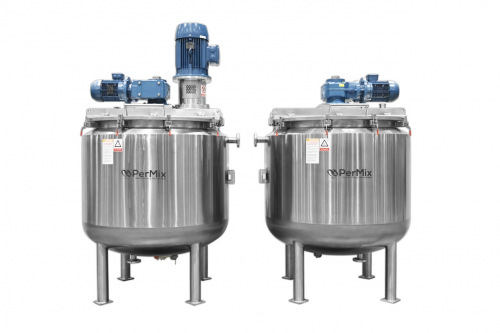
Industrial Mixers
PerMix Homogenizer
 PerMix Homogenizer
Best in Innovation • Best In Performance • Best In Quality • Best In Price • Best In Warranty
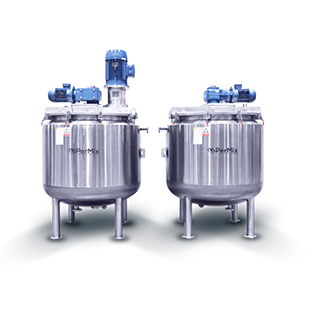
PerMix PS series High Shear Homogenizers are Top Mount Homogenizers and Bottom Mount Homogenizers that are engineered for batch-type mixing.
Top-mount and bottom-mount homogenizers are high-shear liquid processing systems designed to reduce droplet size, disperse immiscible phases, and stabilize emulsions or suspensions directly inside a mixing vessel. Unlike inline homogenizers—which rely on recirculation—these systems apply shear in-tank, allowing precise control over residence time, temperature, and batch behavior.
At PerMix, top- and bottom-mount homogenizers are engineered as integrated vessel systems, not standalone shear devices. They are used when emulsion quality, droplet uniformity, and batch repeatability matter more than raw throughput.
Both top- and bottom-mount homogenizers operate using rotor-stator shear technology.
In simple terms:
Liquid is pulled into the rotor-stator head
Extreme velocity gradients create intense shear
Droplets or particles are broken down uniformly
Processed liquid is discharged back into the vessel
This cycle repeats continuously until the desired structure is achieved—without leaving the tank.
Top-Mount Homogenizers
Mounted from the top of the vessel
Often paired with a bulk agitator
Flexible positioning for different batch sizes
Easier retrofit into existing tanks
Bottom-Mount Homogenizers
Mounted at the vessel bottom
Process material as it naturally circulates downward
Highly efficient for viscous or structured liquids
Ideal for hygienic and CIP-focused applications
Both deliver high shear—the difference is how shear integrates with flow.
In-tank homogenizers were developed to solve problems that inline systems cannot always address:
Limited residence time in recirculation loops
Air introduction during pumping
Temperature drift during external processing
Complexity of valves, piping, and bypass lines
By keeping homogenization inside the vessel, PerMix systems:
Reduce air entrainment
Improve thermal control
Simplify validation and cleaning
Increase batch consistency
PerMix homogenizers are used to:
Create fine, stable emulsions
Reduce droplet size uniformly
Improve suspension stability
Enhance texture and mouthfeel
Shorten processing time
They do not replace bulk mixing—they refine what bulk mixing creates.
Top- and bottom-mount homogenizers are widely used for:
Food emulsions (sauces, dressings, dairy, plant-based products)
Cosmetic and personal care liquids
Pharmaceutical liquids and semi-solids
Chemical emulsions and dispersions
Nutraceutical and functional beverages
They are selected when final product structure defines success.
Inline homogenizers:
Require recirculation
Introduce air upstream
Depend on loop design
In-tank homogenizers:
Process the full batch directly
Maintain vacuum compatibility (when required)
Deliver consistent shear history
Inline systems move product.
In-tank homogenizers build product structure.
Homogenization failures are rarely obvious at startup.
They appear later as:
Phase separation
Texture drift
Visual defects
Shelf-life instability
Understanding why top- and bottom-mount homogenizers exist prevents choosing speed over structure.
Top-mount and bottom-mount homogenizers both deliver high shear—but where that shear enters the vessel, how it interacts with flow, and how it integrates with sanitation and temperature control determines which is the right choice. Selection errors here don’t cause dramatic failures; they cause quiet instability that shows up later as separation, texture drift, or inconsistent batches.
At PerMix, homogenizer selection is driven by flow behavior and process risk, not mounting convenience.
Top-mount homogenizers are typically the best solution when one or more of the following apply:
Wide Batch Size Range
Adjustable positioning allows effective shear across varying fill levels.
Retrofit Into Existing Vessels
Top-entry designs integrate easily without bottom penetrations.
Lower to Moderate Viscosity Liquids
Flow remains responsive to bulk agitation.
Flexible Process Development
R&D and pilot environments benefit from access and adjustability.
Combined with a Bulk Agitator
Top-mounted shear complements top-entry mixing patterns.
Top-mount homogenizers are often chosen for versatility and adaptability.
Bottom-mount homogenizers are preferred when:
Hygiene & CIP Are Critical
Bottom-mounted heads eliminate dead zones and improve cleanability.
Viscosity Is Moderate to High
Natural downward flow feeds material directly into the shear zone.
Emulsion Quality Is Non-Negotiable
Consistent residence time through the homogenizing head improves droplet uniformity.
Vacuum Processing Is Used
Bottom-mount designs integrate cleanly with sealed vessels.
Production Is Repetitive & Validated
Fixed geometry improves batch-to-batch repeatability.
Bottom-mount homogenizers are chosen for control, efficiency, and sanitation.
Top-mount homogenizers:
Rely more on bulk circulation
Are sensitive to fill level and vortex behavior
Offer flexibility at the expense of flow certainty
Bottom-mount homogenizers:
Receive consistent feed from vessel circulation
Are less sensitive to operator technique
Deliver more uniform shear history
The difference shows up in repeatability, not just shear intensity.
In-tank homogenizers—top or bottom—may be unnecessary when:
Processing Is Fully Continuous
Inline homogenizers integrate better with continuous flow.
Residence Time Must Be Extremely Short
High-throughput systems may favor inline shear.
Product Is Highly Shear-Sensitive
Gentle blending or static mixing may be sufficient.
Air Removal Is the Primary Goal
Deaerators address gas—not structure.
Homogenizers refine structure. They should not be forced into roles they are not designed for.
Inline homogenizers:
Excel in continuous systems
Depend on recirculation loops
Are sensitive to upstream air and temperature
In-tank homogenizers:
Control full-batch shear history
Integrate with heating, cooling, and vacuum
Simplify validation and cleaning
Inline systems move product fast.
In-tank systems shape product deliberately.
Choosing the wrong mounting approach leads to:
Uneven droplet size distribution
Inconsistent texture
Longer processing times
Difficult scale-up
Homogenization problems are expensive because they:
Appear after packaging
Affect shelf life
Trigger reformulation attempts
Correct placement prevents these issues entirely.
At PerMix, top- and bottom-mount homogenizers are specified based on:
Flow regime analysis
Viscosity profile
Sanitary and vacuum requirements
Scale-up risk
They are selected as part of a system, not as isolated shear devices.
Top- and bottom-mount homogenizers are deceptively compact pieces of equipment, but they operate under extreme mechanical, thermal, and hygienic demands. They must deliver consistent high shear, withstand continuous duty, integrate cleanly with vessels, and—especially in regulated industries—remain fully cleanable and seal-tight.
At PerMix, in-tank homogenizers are engineered as vessel-integrated systems, not bolt-on shear heads.
At the heart of every homogenizer is the rotor–stator assembly.
PerMix designs focus on:
Precisely machined rotor–stator gaps
Consistent shear zones for predictable droplet size reduction
Stable operation across a wide viscosity range
High shear efficiency without excessive heat generation
Shear is applied uniformly and repeatedly, not randomly or aggressively.
High shear places intense loads on shafts and bearings.
PerMix homogenizers incorporate:
Rigid shaft construction to prevent deflection
Precision balancing for vibration-free operation
Bearings sized for continuous, high-speed duty
Mechanical isolation between drive components and product zone
Mechanical stability is essential for both performance and seal life.
Seals are the most critical—and most failure-prone—component of a homogenizer.
PerMix designs include:
Sanitary mechanical seals compatible with high shear and heat
Seal materials selected for chemical, thermal, and CIP resistance
Configurations suitable for vacuum operation when required
Seal integrity protects both product purity and equipment longevity.
Top-mount homogenizers require careful vessel integration.
Key design considerations include:
Reinforced top plates or bridge supports
Proper shaft length and rigidity for immersion depth
Alignment with bulk agitators to avoid flow conflict
PerMix ensures top-mounted systems deliver shear without inducing vortex instability or air entrainment.
Bottom-mount homogenizers demand even greater precision.
PerMix bottom-entry designs feature:
Flush-mounted, hygienic installation
No dead zones beneath the shear head
Reinforced bottom nozzles to handle shear loads
Clean-in-place compatibility without disassembly
Bottom-mount designs are optimized for flow efficiency and sanitation, not convenience.
Shear generates heat—especially during emulsification.
PerMix integrates homogenizers into vessels with:
Full-coverage heating and cooling jackets
Continuous wall scraping (when paired with anchors)
Controlled shear profiles to limit thermal spikes
Thermal management protects both product structure and ingredient stability.
In-tank homogenizers often process finished or near-finished products.
PerMix offers:
304 stainless steel for general liquid processing
316 / 316L stainless steel for food, cosmetic, pharmaceutical, and chemical use
Polished internal surfaces for hygiene and cleanability
Material and finish selection align with both process chemistry and regulatory needs.
For hygienic applications, PerMix homogenizers are:
Fully CIP-compatible
Designed with drainable geometries
Free of crevices and product traps
Cleanability is engineered into the design—not added as an afterthought.
Homogenizer performance depends on speed stability.
PerMix systems support:
Variable frequency drives (VFDs)
Precise speed control for shear tuning
Integration with PLC/HMI systems
Recipe-based control for validated processes
Automation ensures repeatable emulsification and dispersion across batches.
Every design decision in a PerMix top- or bottom-mount homogenizer is made to:
Deliver consistent shear
Maintain hygienic integrity
Operate reliably under continuous load
Scale from pilot to production without surprises
These are not accessories.
They are structural elements of liquid processing systems.
Homogenizers do not scale the way mixers do. The biggest mistake in liquid processing is assuming that more power or higher RPM automatically delivers the same emulsion quality at larger volume. In reality, homogenizer performance is governed by shear history, residence time, temperature rise, and flow integration—all of which change with scale.
At PerMix, in-tank homogenizers are scaled by preserving structural outcomes, not by copying lab settings.
Homogenizer performance is not defined by motor size. It is defined by:
Final droplet size distribution
Emulsion or suspension stability over time
Texture and mouthfeel (where applicable)
Absence of foam or air defects
Thermal stability during and after processing
If these outcomes change at scale, the homogenizer has failed—regardless of horsepower.
Homogenizers apply localized extreme shear, not vessel-wide energy.
As vessel size increases:
The homogenizing head processes only a fraction of the batch at any moment
Bulk circulation determines how often material passes through the shear zone
Poor circulation = uneven shear history
PerMix systems are designed so every portion of the batch experiences equivalent shear exposure, regardless of vessel size.
Residence time is the hidden variable in homogenization.
At small scale:
Material passes through the shear head frequently
Total shear exposure accumulates quickly
At large scale:
Poor circulation can starve the homogenizer
Shear exposure becomes uneven
Droplet size distribution widens
PerMix addresses this by:
Matching homogenizer capacity to vessel circulation rate
Coordinating homogenizer speed with bulk agitation
Preventing “short-circuiting” where material bypasses the shear zone
Top-mount homogenizers
More sensitive to fill level as scale increases
Depend heavily on bulk agitator design
Require careful coordination of flow patterns
Bottom-mount homogenizers
Receive consistent feed from natural vessel circulation
Scale more predictably at higher viscosities
Offer more uniform shear history at production scale
This is why bottom-mount designs often dominate large-scale, quality-critical systems.
Shear creates heat. At scale, this becomes non-negotiable.
As volume increases:
Total shear energy increases
Heat dissipation per unit volume decreases
Localized overheating becomes possible
PerMix manages this through:
Full-coverage vessel jackets
Continuous wall scraping (when applicable)
Controlled shear profiles rather than maximum speed operation
Thermal control protects emulsion structure and ingredient integrity.
As viscosity increases:
Flow into the homogenizer becomes more resistant
Residence time through the shear zone increases
Heat generation accelerates
PerMix homogenizers are sized and integrated to:
Maintain consistent feed to the rotor-stator
Avoid cavitation or starvation
Preserve shear efficiency across viscosity changes
Scale-up must anticipate final viscosity, not just starting conditions.
In-tank homogenizers are sensitive to geometry.
Best practices include:
Maintaining defined working volume ranges
Ensuring full submergence of the homogenizing head
Avoiding overfilling, which suppresses circulation
Avoiding underfilling, which destabilizes shear
PerMix provides application-specific working volume guidance to protect scale-up performance.
Successful homogenizer scale-up preserves:
Shear density at the rotor-stator
Number of effective shear passes per unit volume
Circulation patterns within the vessel
Thermal flux relative to batch size
PerMix scale-up methodology focuses on matching emulsion outcomes, not duplicating lab RPMs.
Repeatable homogenization requires:
Stable speed control via VFD
Coordinated bulk agitation
Temperature monitoring and control
Recipe-based automation
PerMix PLC/HMI systems ensure every batch experiences the same shear history, regardless of operator.
Poorly scaled homogenizers lead to:
Emulsions that look correct initially but separate later
Texture drift during storage
Increased foam during filling
Costly reformulation attempts
These failures are rarely blamed on the homogenizer—but they originate there.
Top- and bottom-mount homogenizers earn their value after the mixer stops spinning—when products sit on shelves, move through fillers, or face real-world handling. These systems are applied where droplet size, suspension stability, texture, and appearance must remain consistent long after production ends.
Below are real-world liquid workflows where in-tank homogenization is a defining step—not a convenience.
Primary challenges:
Emulsion stability over shelf life
Texture and mouthfeel consistency
Oil separation
Foam control during filling
Typical workflow:
Ingredient Blending in Vessel
Heating (if required)
In-Tank Homogenization (Top or Bottom Mount)
Cooling Under Controlled Agitation
Transfer to Filling or Further Processing
Common products:
Sauces and dressings
Dairy and plant-based beverages
Syrups and liquid concentrates
Why it works:
In-tank homogenization produces uniform droplet size without recirculation loops that introduce air.
Primary challenges:
Fat separation
Protein stabilization
Foam sensitivity
Thermal history control
Typical workflow:
Hydration & Blending
Heating / Pasteurization
Bottom-Mount Homogenization
Cooling & Conditioning
Aseptic or Cold Filling
Why it works:
Bottom-mount homogenizers receive consistent feed and maintain stable structure at production scale.
Primary challenges:
Visual clarity
Texture smoothness
Long-term emulsion stability
Air sensitivity
Typical workflow:
Phase Preparation
Controlled Heating
In-Tank Homogenization
Cooling & Conditioning
Deaeration or Direct Filling
Common products:
Shampoos
Conditioners
Liquid soaps
Serums
Why it works:
Homogenization refines structure without trapping air—critical for premium appearance.
Primary challenges:
Uniform API distribution
Repeatable droplet size
Hygienic design
Validation requirements
Typical workflow:
Solution or Suspension Preparation
In-Tank Homogenization
Thermal Conditioning
Transfer to Filling or Sterile Handling
Why it works:
In-tank systems simplify validation and ensure every batch experiences identical shear history.
Primary challenges:
Oxidation sensitivity
Phase stability
Controlled dispersion
Typical workflow:
Carrier Liquid Charging
Additive Introduction
Top- or Bottom-Mount Homogenization
Cooling or Conditioning
Packaging or Further Processing
Why it works:
Homogenization stabilizes emulsions without excessive turbulence or external pumping.
Primary challenges:
Uniform dispersion of actives
Stability during storage
Clean processing
Typical workflow:
Base Liquid Preparation
Active Addition
In-Tank Homogenization
Cooling & Conditioning
Transfer to Filling
Why it works:
Precise shear protects sensitive actives while maintaining consistent delivery.
Primary challenges:
Translating lab results to production
Understanding shear effects
Predictable scale-up
Typical workflow:
Pilot-Scale Homogenization Trials
Droplet Size & Stability Optimization
Production Scale Replication
Why it works:
In-tank homogenization physics scale reliably when flow and shear exposure are preserved.
Top- and bottom-mount homogenizers perform best when:
Integrated with bulk mixing and thermal control
Matched to viscosity and flow regime
Positioned to refine—not replace—mixing
Application-driven integration results in:
Longer shelf life
Improved texture and appearance
Reduced downstream issues
Predictable, repeatable production
At PerMix, top- and bottom-mount homogenizers are applied as:
Structure-defining tools, not generic shear devices
Integrated vessel systems—not recirculation add-ons
Scalable solutions from pilot to full production
They are selected based on product behavior and quality risk, not just flow rate.
In liquid processing:
Mixing distributes ingredients
Homogenization defines structure
Top- and bottom-mount homogenizers exist because how a liquid looks and behaves tomorrow matters more than how fast it mixes today.
PerMix is here to listen to your needs and provide sustainable solutions. Contact us to discover more.
PerMix Homogenizer Videos