Industrial Mixers
PerMix Applications
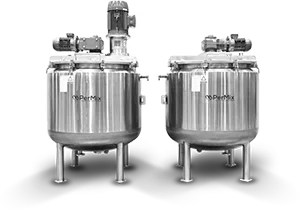
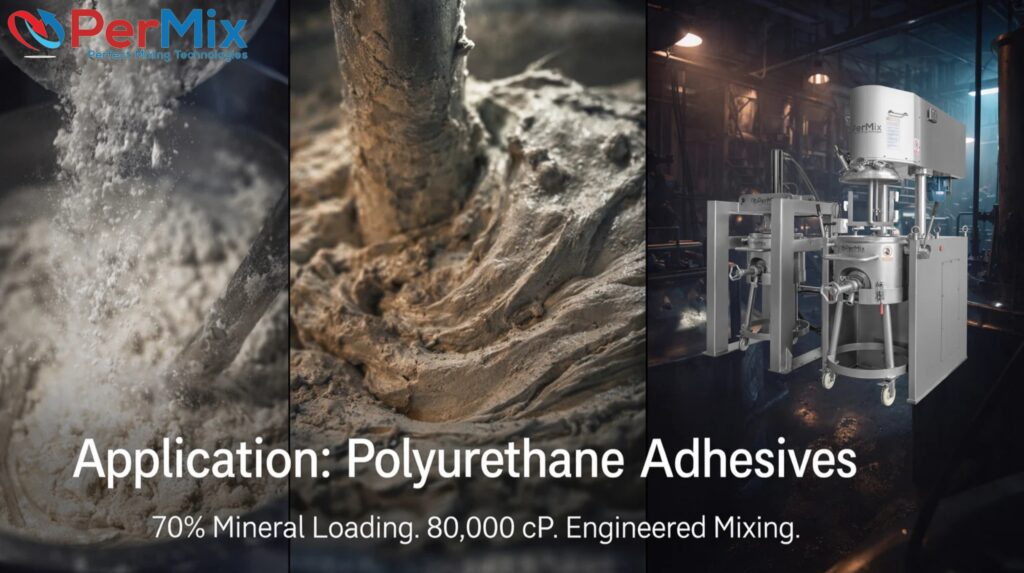
Modern polyurethane (PU) adhesive systems are no longer simple liquid blends. In construction, flooring, tile bonding, and industrial assembly applications, manufacturers increasingly rely on high mineral loading formulations to optimize cost, density, durability, and rheological performance.
Typical industrial formulation profile:
These are torque-driven systems. They do not behave like low-viscosity liquids.
The process begins with blending the liquid polyol and functional additives to achieve homogeneity. At this stage, viscosity is typically manageable (hundreds of cP).
Uniform distribution of catalysts, stabilizers, and rheology modifiers is critical before filler incorporation begins.
Mineral fillers are gradually introduced into the liquid phase.
This stage determines final product quality.
As filler loading increases, viscosity rises exponentially—not linearly. When the formulation reaches 60–70% solids, the system transitions from fluid mixing into high-viscosity paste processing.
Key challenges during filler addition:
Improper mixing at this stage leads to:
At 50,000–80,000 cP, the product behaves as a dense, highly loaded adhesive mass. Shear alone is no longer sufficient. Proper mixing requires:
This is where mixing technology becomes decisive.
High-mineral polyurethane adhesives are produced by:
These manufacturers require:
The mixer becomes the central element in maintaining product integrity and process economics.
High-viscosity adhesive systems demand torque—not high RPM. Excessive speed without torque capacity causes poor turnover and uneven dispersion.
Micronized mineral powders must be fully incorporated into the polyol phase. Insufficient wet-out creates weak bonding regions and product inconsistency.
Viscosity is temperature-sensitive. Mechanical energy input can increase product temperature during mixing. Jacketed vessels provide cooling capability to stabilize rheology.
Air inclusion affects density, bonding strength, and curing behavior. Optional vacuum mixing systems reduce entrained air and improve final performance.
PerMix designs mixing systems specifically for high-viscosity, high-solids adhesive manufacturing.
Ideal for 50,000–100,000+ cP systems:
These systems are engineered for mineral-loaded adhesive pastes where consistent dispersion and repeatability are critical.
For applications requiring staged processing:
Multi-shaft systems allow optimization of shear and bulk movement during filler addition.
In mineral-filled polyurethane adhesives, 70% of the formulation may be solid filler.
If dispersion is inconsistent, bonding performance suffers. If torque is insufficient, cycle times increase. If air is entrained, product quality declines.
The mixer determines:
In high-performance adhesive manufacturing, mixing is not a supporting step.
It is the process.
High-solids polyurethane adhesive systems represent a demanding category of industrial mixing. As formulations become more mineral-loaded and performance-driven, manufacturers must rely on mixing technology engineered for torque, control, and repeatability.
PerMix provides industrial mixing solutions designed specifically for these high-viscosity, mineral-filled systems—supporting adhesive manufacturers with robust, scalable, and process-optimized equipment.
Stay Connected