Making Peanut Butter Better, More Natural & More Nutritious
From “Just Peanuts” to Fortified, High-Performance Spreads — and the Mixing/Milling Systems That Make It Possible
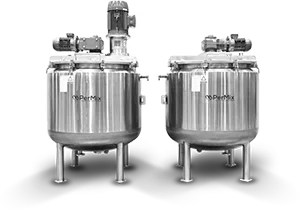
PerMix + DP Pulverizers
Executive Summary
Making peanut butter looks simple: peanuts go in, peanut butter comes out. In reality, modern peanut butter is a controlled suspension of solids in oil, engineered for flavor, mouthfeel, stability, nutrition, shelf life, and repeatability at scale.
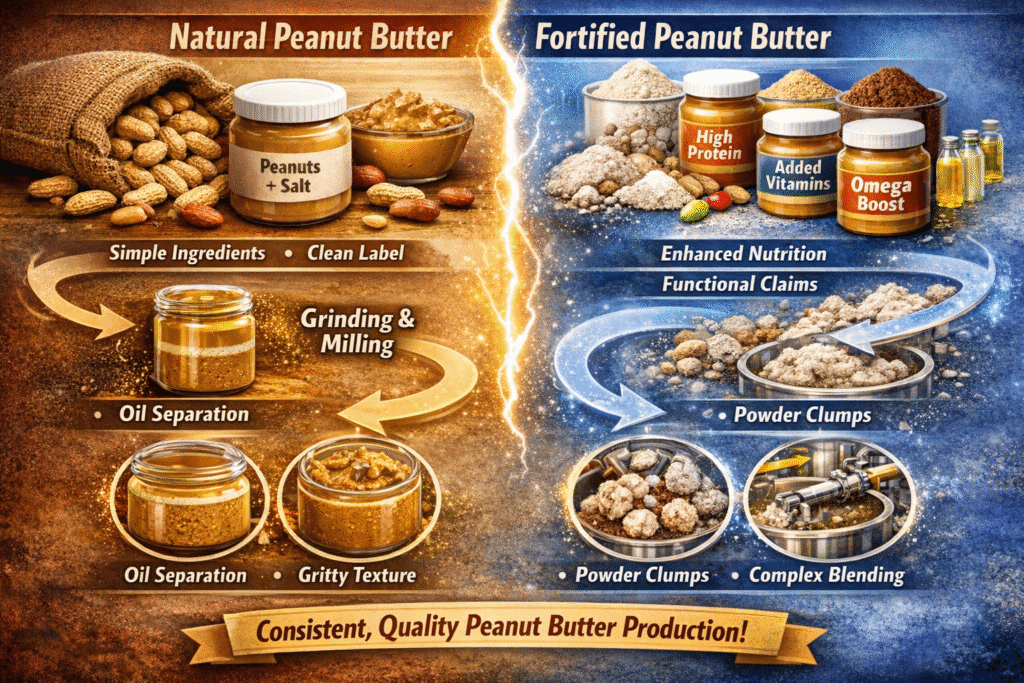
Today’s market splits into two fast-growing camps:
Both categories win customers—until processing problems show up: oil separation, gritty texture, heat damage, poor dispersion of micro-ingredients, oxidation, inconsistent viscosity, allergen-changeover headaches, and downtime from cleaning.
This paper explains how modern peanut butter is made, what makes it “natural” vs “fortified,” the critical process variables that determine quality, and how PerMix + DP Pulverizers address the full pathway—from milling and particle-size control to mixing, dispersion, and hygienic design for high-throughput production.
1) What Peanut Butter Actually Is (Food Physics, Not Magic)
At its core, peanut butter is a semi-solid suspension:
Peanut solids (protein + carbohydrates + fiber)
Peanut oil (continuous phase)
Often added oil (to tune texture)
Sometimes stabilizers/emulsifiers (to reduce oil separation)
Sometimes sweeteners/salts/flavors (sensory profile)
Key controls: order of addition, dispersion method, shear energy, time, temperature, vacuum/air management.
Step 6: Deaeration / Vacuum (Optional but Powerful)
Removing air can:
improve appearance (less foam)
reduce oxidative flavor drift
improve fill accuracy and reduce voids
Step 7: Filling / Packaging
Hot-fill or controlled-temperature fill. Fill performance depends on:
viscosity consistency
temperature stability
air content
Step 8: Cooling / Set and Storage
Stabilizers (when used) often require controlled cooling to lock structure.
4) Where Peanut Butter Lines Fail (and Why)
These are the failure modes that create scrap, complaints, or “mystery variability”:
Gritty texture Usually a PSD tail problem (big particles), not the average particle size.
Oil separation Can be formulation, PSD, insufficient emulsification/stabilization, or thermal history.
Viscosity inconsistency Often driven by peanut lot variability, roast variance, PSD changes, or over/under shear.
Powder clumps in fortified SKUs Poor wet-out method, wrong addition point, wrong shear profile.
Oxidation / flavor drift Excess air entrainment, high temps, long residence time, poor oxygen management.
Downtime and allergen changeover pain Hygienic design + cleanability becomes the real bottleneck in multi-SKU facilities.
5) How DP Pulverizers Answers the Milling and Particle Control Needs
Texture is not “marketing.” Texture is particle engineering.
DP Pulverizers supports peanut butter processing with milling solutions designed around:
Controlled PSD (especially limiting the coarse tail that causes grit)
High throughput stability
Thermal management options to protect flavor and oils
Wear management (materials and design choices depending on abrasiveness and formulation)
What DP brings to the line
A) Particle-size distribution control (smoothness and consistency) DP systems are selected and configured to control not only “average grind,” but the large-particle tail that creates consumer-detectable grit.
B) Scalable milling architecture DP supports scale from pilot to production capacity with a process-first approach: define texture targets, define thermal limits, then build the mill selection around those constraints.
C) Fortified product readiness When peanut butter formulations include additional powders (proteins, fibers, mineral premixes), controlling particle characteristics and dispersion behavior becomes even more important—DP’s process approach ensures milling and downstream mixing behave as a unified system, not two departments arguing over whose fault it is.
6) How PerMix Answers the Mixing, Dispersion, and Hygienic Production Needs
Peanut butter mixing is deceptively difficult because you’re working with:
high viscosity paste
shear-sensitive sensory targets
oils that can separate
micro-additions that must disperse perfectly
sticky, allergen-relevant product that must be cleaned reliably
PerMix supports peanut butter processing with systems engineered for:
high-viscosity mixing and dispersion
powder incorporation (wet-out) for fortified SKUs
temperature control (jackets when needed)
vacuum/low-air mixing options where oxidation or fill quality matters
hygienic design and cleanability (including CIP strategies)
Where PerMix makes the biggest difference
A) Consistent formulation mixing (salt, sweeteners, oils, stabilizers) Uniform dispersion prevents flavor hot spots and stabilizer “pockets” that later cause separation or texture defects.
B) Fortification that doesn’t clump Protein, fibers, vitamins/minerals—all of these can create wet-out problems if they’re not induced and dispersed correctly. PerMix mixing architectures are chosen to match the rheology (how the paste flows) and the dispersion requirement (how aggressively you need to break agglomerates).
C) Temperature-managed mixing Controlling temperature protects flavor, manages viscosity for filling, and reduces variability across batches. Jacketed designs can stabilize the process window when production speed and repeatability matter.
D) Cleanability and allergen discipline Multi-SKU lines live or die by changeover time. PerMix supports hygienic design philosophies and CIP approaches (wet, dry, or hybrid strategies depending on plant reality and utilities) to reduce downtime while maintaining sanitation confidence.
7) Designing a Peanut Butter Line to Win: “System Thinking”
The highest-performing plants don’t treat milling and mixing as separate worlds. They run a single integrated philosophy:
Milling defines PSD and heat history → which defines viscosity and dispersion behavior
Mixing defines dispersion and stabilization → which defines shelf stability and fill behavior
Cleaning strategy defines uptime → which defines profitability
PerMix + DP approach peanut butter lines from the process requirements outward, aligning:
texture target
throughput target
thermal limits
formulation complexity
cleanability/changeover realities
That’s how you build a line that can run:
a minimalist natural SKU in the morning
a fortified high-protein SKU after lunch
and still hit texture, stability, and fill specs without drama.
8) Practical Guidance: Natural vs Fortified Processing Notes
Natural peanut butter (clean label)
Focus on:
PSD tail control (smoothness)
temperature control (flavor protection)
air management (oxidation reduction)
consistent roast + lot handling
Fortified peanut butter (functional)
Focus on:
powder induction/wet-out method
dispersion energy matched to ingredient type
staged addition strategy (micro-additions rarely belong in the “dump and pray” category)
viscosity control (temperature + shear history)
robust sanitation for multi-SKU changeovers
9) Conclusion
Peanut butter is no longer a single product category. It’s a platform: natural, functional, indulgent, high-protein, reduced sugar, crunchy, organic, “kid-friendly,” athlete-focused—each with its own processing traps.
Winning manufacturers will be the ones who control:
particle engineering (texture + consistency)
dispersion and stabilization (shelf life + uniformity)
cleanability and changeover (uptime + compliance)
process repeatability (brand consistency at scale)
PerMix + DP Pulverizers provide the integrated milling and mixing foundation needed to manufacture modern peanut butter—from clean-label classics to high-performance fortified spreads—with the control, hygiene, and scalability competitive lines demand.
To provide the best experiences, we use technologies like cookies to store and/or access device information. Consenting to these technologies will allow us to process data such as browsing behavior or unique IDs on this site. Not consenting or withdrawing consent, may adversely affect certain features and functions.
Functional
Always active
The technical storage or access is strictly necessary for the legitimate purpose of enabling the use of a specific service explicitly requested by the subscriber or user, or for the sole purpose of carrying out the transmission of a communication over an electronic communications network.
Preferences
The technical storage or access is necessary for the legitimate purpose of storing preferences that are not requested by the subscriber or user.
Statistics
The technical storage or access that is used exclusively for statistical purposes.The technical storage or access that is used exclusively for anonymous statistical purposes. Without a subpoena, voluntary compliance on the part of your Internet Service Provider, or additional records from a third party, information stored or retrieved for this purpose alone cannot usually be used to identify you.
Marketing
The technical storage or access is required to create user profiles to send advertising, or to track the user on a website or across several websites for similar marketing purposes.