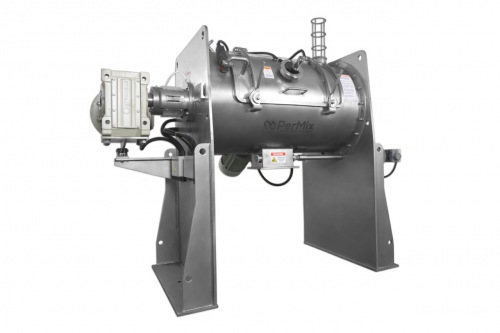
Industrial Mixers
PerMix Plow Mixer
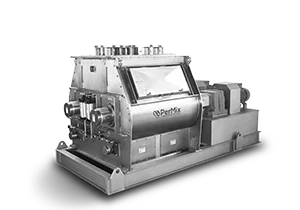
 High-Quality Plow Mixers - Discover the Best Plow Mixer for Your Product Needs
Best in Innovation • Best In Performance • Best In Quality • Best In Price • Best In Warranty
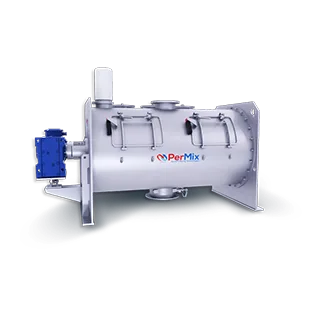
PerMix Plow Mixers lead the industry in technology, performance, and value, and advanced sealing solutions.
PerMix offers a diverse selection of Plow Mixers, available in two types: Horizontal Plow Mixers and Horizontal Plow Mixer / Dryers. Both our Plow Mixers as well as our Plow Mixer / Dryers are available in a range of capacities, from a minimum number of 1 liter to a maximum number of 30,000 liters.
A plow mixer—also known as a ploughshare mixer—is a high-intensity batch mixer designed to process powders and pastes that cannot be effectively blended using low-shear mixing technologies.
Unlike ribbon or paddle mixers that rely primarily on gentle convective flow, a plow mixer uses specially shaped plow elements mounted on a horizontal shaft. As the shaft rotates at higher speeds, these plows mechanically lift, project, and disperse material into a three-dimensional, mechanically fluidized mixing zone.
This fluidized zone allows particles to:
Move freely and independently
Collide and separate continuously
Rapidly exchange position within the batch
The result is fast, uniform mixing, even for cohesive, sticky, or difficult-to-handle materials.
As the shaft rotates:
The plow elements scoop material from the vessel wall
Material is thrown into the mixing chamber
Particles are suspended briefly in a fluidized state
Gravity returns material back into the mixing zone
This repeated lifting and dispersion creates intense mixing energy throughout the vessel rather than relying on slow bulk circulation.
Plow mixers are specifically chosen when:
Powders are cohesive or poorly flowing
Liquid addition must be dispersed rapidly
Agglomerates need to be broken down
Granulation or coating is required
Fast cycle times are critical
Where ribbon mixers gently move material, plow mixers actively energize it.
Plow mixers are commonly used for:
Cohesive powders
Sticky or moisture-sensitive materials
Fine powders prone to agglomeration
Formulations requiring liquid binding or coating
Their ability to mechanically fluidize material makes them one of the most versatile high-energy batch mixers available.
At a fundamental level:
Ribbon mixers excel at uniform blending of free-flowing powders
Plow mixers excel at intensive mixing of difficult materials
Plow mixers are often selected after a ribbon mixer has proven insufficient for a given application.
Understanding how a plow mixer works helps ensure:
Correct mixer selection
Proper process expectations
Better scale-up results
Reduced trial-and-error during commissioning
Now that the basic mixing principle is understood, the next question becomes when a plow mixer is the right choice over other mixer technologies.
Plow mixers are selected when material behavior or process goals exceed the capabilities of low-shear mixers. Understanding when a plow mixer is the correct tool—and when it is not—prevents misapplication, wasted capital, and disappointing results.
A plow mixer is typically the best solution when one or more of the following conditions exist:
Cohesive or Poorly Flowing Powders
Materials that bridge, smear, or resist movement in ribbon or paddle mixers benefit from the mechanical fluidization created by plow elements.
Aggressive Liquid Addition Requirements
When liquids must be dispersed quickly and uniformly—especially at higher addition rates—plow mixers provide the energy needed to prevent lumping and localized over-wetting.
Agglomeration or Wet Granulation
Plow mixers are widely used to intentionally form granules or agglomerates by combining powders with binders or liquids under controlled energy input.
Deagglomeration of Fine Powders
Fine or hygroscopic powders that form soft agglomerates can be broken apart efficiently through high-energy mixing.
Fast Cycle Times
Plow mixers achieve uniformity in significantly shorter mixing times compared to low-shear technologies, making them suitable for high-throughput operations.
Processes Where Ribbon Mixers Struggle
If a ribbon mixer fails to achieve uniformity, cannot handle liquid addition, or produces inconsistent batches, a plow mixer is often the correct escalation.
Plow mixers are commonly chosen for:
Wet powder processing
Powder coating with liquids or binders
Agglomeration and granulation
Mixing materials with wide particle size distributions
Blends that require high dispersion energy
In these cases, mechanical fluidization is not optional—it is essential.
While plow mixers are extremely versatile, they are not always the optimal solution.
A plow mixer may be unnecessary or inefficient when:
Materials Are Free-Flowing and Easy to Blend
If powders blend readily and require only gentle mixing, a ribbon or paddle mixer is often more energy-efficient and cost-effective.
Minimal Shear Is Required
Very fragile ingredients that degrade under higher energy input may be better suited to paddle or ribbon mixers.
Simple Blending Is the Only Goal
When the process involves straightforward blending without liquid addition, granulation, or deagglomeration, high-intensity mixing may be excessive.
Energy Consumption Must Be Minimized
Plow mixers inherently use more energy than low-shear mixers due to their operating principle.
At a high level:
Choose a ribbon mixer for uniform blending of free-flowing powders
Choose a plow mixer for difficult materials, liquid-intensive processes, or granulation
Plow mixers are not replacements for ribbon mixers—they are problem solvers when ribbon mixers reach their limits.
Selecting the correct mixer technology:
Improves batch uniformity
Reduces mixing time
Prevents rework and formulation changes
Lowers long-term operating costs
Improves scale-up success
Misapplying a mixer often leads to longer cycle times, inconsistent product quality, and unnecessary process complexity.
PerMix plow mixers are engineered for high mechanical loads, aggressive mixing energy, and continuous industrial operation. Every component—from the plow geometry to the vessel shell—is designed to withstand demanding processes while delivering consistent, repeatable mixing performance.
The defining feature of a plow mixer is the plow-shaped mixing elements mounted along a horizontal shaft.
PerMix plow mixers feature:
Precisely shaped plow elements designed to lift and project material efficiently
Optimized plow angles to create stable mechanical fluidization
Heavy-duty shafts engineered to resist bending and torsional deflection
Balanced agitator assemblies for smooth operation at higher rotational speeds
Plow geometry, spacing, and quantity are engineered based on material behavior, batch size, and desired mixing intensity.
Plow mixers utilize a horizontal cylindrical mixing chamber designed to contain and control the fluidized product.
Key vessel design considerations include:
Cylindrical geometry to support uniform material circulation
Smooth internal contours to prevent buildup and dead zones
Reinforced shell construction to handle dynamic loads
Rigid end plates to maintain long-term alignment
The vessel is designed not only to hold material, but to actively support the fluidization process.
Plow mixers are frequently used in abrasive, corrosive, or high-wear applications. PerMix offers a wide range of construction materials to match these conditions.
Available materials include:
Carbon steel for general industrial use
304 stainless steel for food and non-corrosive applications
316 / 316L stainless steel for corrosive or hygienic environments
Hardox wear-resistant steel for highly abrasive materials
Specialty alloys such as Hastelloy or titanium for extreme chemical exposure
Proper material selection significantly impacts service life and maintenance requirements.
Many PerMix plow mixers are equipped with side-mounted high-speed choppers, which expand the mixer’s process capabilities.
Choppers are used to:
Break down agglomerates
Improve liquid dispersion
Control granulation size
Prevent lump formation during wet mixing
Chopper speed, number, and placement are selected based on material characteristics and process objectives.
Due to the high-energy nature of plow mixers, robust sealing and bearing systems are critical.
PerMix plow mixers can be equipped with:
Packed gland seals
Mechanical seals
Air purge seals for dust containment
Gas purge seals for inert or hazardous atmospheres
Bearings are mounted externally, outside the product zone, to:
Reduce contamination risk
Simplify maintenance
Extend bearing life
Plow mixers require higher power input compared to low-shear mixers.
PerMix designs drive systems with:
Heavy-duty gear motors sized for startup and full-load torque
Direct-drive or guarded transmission systems
Variable frequency drives (VFDs) for speed control
Drive systems are conservatively sized to ensure reliable operation under peak load conditions.
Discharge design plays a critical role in batch efficiency and cleanout.
Common discharge options include:
Large flush-bottom valves
Bomb bay doors for rapid discharge
Screw-assisted discharge for poor-flowing materials
Discharge selection is based on material flow characteristics and downstream handling requirements.
Plow mixers can be equipped with jackets for thermal processing.
Jacket options include:
Heating or cooling jackets
Steam, hot water, thermal oil, or chilled water service
Single-zone or multi-zone temperature control
Thermal jackets are commonly used for drying, conditioning, or controlling material viscosity during processing.
Every structural and mechanical element of a PerMix plow mixer is designed to handle:
High mixing energy
Dynamic loads
Abrasive or cohesive materials
Continuous production environments
This focus on mechanical integrity ensures reliable performance over long service intervals.
PerMix plow mixers are highly configurable to support complex, high-energy processes. Options are engineered as part of the mixer design—not added as afterthoughts—ensuring performance, safety, and long-term reliability.
Plow mixers excel at rapid and uniform liquid dispersion, even at higher addition rates.
Available liquid addition options include:
Spray lances or injection ports positioned in the active mixing zone
Metered dosing pumps for precise liquid control
Multiple injection points for staged or multi-component addition
Heated liquid delivery for viscous binders or additives
High mixing energy minimizes lump formation and improves coating uniformity.
Side-mounted high-speed choppers significantly expand the capabilities of a plow mixer.
Chopper options include:
Variable-speed drives
Multiple choppers per vessel
Wear-resistant chopper blades
Choppers are commonly used for:
Deagglomeration of fine powders
Granulation size control
Improved liquid dispersion
Breaking down oversize clusters
Thermal jackets can be integrated for temperature control during mixing or drying.
Options include:
Full welded jackets
Dimple jackets for enhanced heat transfer
Steam, hot water, thermal oil, or chilled water service
Multi-zone temperature control
Thermal processing improves material behavior and supports drying and conditioning applications.
Vacuum plow mixers combine high-energy mixing and vacuum drying in one sealed system.
Available features include:
Vacuum-rated vessel design
Condensing columns and solvent recovery
Inert gas purge capability
Oxygen-free processing environments
These systems are widely used for chemical, pharmaceutical, battery, and advanced material applications.
Plow mixers are available with discharge configurations designed for fast, complete emptying.
Common options include:
Large flush-bottom discharge valves
Bomb bay doors for rapid batch discharge
Screw-assisted discharge for cohesive materials
Proper discharge selection reduces batch cycle time and material hold-up.
Plow mixers can be customized with materials selected for wear, corrosion, and regulatory requirements.
Available materials include:
Carbon steel
304 and 316 / 316L stainless steel
Hardox wear-resistant liners
Specialty alloys such as Hastelloy or titanium
Material choice directly impacts durability and maintenance intervals.
Seal configurations are selected based on product sensitivity and safety requirements.
Available options include:
Packed gland seals
Mechanical seals
Air purge seals for dust control
Gas purge seals for inert or hazardous atmospheres
Atmosphere control improves safety and protects sensitive materials.
Plow mixers can be equipped with automation systems tailored to process complexity.
Control options include:
Local control panels
PLC and HMI systems
Recipe management and batch sequencing
Chopper and mixer speed control
Data logging and traceability
Automation improves repeatability and reduces operator dependency.
PerMix offers structural customization to simplify installation and integration.
Options include:
Integrated support frames and platforms
Load cells for batch weighing
Skid-mounted designs
Custom inlet and outlet configurations
These features support efficient plant layout and operation.
Each option is engineered to support the demanding nature of plow mixing, ensuring the mixer performs reliably under high mechanical and thermal loads.
Plow mixers are selected for processes where mixing energy, dispersion speed, and material transformation are critical. Achieving consistent performance at scale requires careful control of mixing dynamics, energy input, and material behavior.
PerMix plow mixers are engineered to deliver predictable results from lab and pilot systems through full-scale production.
Plow mixers operate by creating a mechanically fluidized mixing zone. Unlike convective mixers, performance is driven by energy input, not just material circulation.
Key performance drivers include:
Plow geometry and spacing
Shaft speed and tip speed
Batch fill level
Material cohesiveness and moisture content
When properly engineered, the entire batch enters a dynamic, fluidized state, allowing particles to mix rapidly and uniformly.
Plow mixers typically achieve uniformity in significantly shorter cycle times than low-shear mixers.
Performance advantages include:
Rapid dispersion of liquids
Fast deagglomeration
Efficient granulation or coating
Shorter mixing cycles support higher throughput without sacrificing batch quality.
Scaling a plow mixer requires maintaining similar mixing energy and fluidization behavior, not simply increasing vessel size.
PerMix scale-up methodology focuses on:
Maintaining comparable tip speed and energy density
Adjusting plow configuration for vessel diameter
Coordinating plow speed and chopper speed
Preserving similar batch fill ratios
This approach ensures that formulations developed in R&D behave consistently in production.
Plow mixers are widely used for wet granulation and agglomeration processes.
Granule characteristics are controlled by:
Liquid addition rate
Binder viscosity
Mixing energy
Chopper speed and duration
Fine adjustments allow manufacturers to target specific granule sizes and densities without reformulating at scale.
As batch size increases, liquid addition becomes more sensitive to timing and distribution.
PerMix addresses this by:
Scaling nozzle placement and spray patterns
Controlling liquid flow rate relative to mixing energy
Synchronizing liquid addition with mixer and chopper speeds
This prevents localized over-wetting and ensures consistent results across batch sizes.
Due to higher energy input, plow mixers naturally generate more heat than ribbon or paddle mixers.
Thermal management strategies include:
Optimized mixing speeds
Integrated heating or cooling jackets
Vacuum operation for temperature-sensitive products
Proper thermal control protects product integrity and improves process stability.
Vacuum plow mixers combine high-energy mixing with reduced pressure to accelerate drying.
Performance benefits include:
Lower drying temperatures
Improved mass transfer due to constant agitation
Uniform moisture removal across the batch
Reduced oxidation and degradation
Drying performance scales reliably when vessel geometry and agitation parameters are properly matched.
Repeatable performance is achieved through:
Rigid mechanical design
Stable drive systems
Controlled liquid and energy input
Optional automation and recipe control
These features reduce operator variability and support quality control requirements.
Poor scale-up can lead to:
Inconsistent granule size
Over- or under-mixing
Excessive heat generation
Product quality drift
PerMix plow mixers are engineered to minimize these risks by applying proven scale-up principles from the earliest stages of development.
Plow mixers are selected when materials, formulations, or processing goals require high-energy mixing, rapid dispersion, or material transformation. Their ability to mechanically fluidize product makes them especially effective in applications where low-shear mixers fall short.
Below are common plow mixer workflows used across industries, often integrated with milling, liquid addition, and drying.
Primary challenges:
Cohesive or poorly flowing powders
Agglomeration
Uneven liquid dispersion
Abrasive materials
Typical workflow:
Pre-Milling or Size Conditioning
Raw materials are milled or screened to control particle size distribution and remove oversize material.
Plow Mixing
Powders are mechanically fluidized to ensure rapid and uniform blending.
Liquid Addition / Granulation (Optional)
Binders, reactants, or coatings are added and dispersed quickly without lump formation.
Optional Drying or Conditioning
Jacketed or vacuum plow mixers are used to remove moisture or solvents.
Why it works:
High-energy mixing overcomes cohesion and ensures consistent dispersion in chemically complex formulations.
Primary challenges:
Fine powders prone to agglomeration
Sensitive chemistries
Dust control
Repeatability and scale-up
Typical workflow:
Fine Milling or Micronization
Active materials are milled to precise particle size targets.
Plow or Vacuum Plow Mixing
Powders are blended under controlled energy to break soft agglomerates.
Inert or Vacuum Processing
Oxygen-sensitive materials are protected during mixing and drying.
Why it works:
Mechanical fluidization ensures uniform distribution while minimizing batch-to-batch variation.
Primary challenges:
Liquid addition without lumping
Powder wetting
Controlled agglomeration
Short cycle times
Typical workflow:
Ingredient Pre-Processing
Dry ingredients are milled or screened for consistent size.
Plow Mixing with Liquid Addition
Oils, syrups, or binders are rapidly dispersed into powders.
Optional Agglomeration
Granule size is controlled through energy input and chopper speed.
Optional Drying or Cooling
Product is conditioned for downstream handling or packaging.
Why it works:
Plow mixers provide the energy needed for liquid incorporation without extended mixing times.
Primary challenges:
Uniform potency
Granulation control
Regulatory compliance
Cleaning and validation
Typical workflow:
Precision Milling of Actives and Excipients
Ingredients are milled to tight particle size specifications.
Plow Mixing or Wet Granulation
Powders are blended or granulated with controlled energy.
Vacuum Drying (Optional)
Moisture is removed while preserving active compounds.
Downstream Processing
Granules are prepared for tableting, encapsulation, or further blending.
Why it works:
Plow mixers offer repeatable granulation and blending while supporting sanitary design requirements.
Primary challenges:
Abrasive materials
Large batch sizes
Consistency at scale
Equipment wear
Typical workflow:
Pre-Milling or Classification
Minerals and fillers are conditioned for uniform feedstock.
Heavy-Duty Plow Mixing
Materials are blended rapidly with high mechanical robustness.
Additive Injection (Optional)
Minor ingredients or binders are dispersed evenly.
Why it works:
High-energy mixing and wear-resistant construction support reliable, high-throughput production.
Primary challenges:
Inconsistent feedstock
Moisture variation
Agglomerates
Difficult material behavior
Typical workflow:
Size Reduction or Pre-Conditioning
Feedstock is milled or shredded to improve consistency.
Plow Mixing
Materials are homogenized, conditioned, or agglomerated.
Drying or Stabilization
Moisture is reduced to improve downstream processing or reuse.
Why it works:
Plow mixers handle variability and deliver uniform processing despite inconsistent inputs.
Designing the process around material behavior, not just equipment type, delivers:
Faster mixing cycles
Improved uniformity
Better granulation control
More reliable scale-up
Reduced rework and waste
Plow mixers succeed when they are part of a coordinated workflow, not a standalone decision.
Many mixing challenges don’t start in the mixer — they start upstream with inconsistent particle size.
If powders are too coarse, too fine, too wide in distribution, or irregular in shape, even the best mixer will struggle to achieve uniformity, fast cycle times, and repeatable results.
That’s why PerMix approaches process design holistically, combining milling and mixing into a single, engineered solution.
Proper size-reduction directly impacts mixing performance by improving:
Particle-to-particle contact
Flowability and bulk density consistency
Liquid absorption and coating uniformity
Blend homogeneity and repeatability
When particle size is controlled before mixing, batch cycles are shorter, variability is reduced, and scale-up becomes far more predictable.
PerMix works closely with DP Pulverizers, a specialist manufacturer of industrial milling and size-reduction equipment, to provide complete milling and mixing systems.
DP Pulverizers offers a full range of mills designed to prepare materials for optimal downstream mixing, including:
Hammer mills
Pin mills
Turbo mills
Air classifier mills
Jet mills
Fine grinding and micronization systems
These mills are used across food, pharmaceutical, chemical, nutraceutical, battery, and industrial applications where particle size control is critical.
Learn more about DP Pulverizers milling solutions here:
👉 https://www.dpmills.com
Combining milling and mixing under one engineered approach provides key advantages:
Improved blend uniformity
Reduced segregation during mixing
More consistent liquid distribution
Better scale-up from lab to production
Fewer process variables and transfers
Rather than treating milling and mixing as separate equipment decisions, PerMix helps customers design complete powder processing lines that perform reliably from the first batch through full-scale production.
Whether you need size reduction before mixing, tighter particle size control, or a fully integrated milling and mixing system, PerMix and DP Pulverizers work together to support your process from raw material to finished blend.
Plow mixers are often selected because mixing alone is not enough. In many high-energy applications, upstream particle size and material consistency directly determine whether the plow mixer performs as intended.
Understanding the role of milling, mixing, or a combined approach is critical to achieving consistent results and reliable scale-up.
Milling, or size reduction, is used to control particle size and distribution before mixing. While plow mixers can break soft agglomerates, they are not designed to correct wide particle size variation in raw materials.
Milling is used to:
Reduce oversized particles
Narrow particle size distribution
Improve flowability and bulk density consistency
Prepare materials for uniform wetting or granulation
When incoming materials vary significantly in size, even high-energy plow mixing becomes inefficient and inconsistent.
Plow mixing focuses on energy-driven dispersion and transformation, not size reduction.
Plow mixers are used to:
Rapidly blend cohesive powders
Disperse liquids evenly into dry solids
Break soft agglomerates
Perform wet granulation or agglomeration
Achieve fast, uniform batch processing
Plow mixers excel once particle size is within a workable range.
Milling alone may be sufficient when:
A single material is being processed
Particle size is the primary specification
No blending or coating is required
Examples include:
Producing fine powders for downstream use
Conditioning recycled or revalorized materials
Preparing feedstock for later processing
In these cases, a mixer may not be required.
Plow mixing alone is appropriate when:
Raw materials already have consistent particle size
The process requires dispersion, not size reduction
Liquid addition or granulation is the primary goal
Examples include:
Wet granulation of pre-milled powders
Coating powders with binders or additives
Deagglomeration of fine materials
Here, the plow mixer provides all required processing energy.
Many industrial processes perform best when milling and plow mixing are integrated.
A combined approach is recommended when:
Raw materials arrive with wide particle size variation
Fine and coarse materials must be blended together
Liquid coating or granulation must be tightly controlled
Scale-up consistency is critical
In these cases:
Milling prepares the material
Plow mixing performs dispersion, granulation, or transformation
Each step reinforces the other.
Integrating milling upstream of a plow mixer delivers:
Faster mixing cycles
More uniform granule formation
Reduced energy consumption during mixing
Improved batch-to-batch repeatability
Easier scale-up from lab to production
Rather than forcing the plow mixer to solve a particle size problem, the process is engineered correctly from the start.
PerMix works closely with DP Pulverizers to provide complete milling and plow mixing systems for demanding applications.
DP Pulverizers offers industrial size-reduction technologies including:
Hammer mills
Pin mills
Turbo mills
Air classifier mills
Jet mills
Fine grinding and micronization systems
These mills prepare materials for optimal downstream plow mixing performance.
Learn more about industrial milling solutions here:
👉 https://www.dpmills.com
Understanding when to mill, when to mix, and when to do both:
Prevents misapplication of equipment
Reduces trial-and-error during commissioning
Improves product quality
Protects capital investment
Plow mixers perform best when they are part of a properly engineered process, not a last resort.
PerMix is here to listen to your needs and provide sustainable solutions. Contact us to discover more.
PerMix Plow Mixer Videos