Industrial Mixers
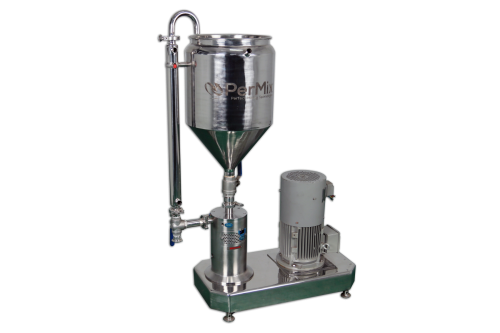
PerMix Emulsifier
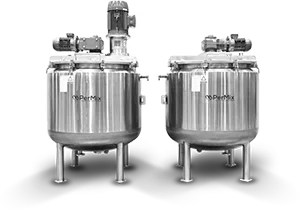
 PerMix Emulsifier
Best in Innovation • Best In Performance • Best In Quality • Best In Price • Best In Warranty
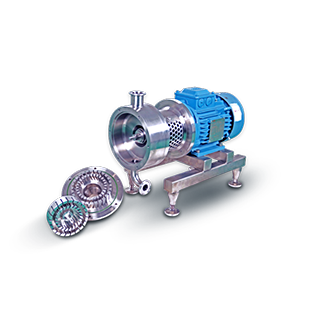
PerMix Emulsifiers & Inline Homogenizer Mixer is a high shear mixer for inline or continuous operation. In the Inline process, the mixer is installed outside the tank.
An inline emulsifier is a high-shear liquid processing device installed directly into a pipeline to emulsify, disperse, or homogenize fluids continuously or in recirculation. It uses a rotor–stator shear head to break droplets or particles down as liquid flows through the unit—without requiring in-tank shear.
At PerMix, inline emulsifiers are positioned as flow-driven shear tools, not batch mixers. They are selected when throughput, integration, and continuous processing matter more than full-batch shear history.
Inline emulsifiers operate on a simple but powerful principle:
Liquid is pumped into the emulsifier housing
The rotor accelerates the liquid toward the stator
Extreme velocity gradients generate intense shear
Droplets or particles are reduced in size
Processed liquid exits immediately downstream
Shear is applied once per pass—or multiple times if the system is configured in recirculation.
Inline emulsifiers were developed to solve problems that in-tank systems cannot always address:
Continuous production requirements
Limited tank residence time
Integration into existing pipelines
High throughput with compact footprint
Modular processing architectures
They are ideal when liquid is already moving and shear must be added without stopping flow.
PerMix inline emulsifiers are used to:
Create oil–water emulsions
Disperse powders into liquids
Break down agglomerates
Reduce droplet size
Improve suspension stability
They do not manage bulk circulation, temperature uniformity, or air removal unless paired with other systems.
Inline emulsifiers:
Apply shear in a pipe
Depend on pump flow
Process only what passes through
In-tank homogenizers:
Control full-batch shear history
Integrate with heating, cooling, and vacuum
Deliver uniform exposure across the vessel
Inline emulsifiers add shear-on-demand.
In-tank homogenizers build structure deliberately.
High-speed mixers:
Generate shear via vortex formation
Are batch-oriented
Introduce air easily
Inline emulsifiers:
Generate shear mechanically
Operate under pressure
Can be sealed and air-controlled
They are fundamentally different tools solving different problems.
Inline emulsifiers are widely used for:
Food emulsions and sauces
Beverage flavor emulsions
Cosmetic and personal care liquids
Chemical emulsions and dispersions
Pharmaceutical liquids and suspensions
They are chosen when continuous shear integration matters more than batch perfection.
This is the most common misunderstanding.
Inline emulsifiers:
Require proper upstream pumping
Are sensitive to air entrainment
Depend on system pressure and flow stability
They work best as part of a designed liquid processing line, not as drop-in fixes.
Inline emulsifiers often look interchangeable on paper.
In practice, system integration determines success, not rotor speed.
Understanding what inline emulsifiers truly do prevents:
Over-shearing
Inconsistent emulsions
Excessive heat generation
Costly rework
Inline emulsifiers are chosen when shear must be added to a moving liquid stream—not when a full batch needs to be structurally rebuilt. They are powerful, efficient tools, but only when applied within the right process context. Most inline emulsifier failures come from asking them to do jobs they were never meant to do.
At PerMix, inline emulsifiers are specified based on flow behavior, residence time, and integration risk, not just flow rate and horsepower.
An inline emulsifier is typically the correct solution when one or more of the following conditions apply:
Continuous or Semi-Continuous Production
The process already operates in a pipeline or loop and cannot stop for batch processing.
Shear Is Needed Mid-Process
Emulsification, dispersion, or droplet refinement must occur between unit operations.
High Throughput with Compact Footprint
Floor space is limited and high shear must be delivered efficiently.
Recirculation Is Acceptable
Multiple passes through the emulsifier can be used to build structure.
Integration with Existing Equipment
Tanks, pumps, and heat exchangers are already in place.
Inline emulsifiers excel when liquid is already moving and must stay moving.
Inline emulsifiers are commonly used for:
Sauce and dressing production lines
Beverage flavor emulsions
Chemical emulsions and dispersions
Cosmetic liquid processing
Pre-emulsification before filling or further processing
In these cases, shear is applied as part of the flow, not as a standalone batch step.
Despite their efficiency, inline emulsifiers are not universal.
They may be the wrong tool when:
Full-Batch Uniformity Is Critical
Inline systems process only what passes through—shear history can vary.
Air Is a Major Quality Risk
Upstream pumping and recirculation can introduce air.
Precise Droplet Size Control Is Required
Vacuum emulsifying or in-tank homogenization offers tighter control.
Thermal History Must Be Managed Carefully
Inline shear can generate heat quickly without uniform dissipation.
Viscosity Is High or Variable
Flow resistance limits effective shear delivery.
In these cases, in-tank or vacuum systems are more reliable.
Inline emulsifier:
Flow-dependent
Shear per pass
Requires recirculation for refinement
In-tank homogenizer:
Full-batch control
Uniform shear exposure
Integrated thermal and vacuum options
Inline systems optimize throughput.
In-tank systems optimize structure.
Vacuum emulsifying mixer:
Prevents air incorporation
Controls droplet formation during emulsification
Produces finished, shelf-stable emulsions
Inline emulsifier:
Adds shear to an existing flow
Does not control air inherently
Often requires downstream conditioning
Inline emulsifiers support processes.
Vacuum emulsifiers define product quality.
Using an inline emulsifier where it is not suited leads to:
Inconsistent emulsions
Excessive heat buildup
Foaming and air entrainment
Longer processing times
Using batch systems where inline emulsification is sufficient leads to:
Unnecessary complexity
Reduced throughput
Higher capital cost
Inline emulsifiers are precision tools, not shortcuts.
At PerMix, inline emulsifiers are applied as:
Components of engineered liquid systems
Shear devices matched to real flow conditions
Tools integrated with pumps, heat exchangers, and deaerators
They are specified based on system behavior, not just flow rate targets.
Inline emulsifiers live a hard life. They operate at high speed, under pressure, often continuously, and are expected to deliver repeatable shear without introducing air, overheating product, or wearing themselves to death. Good inline emulsifiers are engineered. Bad ones are simply fast motors in a pipe.
At PerMix, inline emulsifiers are designed as industrial shear devices, not laboratory tools scaled up optimistically.
The rotor–stator assembly defines emulsifier performance.
PerMix designs emphasize:
Precisely machined rotor–stator gaps for consistent shear
Optimized slot and tooth geometry to control droplet breakup
Uniform shear zones rather than single aggressive pinch points
Stable performance across a defined viscosity window
Shear is engineered to be effective and repeatable, not destructive.
Inline emulsifiers must balance shear with flow stability.
PerMix housings are designed to:
Minimize turbulence that re-entrains air
Avoid dead zones where product can stagnate
Maintain consistent pressure through the shear zone
Support both single-pass and recirculation configurations
A poor flow path can undo excellent rotor–stator design.
High RPM under load stresses rotating components.
PerMix inline emulsifiers incorporate:
Rigid shafts sized to prevent deflection
Precision-balanced rotating assemblies
Bearings selected for continuous-duty, high-speed operation
Mechanical isolation between bearings and the product zone
Mechanical stability protects shear consistency and seal life.
Inline emulsifiers operate under pressure, vacuum, or both.
PerMix designs include:
High-performance mechanical seals
Seal materials compatible with temperature, solvents, and CIP
Configurations suitable for sanitary and industrial duty
Seal failure is not just a maintenance issue—it is a contamination risk.
Inline emulsifiers frequently handle finished or near-finished products.
PerMix offers:
304 stainless steel for general liquid processing
316 / 316L stainless steel for food, cosmetic, pharmaceutical, and chemical use
Polished internal surfaces for hygiene and cleanability
Materials are selected to match process chemistry and regulatory requirements.
Shear creates heat rapidly in inline systems.
PerMix manages this by:
Optimizing shear intensity instead of maximizing RPM
Designing housings that dissipate heat efficiently
Integrating with upstream or downstream heat exchangers
Inline emulsifiers should refine structure—not cook the product.
For hygienic applications, PerMix inline emulsifiers are:
Fully CIP-compatible
Free of crevices and dead legs
Designed for full internal surface coverage during cleaning
Cleanability is engineered into the flow path, not assumed.
Shear consistency requires speed stability.
PerMix systems support:
Variable frequency drives (VFDs)
Stable RPM under fluctuating load
Integration with PLC/HMI systems
Recipe-based shear control
Speed control allows emulsification to be tuned, not guessed.
Inline emulsifiers must integrate cleanly into piping systems.
PerMix designs allow for:
Horizontal or vertical installation
Flexible inlet and outlet orientations
Easy access for inspection and maintenance
Installation geometry affects both performance and service life.
Every design decision in a PerMix inline emulsifier is made to:
Withstand continuous operation
Deliver consistent shear per pass
Maintain seal and bearing integrity
Integrate seamlessly into production lines
These are process components, not add-ons.
Inline emulsifiers scale very differently from tank-based systems. What works flawlessly at pilot flow rates can quietly fail at production scale—producing emulsions that look correct at discharge but drift, separate, or foam later. Performance is therefore measured not at the outlet, but after the product has lived its life.
At PerMix, inline emulsifier scale-up is treated as a mass-transfer and residence-time problem, not a motor-sizing exercise.
True inline emulsifier performance is defined by:
Droplet size distribution after processing
Emulsion stability over time
Absence of foam or air defects
Controlled temperature rise
Consistency across operating conditions
Flow rate alone is not a performance metric.
Inline emulsifiers apply shear only while the product is inside the shear zone.
As flow rate increases:
Residence time decreases
Shear exposure per pass drops
Droplet refinement becomes incomplete
PerMix manages this by:
Matching emulsifier size to target flow range
Designing rotor-stator geometry for effective shear at realistic velocities
Recommending recirculation when single-pass exposure is insufficient
Scale-up must preserve effective shear time, not just throughput.
Single-pass emulsification
Faster
Lower complexity
Limited refinement
Recirculation emulsification
Greater droplet refinement
More uniform shear history
Increased heat and air-management requirements
PerMix helps determine when recirculation improves quality—and when it simply adds risk.
Inline emulsifiers depend on controlled flow.
As viscosity increases:
Pumping resistance rises
Flow into the shear zone becomes uneven
Heat generation increases
PerMix systems are sized so:
The emulsifier is never starved or flooded
Shear remains consistent across viscosity changes
Pump selection supports stable emulsification
Viscosity assumptions made at pilot scale often fail at production scale.
Inline shear generates concentrated heat.
At higher flow or RPM:
Temperature spikes can occur rapidly
Sensitive ingredients can degrade
Emulsion structure can collapse
PerMix controls this by:
Optimizing shear geometry rather than maximizing speed
Integrating emulsifiers with heat exchangers when required
Avoiding unnecessary recirculation
Heat management is a scale-up constraint, not a secondary concern.
Air is the silent performance killer in inline systems.
At scale:
Pumps entrain more air
Recirculation increases exposure
Foam formation accelerates
PerMix addresses this by:
Evaluating upstream pump selection
Recommending deaeration where required
Designing flow paths that minimize turbulence
Inline emulsifiers do not remove air—they often create it.
Inline emulsifiers do not operate in isolation.
Performance depends on:
Stable inlet pressure
Proper pump sizing
Smooth piping transitions
Controlled downstream velocity
PerMix evaluates the entire liquid path, not just the emulsifier.
Successful scale-up preserves:
Shear intensity per unit volume
Residence time per pass
Thermal profile
Air exposure history
PerMix avoids the most common mistake:
Increasing RPM to compensate for lost residence time.
This usually makes things worse.
Repeatable inline emulsification requires:
Stable flow control
Consistent speed via VFD
Temperature monitoring
Defined recirculation strategy
PerMix automation ensures emulsification is repeatable, not operator-dependent.
Poorly scaled inline emulsifiers lead to:
Emulsions that separate in storage
Texture drift
Excessive foam at filling
Costly reformulation attempts
These failures are often blamed on formulation—but originate in shear history.
Inline emulsifiers earn their place in production lines where liquid is already in motion and shear must be applied without interrupting flow. They are not quality-insurance devices on their own; they are process accelerators that perform best when correctly positioned within a well-designed liquid system.
Below are real-world workflows where inline emulsifiers deliver measurable value.
Primary challenges:
Fast throughput requirements
Consistent emulsion quality
Integration with thermal processing
Limited floor space
Typical workflow:
Ingredient Pre-Blend Tank
Inline Emulsifier (Single-Pass or Recirculation)
Heat Exchanger / Pasteurization
Deaeration (if required)
Filling
Common products:
Salad dressings
Sauces and marinades
Flavor emulsions
Syrups
Why it works:
Inline emulsifiers integrate seamlessly into continuous food lines, providing controlled shear without slowing production.
Primary challenges:
Fine droplet size
Rapid dispersion of actives
Heat sensitivity
Throughput efficiency
Typical workflow:
Carrier Liquid Preparation
Active or Oil Phase Addition
Inline Emulsification (Recirculation Loop)
Cooling & Conditioning
Packaging or Further Dilution
Why it works:
Inline emulsifiers allow rapid refinement of emulsions without large batch vessels.
Primary challenges:
Smooth texture
Consistent appearance
Modular line layouts
Mid-process shear control
Typical workflow:
Bulk Mixing Vessel
Inline Emulsifier for Structure Refinement
Cooling or Conditioning
Deaeration or Direct Filling
Common products:
Liquid soaps
Shampoos
Conditioners
Cleansers
Why it works:
Inline emulsifiers refine emulsions downstream of bulk mixing without disturbing batch timing.
Primary challenges:
Controlled dispersion
Continuous operation
Process reliability
Compact system design
Typical workflow:
Carrier Fluid Pumping
Additive Injection
Inline Emulsification
Holding or Packaging
Why it works:
Inline emulsifiers deliver repeatable shear in continuous chemical processing environments.
Primary challenges:
Uniform distribution
Controlled processing steps
Validation simplicity
Integration with filtration or filling
Typical workflow:
Solution or Suspension Preparation
Inline Emulsification or Dispersion
Conditioning or Filtration
Filling
Why it works:
Inline emulsifiers support controlled processing steps without full batch rehandling.
Primary challenges:
Reducing load on downstream equipment
Improving efficiency of homogenizers or vacuum emulsifiers
Typical workflow:
Pre-Blend Tank
Inline Pre-Emulsification
Vacuum Emulsifying Mixer or In-Tank Homogenizer
Final Conditioning
Why it works:
Inline emulsifiers act as process multipliers, improving efficiency downstream.
Inline emulsifiers perform best when:
Positioned intentionally within the process
Matched to flow rate and viscosity
Supported by proper pumping and air control
Misplaced inline emulsifiers often:
Introduce air
Overheat product
Deliver inconsistent structure
Correct placement turns them into high-value assets.
At PerMix, inline emulsifiers are applied as:
Components of engineered liquid systems
Shear devices integrated with upstream and downstream equipment
Tools selected based on process behavior, not just flow numbers
They are specified where inline shear adds value, not where it creates hidden problems.
Inline emulsifiers:
Excel in continuous and flow-driven processes
Add shear without stopping production
Depend on system design for success
They are not shortcuts to quality—but when applied correctly, they are powerful enablers of throughput and consistency.
PerMix is here to listen to your needs and provide sustainable solutions. Contact us to discover more.
PerMix Emulsifier Videos