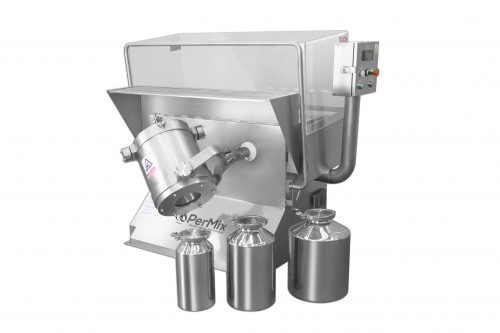
Industrial Mixers
PerMix 3D Mixer
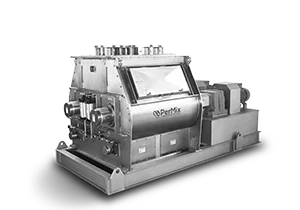
 PerMix 3D Mixer
Best in Innovation • Best In Performance • Best In Quality • Best In Price • Best In Warranty
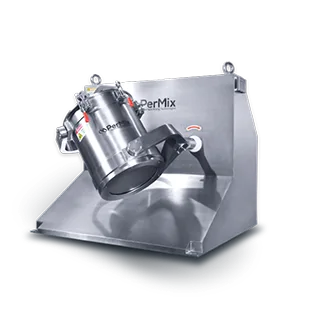
PerMix 3D Mixers or Multi Direction Powder Mixers are used for homogeneous mixing of powdery substances with different specific weights and particle sizes.
Producing dry-to-wet and wet-to-wet mixtures is also possible.
A 3-D mixer—sometimes called a three-dimensional motion mixer—is a tumble-style powder mixer that achieves uniform blending by moving the mixing vessel through simultaneous rotation in multiple axes. Instead of relying on internal agitators or a single tumbling motion, a 3-D mixer continuously reorients the entire batch in space.
The result is exceptionally gentle yet highly effective mixing, even for materials that are prone to segregation in conventional tumble or agitator-driven mixers.
3-D mixers are widely used in pharmaceutical, nutraceutical, specialty food, and advanced material applications where blend homogeneity, particle preservation, and consistency are critical.
During operation:
The mixing vessel rotates around its own axis
Simultaneously, the vessel oscillates and tumbles in additional planes
The powder bed is constantly lifted, redistributed, and reoriented
Particles experience continuous positional change without shear
This true three-dimensional motion prevents particles from settling into repetitive flow paths, which is a common limitation of single-axis tumble mixers.
3-D mixers differ fundamentally from V-blenders and double cone mixers.
They are designed to:
Eliminate fixed tumble patterns
Reduce segregation caused by density or size differences
Achieve homogeneity at lower fill levels
Mix without internal agitators, shear, or heat generation
Rather than relying on gravity alone, 3-D mixers use controlled spatial movement to continuously disrupt particle stratification.
3-D mixers are commonly used for:
Pharmaceutical powders and excipients
Nutraceutical blends
Fine chemicals
Specialty food ingredients
Advanced and high-value powders
They are especially effective for difficult-to-blend formulations that resist uniformity in conventional tumble mixers.
At a high level:
V-blenders use split-and-recombine tumble motion
Double cone mixers use symmetrical tumble motion
Conical mixers use gentle vertical circulation
3-D mixers use continuous multi-axis movement
3-D mixers are often selected when conventional tumble mixers reach their limits but high-shear mixing is undesirable.
Understanding the 3-D mixing principle explains why these mixers:
Achieve excellent uniformity with minimal shear
Reduce segregation in challenging blends
Preserve particle structure
Scale predictably when material properties are controlled
3-D mixers are chosen not for speed, but for blend reliability in demanding formulations.
3-D mixers are selected when exceptional blend uniformity must be achieved without shear, especially in formulations that resist uniform mixing in conventional tumble mixers. They are not brute-force machines; they are precision tools for difficult blends where particle movement—not energy—is the solution.
Knowing when a 3-D mixer is the right choice (and when it is not) prevents over-engineering and ensures predictable results.
A 3-D mixer is typically the correct solution when one or more of the following conditions apply:
Difficult-to-Blend Formulations
Blends with moderate differences in particle size or density that segregate in V-blenders or double cone mixers benefit from continuous multi-axis movement.
High Homogeneity Requirements
Applications demanding extremely tight blend uniformity—often pharmaceutical or high-value materials—are well suited for 3-D mixing.
Shear-Sensitive or Fragile Materials
Because there are no internal agitators, particles are protected from breakage, smearing, or heat generation.
Low Fill Levels or Small Batches
3-D mixers perform effectively across a wider range of fill volumes than traditional tumble mixers.
R&D, Pilot, and Scale-Up Environments
Formulation development benefits from the flexibility and repeatability of true three-dimensional motion.
3-D mixers are commonly chosen for:
Pharmaceutical actives and excipient blends
Nutraceutical formulations
Specialty chemicals
Pigments, colors, and additives
High-value or low-volume products
These applications value uniformity and reliability over speed.
Despite their advantages, 3-D mixers are not universal solutions.
A 3-D mixer may be inefficient or unsuitable when:
Very Large Production Volumes Are Required
3-D mixers are typically used for lab, pilot, and small-to-medium production scales.
Aggressive Liquid Addition Is Required
They are not designed for liquid dispersion or wet mixing.
Granulation or Agglomeration Is Required
3-D mixers do not intentionally form granules.
Highly Cohesive or Sticky Materials Are Processed
Materials that do not flow freely may not redistribute effectively.
Very Short Mixing Times Are Critical
Higher-energy mixers may be better suited for rapid blending.
At a high level:
Choose a V-blender for simple, free-flowing powders
Choose a 3-D mixer when conventional tumble motion produces segregation
Both are low-shear mixers, but the 3-D mixer adds continuous spatial reorientation.
Double cone mixers rely on symmetrical tumbling
3-D mixers disrupt fixed flow paths through multi-axis motion
3-D mixers are often chosen when a double cone mixer achieves partial—but not sufficient—uniformity.
Choosing the correct mixer:
Improves blend consistency
Reduces segregation risk
Protects particle integrity
Simplifies scale-up
Reduces development time and rework
Using a 3-D mixer where higher energy is required—or using a high-energy mixer where gentleness is needed—both lead to compromised results.
PerMix 3-D mixers are engineered to deliver true multi-axis motion with absolute mechanical stability. Unlike simple tumble mixers, a 3-D mixer’s performance depends on the precision of its motion system, structural balance, and vessel integrity. Every design element is focused on repeatable movement, gentle handling, and long service life.
The defining feature of a 3-D mixer is its simultaneous movement in multiple axes.
PerMix 3-D mixers are designed to:
Rotate the vessel around its own axis
Oscillate and tumble the vessel through additional planes
Continuously change particle orientation and flow paths
This eliminates repetitive tumble patterns and prevents particle stratification.
The vessel geometry is optimized for uniform redistribution without dead zones.
Design features include:
Smooth internal contours
Symmetrical shape to support even movement
No internal agitators, blades, or obstructions
This ensures particles move freely as the vessel changes orientation.
Because the vessel moves in multiple planes, balance and rigidity are critical.
PerMix design features include:
Precision-fabricated vessels with tight tolerances
Dynamic balancing of the vessel assembly
Rigid construction to resist fatigue over repeated cycles
Proper balance ensures smooth motion, reduces vibration, and protects bearings and drives.
3-D mixers require carefully synchronized drive systems.
PerMix designs include:
Gear-reduced drives for smooth torque delivery
Precisely engineered linkages or motion arms
Variable frequency drives (VFDs) for speed control
Speed and motion profiles can be adjusted to suit material behavior without introducing shear.
The support structure must withstand continuous multi-directional loads.
PerMix frames are designed with:
Heavy-duty welded construction
Reinforced mounting points
Stable footprint to prevent movement or resonance
This ensures long-term mechanical stability and safe operation.
3-D mixers are commonly used in hygienic and high-purity environments.
Available materials include:
Carbon steel for general industrial use
304 stainless steel for food and non-corrosive applications
316 / 316L stainless steel for pharmaceutical and corrosive environments
Internal surfaces can be polished to reduce adhesion and simplify cleaning.
Efficient loading and unloading are essential for batch consistency.
Design features include:
Secure charging ports or quick-access lids
Centrally located discharge ports
Dust-tight sealing options
Port placement is engineered to avoid disrupting internal movement.
For regulated industries, PerMix offers hygienic 3-D mixer designs.
Features include:
Smooth internal finishes
Continuous welds
Minimal crevices
CIP-ready configurations (where applicable)
These features support validation and rapid changeover.
Every component of a PerMix 3-D mixer supports:
Zero internal shear
Minimal heat generation
Consistent, repeatable blending
Long mechanical service life
This design philosophy ensures reliable performance even for demanding, segregation-prone blends.
PerMix 3-D mixers are deliberately simple at their core, but they can be carefully customized to support specific materials, cleanliness standards, and operating environments—without compromising the fundamental advantage of true multi-axis, low-shear motion.
Every option is engineered to enhance control, not add force.
Many 3-D mixers are used in environments requiring frequent changeovers or strict containment.
Available configurations include:
Fixed vessels for dedicated product lines
Removable vessels for fast changeover and cleaning
Multiple vessels per drive for flexible production scheduling
Removable vessels are especially valuable in pharmaceutical and R&D environments.
3-D mixers are frequently used in hygienic and high-purity applications.
Customization options include:
Carbon steel
304 stainless steel
316 / 316L stainless steel
Polished internal finishes to reduce adhesion and simplify cleaning
Material selection supports corrosion resistance, validation, and long-term durability.
For potent, fine, or hazardous powders, containment is critical.
Available options include:
Dust-tight vessel seals
Inert gas purge capability
Containment-ready vessel designs
O-ring or gasketed closures
These features protect operators and preserve product integrity.
Flexible charging options improve ergonomics and process efficiency.
Available options include:
Manual charging ports
Quick-release lids or clamps
Multiple inlet configurations
Port placement is designed to preserve internal redistribution and avoid dead zones.
Discharge design affects cleanliness and repeatability.
Available discharge options include:
Bottom discharge ports
Side discharge ports
Dust-tight discharge interfaces
Integration with downstream hoppers or containers
Discharge systems are engineered to empty the vessel completely with minimal residue.
PerMix 3-D mixers can be supplied with control systems ranging from basic to advanced.
Available control options include:
Simple start/stop and timer controls
Variable speed control via VFD
PLC and HMI systems with recipe management
Data logging and batch traceability
Automation improves repeatability while preserving gentle mixing action.
Customization options are available to support plant integration.
These include:
Floor-mounted or bench-top designs
Skid-mounted systems
Custom frames for cleanroom or lab environments
Vibration-isolated mounting
These features improve safety, ergonomics, and reliability.
Every option offered on a PerMix 3-D mixer is evaluated against one guiding principle:
Does it preserve true three-dimensional, low-shear motion?
If the answer is yes, it belongs.
If not, a different mixer technology is recommended.
3-D mixers are selected when blend uniformity must be achieved without shear, even as batch size changes. Because 3-D mixers rely on multi-axis motion rather than energy input, their performance scales predictably—provided material behavior and fill discipline are maintained.
PerMix 3-D mixers are engineered so that motion geometry, not brute force, governs mixing performance at every scale.
3-D mixers achieve homogeneity through continuous spatial reorientation of the powder bed.
Performance is governed by:
Multi-axis motion profile
Vessel geometry and symmetry
Batch fill level
Particle flowability
Differences in particle size and density
By constantly changing orientation, particles avoid settling into repetitive flow paths, resulting in highly uniform blends.
3-D mixers typically require moderate mixing times, balancing gentleness with effectiveness.
Performance benefits include:
No particle breakage or attrition
No frictional heat generation
No compaction or smearing
Stable blends that remain uniform after discharge
Mixing time is driven by redistribution, not energy intensity.
Scale-up in 3-D mixers focuses on preserving motion dynamics, not increasing speed.
PerMix scale-up methodology emphasizes:
Maintaining consistent motion geometry
Preserving optimal batch fill percentages
Matching rotational and oscillation speed ratios
Accounting for changes in bulk density
This allows blends developed in lab-scale 3-D mixers to translate directly to pilot and production units.
Fill level plays a critical role in 3-D mixer performance.
Best practices include:
Avoiding overfilling, which restricts internal redistribution
Avoiding underfilling, which reduces particle interaction
Operating within validated working volume ranges
PerMix provides application guidance to ensure optimal fill levels are maintained at all scales.
3-D mixers are particularly effective at controlling segregation.
Design features that support this include:
Constant disruption of gravity-driven settling
Elimination of fixed tumble patterns
Multi-directional particle movement
However, extreme differences in particle size or density should still be addressed upstream.
3-D mixers are not designed for wet mixing, but minor liquid additions may be possible in limited cases.
When used:
Liquid volumes remain small
Addition rates are carefully controlled
Mixing time is adjusted to maintain uniform distribution
These applications are evaluated case by case.
Repeatable performance is achieved through:
Simple vessel design
Stable, synchronized motion
Balanced mechanical construction
Optional automation and recipe timing
This minimizes operator dependency and supports validated processes.
Improper scale-up can result in:
Incomplete blending
Localized segregation
Excessive mixing time adjustments
False conclusions about mixer capability
PerMix 3-D mixers are engineered to avoid these pitfalls by applying proven multi-axis mixing principles from the earliest development stage.
3-D mixers are applied when exceptional homogeneity is required without shear, particularly in blends that resist uniform mixing in conventional tumble or agitator-based mixers. Their continuous multi-axis motion makes them especially valuable for segregation-prone, high-value, or formulation-sensitive materials.
Below are common 3-D mixer workflows across industries.
Primary challenges:
Potency uniformity
Segregation of low-dose actives
Fragile excipients
Validation and containment
Typical workflow:
Particle Size Conditioning
APIs and excipients are milled or classified to controlled size ranges.
3-D Mixing
Powders are blended using multi-axis motion to eliminate stratification.
Optional Removable Vessel Handling
Vessel is transferred for discharge or cleaning.
Downstream Processing
Blends move to encapsulation, tableting, or secondary blending.
Why it works:
True three-dimensional motion prevents actives from migrating or settling, even at low concentrations.
Primary challenges:
Vitamin and mineral segregation
Dust generation
Maintaining label accuracy
Small-to-medium batch flexibility
Typical workflow:
Ingredient Preparation
Powders are screened or lightly milled.
3-D Mixing
Multi-axis motion redistributes ingredients uniformly.
Optional Vessel Exchange
Removable vessels support rapid SKU changeover.
Packaging or Encapsulation
Why it works:
Gentle motion protects sensitive nutrients while improving blend reliability.
Primary challenges:
Density-driven segregation
Fragile crystalline structures
Heat sensitivity
Typical workflow:
Size Conditioning or Classification
Materials are prepared for consistent flow.
3-D Mixing
Powders are blended without attrition or heat generation.
Optional Inert Atmosphere Operation
Why it works:
Continuous spatial reorientation minimizes segregation without mechanical stress.
Primary challenges:
Color consistency
Fine particle segregation
Low dosage accuracy
Typical workflow:
Pre-Blending or Conditioning
Pigments are prepared for dispersion.
3-D Mixing
Multi-axis motion distributes pigments evenly through carriers.
Discharge to Downstream Processing
Why it works:
3-D mixing reduces color streaking and improves batch-to-batch consistency.
Primary challenges:
Fine particle control
Oxidation sensitivity
Small batch precision
Typical workflow:
Micronization or Fine Milling
Materials are prepared to tight specifications.
3-D Mixing
Blending occurs under controlled conditions with minimal stress.
Downstream Processing or Packaging
Why it works:
Low-shear multi-axis motion protects material structure and performance.
Primary challenges:
Repeatability across trials
Predictable scale-up
Frequent formulation changes
Typical workflow:
Lab-Scale 3-D Mixing Trials
Formulations are evaluated for homogeneity.
Pilot-Scale Validation
Motion profiles and fill levels are refined.
Production-Scale Replication
Why it works:
3-D mixers translate reliably from lab to production when motion geometry is preserved.
3-D mixers perform best when:
Segregation risk exists
Shear must be avoided
Uniformity must be achieved through motion, not force
Application-driven workflows result in:
Improved blend reliability
Reduced segregation risk
Easier scale-up
Lower formulation rework
3-D mixers are exceptionally effective at eliminating segregation through motion, but like all low-shear mixing technologies, they depend on disciplined particle preparation upstream. A 3-D mixer will not correct extreme particle size or density disparities—it will faithfully redistribute what it is given.
Understanding when to mill, when to mix, and when to do both is critical to achieving reliable, scalable results with 3-D mixing.
Milling or size conditioning is often required before 3-D mixing to stabilize material behavior.
Milling is typically used to:
Reduce oversized particles that dominate motion paths
Narrow particle size distribution
Improve bulk density alignment between ingredients
Enhance overall flowability
While 3-D motion reduces segregation risk, severe particle mismatch must still be addressed upstream.
3-D mixing solves redistribution challenges that conventional tumble mixers cannot.
3-D mixers are used to:
Blend powders with moderate density or size differences
Prevent stratification during mixing
Achieve high homogeneity at low fill levels
Preserve particle structure
They accomplish this without shear, compression, or heat.
Milling alone may be sufficient when:
Particle size is the final product specification
Only one material is being processed
No blending is required
Examples include:
Fine powders prepared for packaging
Single-material conditioning steps
In these cases, mixing adds no value.
3-D mixing alone is appropriate when:
Particle size distribution is already controlled
Ingredients have manageable density differences
Gentle but effective redistribution is required
Examples include:
Pharmaceutical pre-blends
Nutraceutical formulations
Specialty powder blends prone to segregation in V-blenders
Here, 3-D motion delivers uniformity without added process steps.
Many demanding applications benefit from a combined milling and 3-D mixing approach.
This is recommended when:
Raw materials arrive with variable particle size
Low-dose actives must be evenly distributed
Segregation risk must be minimized
Scale-up repeatability is critical
In these cases:
Milling prepares and stabilizes the powder
3-D mixing ensures uniform redistribution
Each step reinforces the other.
Integrating milling upstream of a 3-D mixer delivers:
Faster achievement of uniformity
Reduced segregation risk during mixing
More predictable scale-up
Shorter development timelines
Improved batch-to-batch consistency
Attempting to rely solely on motion to overcome poor particle preparation often leads to inconsistent results.
PerMix works closely with DP Pulverizers to provide complete milling and 3-D mixing solutions.
DP Pulverizers offers industrial size-reduction technologies including:
Hammer mills
Pin mills
Turbo mills
Air classifier mills
Jet mills
These mills prepare powders for optimal downstream 3-D mixing performance.
Learn more about industrial milling solutions here:
👉 https://www.dpmills.com
PerMix 3-D mixers are engineered around one core principle: true three-dimensional motion must be precise, repeatable, and mechanically disciplined. Many mixers claim “3-D motion,” but only a properly engineered system delivers consistent multi-axis movement without vibration, drift, or product damage.
PerMix builds 3-D mixers for applications where uniformity is non-negotiable and shear is unacceptable.
Some manufacturers label orbital or rocking mixers as “3-D,” even though motion is limited or repetitive.
PerMix 3-D mixers deliver:
Simultaneous rotation, oscillation, and tumbling
Continuously changing motion vectors
No fixed flow paths inside the vessel
This ensures powders never settle into predictable segregation patterns.
In a 3-D mixer, motion accuracy matters more than power.
PerMix advantages include:
Precisely engineered motion arms and linkages
Controlled speed ratios across all axes
Smooth acceleration and deceleration profiles
This allows lab-scale results to translate directly into pilot and production systems without reformulation.
Multi-axis motion introduces complex mechanical loads. Poor design leads to vibration, noise, and premature wear.
PerMix designs feature:
Rigid, reinforced frames
Dynamically balanced vessels
Oversized bearings and drive components
Long-term fatigue resistance
The result is stable motion that protects both product integrity and equipment life.
Some manufacturers introduce internal elements or aggressive motion to “speed things up.”
PerMix 3-D mixers:
Use no internal agitators or blades
Avoid compression, impact, and friction
Generate virtually no heat
Preserve particle shape, size, and surface structure
This is essential for fragile, high-value, and regulated products.
3-D mixers are frequently used in pharmaceutical and high-purity environments.
PerMix designs include:
Smooth internal surfaces
Polished finishes when required
Minimal crevices and clean welds
Removable vessel options for containment
FDA-compliant materials and seals
These features reduce cleaning time and simplify validation.
PerMix does not oversell 3-D mixers.
Customers benefit from:
Clear guidance on when 3-D mixing is appropriate
Honest recommendations when another mixer is better
Integration support with upstream milling and downstream handling
Scale-up support from R&D through production
This protects process outcomes and long-term performance.
Lower-cost 3-D mixers often suffer from:
Inconsistent motion
Vibration and mechanical fatigue
Limited scalability
Incomplete blending
PerMix 3-D mixers deliver:
Predictable, repeatable blending
Long mechanical service life
Stable scale-up behavior
Lower total cost of ownership
3-D mixers are chosen when conventional tumble mixing isn’t enough—but shear is not an option.
PerMix 3-D mixers deliver:
True multi-axis motion
Exceptional blend uniformity
Zero internal shear
Clean, validation-ready construction
Engineering support beyond delivery
That’s why PerMix 3-D mixers are trusted for pharmaceutical, nutraceutical, specialty chemical, advanced material, and high-value powder applications worldwide.
PerMix is here to listen to your needs and provide sustainable solutions. Contact us to discover more.