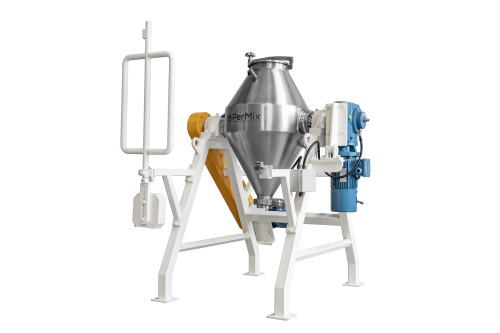
Industrial Mixers
PerMix Double Cone Mixer
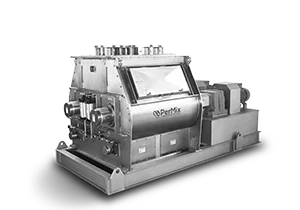
 Double Cone Mixers - Delivering Uniform Blending
Best in Innovation • Best In Performance • Best In Quality • Best In Price • Best In Warranty
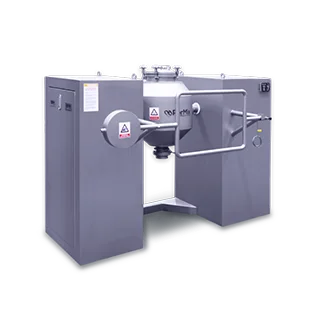
The PerMix Double Cone Mixers, a type of Tumbler Mixers, excel in mixing by continuously rotating, ensuring thorough contact of the mixtures with the internal surfaces of the vessel. This design is ideal for rapid and uniform mixing of free-flowing dry powders, granules, and crystals.
With the simplest structure among all mixers, double cone mixers are featured for low investment, easy operation, efficient discharge without residual, quick cleaning, and simple maintenance.
A double cone mixer is a tumble-style batch mixer designed for gentle, highly uniform dry blending of free-flowing powders and granules. Like a V-blender, it relies on gravity and vessel geometry rather than internal agitation, but uses a single, symmetrical double-cone vessel instead of a split “V” configuration.
The defining advantage of a double cone mixer is its ability to achieve excellent homogeneity with extremely low shear, while offering simple geometry, efficient discharge, and easy cleaning.
Double cone mixers are widely used in pharmaceutical, nutraceutical, food, and specialty chemical applications where particle integrity and blend purity are critical.
During operation:
The double cone vessel rotates around a horizontal axis
Powder gently cascades from one cone section to the other
Particles continuously separate, flow, and recombine
Each rotation increases random particle redistribution
This smooth, uninterrupted tumbling motion produces uniform blending without compression, impact, or heat generation.
Double cone mixers share the low-shear philosophy of V-blenders, but differ in geometry and flow behavior.
They are designed to:
Provide symmetrical tumble mixing
Eliminate internal agitators and shear points
Reduce powder hang-up
Support complete, clean discharge
Simplify cleaning and inspection
The single-vessel geometry often appeals to regulated industries due to its simplicity and cleanliness.
Double cone mixers are commonly used for:
Free-flowing pharmaceutical powders
Fragile granules and crystals
Nutraceutical blends
Specialty food ingredients
Fine chemicals
They perform best when materials have similar particle size and density and do not require aggressive dispersion.
At a high level:
Ribbon mixers emphasize throughput and shear
Paddle mixers provide gentle horizontal blending
Conical mixers provide gentle vertical circulation
V-blenders provide split-and-recombine tumble mixing
Double cone mixers provide symmetrical, low-shear tumble mixing
They are often selected when a simpler internal geometry or cleaner discharge is preferred over a V-shell design.
Understanding the double cone mixing principle explains why these mixers:
Preserve particle structure
Generate virtually no fines
Deliver stable, repeatable blends
Scale reliably when materials are well conditioned
Double cone mixers are chosen not for speed, but for blend integrity and process cleanliness.
Double cone mixers are selected when absolute gentleness, blend purity, and clean geometry are more important than speed or shear. They are especially valued in environments where product integrity, validation, and cleanability drive equipment decisions.
Knowing when a double cone mixer is the right solution—and when it is not—prevents misapplication and protects long-term process performance.
A double cone mixer is typically the correct solution when one or more of the following conditions apply:
Free-Flowing Powders and Granules
Materials that tumble easily benefit from the smooth, uninterrupted flow path of the double cone geometry.
Fragile or Shear-Sensitive Ingredients
Crystals, agglomerates, and friable particles retain their shape because there are no internal agitators or high-energy zones.
Heat-Sensitive Materials
Low rotational speeds generate virtually no frictional heat, protecting thermally sensitive compounds.
Dry Blending with High Purity Requirements
Processes that do not require liquid dispersion, granulation, or densification are ideal candidates.
Regulated and Hygienic Environments
The simple internal geometry supports easy cleaning, inspection, and validation.
Double cone mixers are commonly chosen for:
Pharmaceutical excipients and powder blends
Nutraceutical formulations
Specialty food ingredients
Fine and specialty chemicals
R&D and pilot-scale blending
These applications value repeatability and cleanliness over aggressive mixing action.
Despite their strengths, double cone mixers are not universal solutions.
A double cone mixer may be inefficient or unsuitable when:
Large Differences in Particle Size or Density Exist
Significant disparities increase segregation risk during tumbling.
Liquid Addition Is Required
Double cone mixers are not designed for liquid dispersion unless equipped with an intensifier bar—and even then, capability is limited.
Agglomeration or Granulation Is Required
Tumble mixing does not intentionally form granules or agglomerates.
Cohesive or Poor-Flowing Materials Are Processed
Materials that resist flow may not tumble effectively.
Very Short Mixing Times Are Required
High-throughput applications may favor higher-energy mixer designs.
At a high level:
Choose a double cone mixer for symmetrical tumble mixing, simple geometry, and clean discharge
Choose a V-blender when split-and-recombine flow is preferred
Both are low-shear tumble mixers; the choice often comes down to geometry preference and cleaning philosophy.
Double cone mixers rely on tumble mixing
Conical mixers rely on gentle vertical circulation via a screw
Conical mixers handle wider material variability, while double cone mixers excel with well-conditioned, free-flowing powders.
Choosing the right mixer:
Preserves particle integrity
Prevents fines generation and segregation
Improves batch consistency
Simplifies scale-up
Reduces rework and scrap
Using a tumble mixer where more energy is required often leads to incomplete or unstable blends.
PerMix double cone mixers are engineered to deliver pure tumble mixing with absolute mechanical simplicity. Every design choice—vessel geometry, balance, drive alignment, and surface finish—is focused on uniform blending, clean discharge, and long-term reliability, especially in regulated and high-purity environments.
The defining element of a double cone mixer is its single, symmetrical vessel.
Key design advantages include:
Smooth, uninterrupted tumble path
Symmetrical powder flow between both cone sections
Elimination of dead zones
Predictable, repeatable particle redistribution
The continuous cone-to-cone transition promotes uniform cascading without compression or shear.
Because the entire vessel rotates, precision fabrication is critical.
PerMix design features include:
Tight dimensional tolerances during fabrication
Precision alignment of cone sections
Dynamic balancing of the assembled vessel
Reinforced construction to prevent distortion over time
Proper balance reduces vibration, protects bearings, and preserves gentle mixing behavior.
Double cone mixers are commonly used in hygienic and corrosive environments.
Available materials include:
Carbon steel for general industrial use
304 stainless steel for food and non-corrosive applications
316 / 316L stainless steel for pharmaceutical and corrosive environments
Internal surface finishes can be supplied polished to reduce adhesion and improve cleanability.
Double cone mixers operate at low rotational speeds to preserve particle integrity.
Drive system features include:
Gear-reduced drives for smooth torque delivery
Variable frequency drives (VFDs) for precise speed control
Controlled acceleration and deceleration
Speed control allows operators to optimize tumble behavior without introducing shear.
The rotating vessel is supported by heavy-duty trunnions and bearings.
PerMix design considerations include:
Oversized bearings for long service life
Bearing isolation from the product zone
Rigid support frames to prevent deflection
This construction ensures stable operation and minimal maintenance over time.
Proper access supports safe operation and efficient cleaning.
Available features include:
Manway or quick-access charging ports
Multiple inlet configurations
Sight ports for visual inspection
Port placement is designed to avoid disrupting internal tumble dynamics.
Discharge geometry plays a critical role in maintaining blend integrity.
Common discharge options include:
Flush-mounted discharge valves
Butterfly or slide gate valves
Dust-tight discharge connections
The cone geometry promotes complete discharge with minimal residue and reduced re-segregation risk.
When limited de-agglomeration or minor liquid addition is required, PerMix can integrate an intensifier bar.
Key characteristics:
Independently driven
Used intermittently
Positioned to minimize disruption of tumble mixing
This option expands capability while preserving low-shear operation.
For food, nutraceutical, and pharmaceutical applications, PerMix offers hygienic double cone mixer designs.
Features include:
Smooth internal surfaces
Continuous welds
Minimal crevices
CIP-ready configurations (where required)
These features reduce cleaning time and support validation.
Every PerMix double cone mixer is engineered to deliver:
Zero internal shear
Minimal heat generation
Consistent blend quality
Long mechanical life
This makes double cone mixers a trusted solution when product purity and simplicity matter most.
PerMix double cone mixers are intentionally simple at their core, but they can be strategically customized to support specific materials, cleanliness requirements, and production workflows—without compromising the fundamental low-shear tumble mixing principle.
Every option is evaluated against one rule: it must preserve gentle, symmetrical tumbling.
When dry powders contain soft agglomerates or when limited liquid addition is required, an intensifier bar can be integrated.
Key characteristics include:
Independently driven high-speed chopper
Used intermittently, not continuously
Designed to break soft lumps or assist light coating
Positioned to minimize disruption of tumble flow
This option expands capability while maintaining the mixer’s low-shear nature.
Double cone mixers are not intended for wet mixing, but small, controlled liquid additions can be supported.
Available configurations include:
Spray nozzles used in conjunction with intensifier bars
Metered dosing pumps for precise liquid introduction
Staged addition during vessel rotation
These systems are ideal for light coating or minor binder addition—not granulation or aggressive wetting.
Double cone mixers are frequently used in hygienic and regulated industries.
Customization options include:
Carbon steel
304 stainless steel
316 / 316L stainless steel
Polished internal finishes to reduce adhesion and improve cleanability
Material selection supports corrosion resistance, hygiene, and long-term durability.
Discharge design directly affects cleanliness and blend integrity.
Available discharge options include:
Flush-bottom discharge valves
Butterfly or slide gate valves
Dust-tight discharge connections
Integration with downstream hoppers or conveyors
Proper discharge geometry minimizes hang-up and reduces re-segregation risk.
Flexible charging improves safety and ergonomics.
Available options include:
Manual or automated charging ports
Quick-access manways
Multiple inlet locations for ingredient staging
Port placement is engineered to maintain symmetrical internal flow.
PerMix double cone mixers can be supplied with a range of control systems.
Options include:
Basic timer-based controls
Variable speed control via VFD
PLC and HMI systems with recipe management
Data logging and batch traceability
Automation improves repeatability without introducing complexity to the mixing action.
Customization options are available to support plant integration.
These include:
Floor-mounted or platform-mounted designs
Load cells for batch weighing
Skid-mounted systems
Custom support frames and access platforms
These features improve operational efficiency and safety.
For fine or potent powders, containment options are available.
Options include:
Dust-tight seals
Inert gas purge capability
Enclosed discharge interfaces
These features protect both operators and product quality.
Every option offered on a PerMix double cone mixer supports one objective:
Maintain gentle, symmetrical tumble mixing with maximum cleanliness and reliability.
If a process requires more energy, a different mixer technology is recommended.
Double cone mixers are chosen when blend purity and particle preservation must remain consistent from small R&D batches through full-scale production. Because they rely on **geometry and gravity—not shear—**their performance scales predictably when material properties are respected and process discipline is maintained.
PerMix double cone mixers are engineered to preserve identical tumble behavior across sizes, eliminating surprises during scale-up.
Double cone mixers achieve homogeneity through symmetrical, randomized particle redistribution.
Performance is governed by:
Vessel geometry and symmetry
Rotational speed
Batch fill level
Powder flowability
Similarity in particle size and density
When these factors are aligned, double cone mixers deliver highly uniform blends with no particle damage.
Double cone mixers typically operate with longer mixing times than high-energy mixers—and this is intentional.
Performance benefits include:
No particle breakage or attrition
No frictional heat generation
No compaction or smearing
Stable blends that remain uniform after discharge
Extended mixing time does not degrade the product, making double cone mixers ideal for fragile or high-value materials.
Scale-up for double cone mixers focuses on preserving tumble dynamics, not increasing energy input.
PerMix scale-up methodology emphasizes:
Maintaining consistent cone geometry ratios
Preserving optimal batch fill percentages
Matching rotational speed ranges
Ensuring similar material flow behavior
This allows blends developed in lab-scale units to translate directly to pilot and production-scale mixers.
Fill level is one of the most critical performance variables in double cone mixers.
Best practices include:
Avoiding overfilling, which restricts cascading motion
Avoiding underfilling, which reduces particle interaction
Operating within recommended working volume ranges
PerMix provides application guidance to ensure proper fill levels are maintained at all scales.
When correctly applied, double cone mixers do not induce segregation.
Design features that support this include:
Symmetrical tumble paths
Gentle cascading motion
Absence of centrifugal forces
However, scale-up success depends on particle similarity. Significant density or size differences should be addressed upstream.
For mixers equipped with intensifier bars:
Liquid addition remains controlled and localized
Scale-up focuses on proportional liquid flow rates
Intensifier use remains intermittent
These systems scale reliably when used for light coating or de-agglomeration—not wet mixing or granulation.
Repeatable performance is achieved through:
Simple, robust mechanical design
Stable low-speed rotation
Balanced vessel construction
Optional automation and recipe timing
This minimizes operator variability and supports validated processes.
Improper scale-up can lead to:
Incomplete blending
Localized segregation
Excessive mixing time adjustments
Misinterpretation of mixer capability
PerMix double cone mixers are engineered to eliminate these risks by applying proven tumble-mixing principles from the earliest development stage.
Double cone mixers are applied when blend purity, gentle handling, and clean geometry are essential to product quality. Their symmetrical tumble action makes them especially effective in regulated industries and applications where materials are well conditioned and particle damage cannot be tolerated.
Below are common double cone mixer workflows across industries.
Primary challenges:
Potency uniformity
Fragile excipients
Segregation control
Validation and cleanability
Typical workflow:
Particle Size Conditioning
APIs and excipients are milled or classified to similar size and density.
Double Cone Mixing
Powders are gently tumble-mixed to achieve uniform potency.
Optional Intensifier Bar Use
Used briefly to break soft agglomerates if required.
Discharge to Downstream Processing
Blends move to encapsulation, tableting, or secondary blending.
Why it works:
Symmetrical tumbling delivers uniform blends without heat or shear, supporting validated pharmaceutical processes.
Primary challenges:
Uniform distribution of vitamins and minerals
Dust control
Protecting sensitive ingredients
Frequent SKU changeovers
Typical workflow:
Ingredient Preparation
Powders are screened or lightly milled.
Double Cone Mixing
Ingredients are blended gently without degradation.
Optional Light Liquid Coating
Oils or functional additives added using an intensifier bar (when equipped).
Packaging or Encapsulation
Why it works:
Low-shear tumble mixing preserves nutrient integrity and blend stability.
Primary challenges:
Fragile crystals, flakes, or inclusions
Maintaining appearance and texture
Allergen changeover and cleaning
Typical workflow:
Raw Ingredient Conditioning
Ingredients are prepared for consistent flow.
Double Cone Mixing
Spices, seasonings, sweeteners, or powders are gently blended.
Discharge & Packaging
Why it works:
Tumble mixing avoids fines generation and preserves visual and functional quality.
Primary challenges:
Particle breakage
Heat sensitivity
Density-driven segregation
Typical workflow:
Size Classification or Conditioning
Materials are prepared for uniform flow.
Double Cone Mixing
Powders are blended evenly without inducing attrition.
Optional Inert Atmosphere Operation
Why it works:
Gravity-driven mixing minimizes mechanical stress on sensitive particles.
Primary challenges:
Predictable scale-up
Repeatability between trials
Process development flexibility
Typical workflow:
Lab-Scale Double Cone Trials
Initial blend uniformity is established.
Pilot-Scale Validation
Mixing parameters are refined.
Production-Scale Replication
Why it works:
Double cone mixers scale reliably when particle properties are maintained.
Primary challenges:
Fast cleaning and changeover
Cross-contamination prevention
Flexible batch sizes
Typical workflow:
Ingredient Staging
Double Cone Mixing
Rapid Discharge & Cleaning
Next SKU Changeover
Why it works:
Simple internal geometry enables efficient cleaning and consistent results.
Double cone mixers perform best when:
Particle size and density are controlled upstream
The process is designed for dry blending
Gentle mixing is required, not a limitation
Application-driven workflows result in:
Stable blend uniformity
Reduced fines and dust
Easier scale-up
Lower rework rates
Double cone mixers deliver exceptionally gentle, symmetrical tumble mixing, but they are also highly dependent on upstream material preparation. Like all tumble mixers, a double cone mixer will not correct particle size problems—it will faithfully preserve them.
Understanding when to mill, when to mix, and when both are required is essential to achieving uniform, repeatable results.
Milling or size conditioning is often required before double cone mixing to ensure stable tumbling and uniform redistribution.
Milling is typically used to:
Reduce oversized particles that interrupt smooth tumbling
Narrow particle size distribution
Align bulk density between ingredients
Improve powder flowability
Because double cone mixers rely entirely on gravity-driven motion, particle similarity is critical.
Double cone mixing focuses on uniform redistribution without shear or compression.
Double cone mixers are used to:
Homogenize free-flowing powders and granules
Preserve fragile particle structure
Avoid fines generation
Maintain blend purity and appearance
They do this without internal agitators, heat generation, or impact forces.
Milling alone may be sufficient when:
Particle size is the final product specification
Only one material is being processed
No blending or coating is required
Examples include:
Size-conditioned excipients
Standalone powder preparation
Pre-processed raw materials
In these cases, a mixer may not be required.
Double cone mixing alone is appropriate when:
All ingredients have similar particle size and density
Powders are free-flowing
Only dry blending is required
Examples include:
Pharmaceutical pre-blends
Nutraceutical carrier blends
Specialty food powders
Here, the double cone mixer delivers excellent uniformity with minimal complexity.
Many real-world applications benefit from a combined milling and double cone mixing approach.
This is recommended when:
Raw materials arrive with variable particle size
Fine actives must be blended with larger carriers
Segregation risk must be minimized
Scale-up repeatability is required
In these cases:
Milling prepares the material
Double cone mixing preserves structure while achieving homogeneity
Each step supports the other.
Integrating milling upstream of a double cone mixer delivers:
Faster achievement of uniformity
Reduced segregation during tumbling
Shorter overall blending times
More predictable scale-up
Improved batch-to-batch consistency
Trying to force a tumble mixer to overcome poor particle size control almost always results in inconsistent blends.
PerMix works closely with DP Pulverizers to provide complete milling and double cone mixing solutions.
DP Pulverizers offers industrial size-reduction technologies including:
Hammer mills
Pin mills
Turbo mills
Air classifier mills
Jet mills
These mills prepare powders for optimal downstream double cone mixing performance.
Learn more about industrial milling solutions here:
👉 https://www.dpmills.com
Understanding when to mill, when to mix, and when to do both:
Protects fragile materials
Prevents segregation
Improves blend repeatability
Simplifies scale-up
Reduces rework and scrap
Double cone mixers reward disciplined process design and punish shortcuts.
PerMix double cone mixers are engineered around a simple but unforgiving truth: tumble mixing only works when geometry, balance, and discipline are correct. While many double cone mixers look similar on paper, real-world performance is defined by execution—not appearance.
PerMix builds double cone mixers to deliver repeatable purity, gentle handling, and long-term reliability, especially in regulated and high-value applications.
Double cone mixers succeed or fail based on geometry. Poor cone angles or misalignment create dead zones and inconsistent tumbling.
PerMix double cone mixers feature:
Precisely engineered cone angles for consistent cascading
Symmetrical vessel design to promote uniform redistribution
Consistent geometry across lab, pilot, and production sizes
This ensures scale-up without reformulation or performance drift.
Many competitors compromise tumble mixing with unnecessary internal features or poor discharge design.
PerMix double cone mixers:
Use no internal agitators unless explicitly specified
Avoid compression, impact, and friction
Generate virtually no heat
Preserve particle size, shape, and surface structure
The result is pure blending, exactly as tumble mixing is intended.
Because the entire vessel rotates, mechanical integrity is critical.
PerMix advantages include:
Precision-balanced vessels
Oversized trunnions and bearings
Rigid, vibration-resistant support frames
Smooth acceleration and deceleration control
This protects sensitive blends, extends bearing life, and ensures stable operation over decades—not just years.
Where some manufacturers oversell intensifier bars, PerMix treats them as support tools, not core mixing mechanisms.
PerMix designs ensure:
Intensifiers are optional, not mandatory
Used intermittently, not continuously
Positioned to minimize disruption of tumble flow
This preserves the low-shear advantage while expanding flexibility responsibly.
Double cone mixers are often selected for regulated industries—and PerMix designs accordingly.
Features include:
Polished internal surfaces
Smooth, continuous welds
Minimal crevices
CIP-ready configurations (when required)
FDA-compliant seals and elastomers
These details shorten cleaning cycles, simplify validation, and reduce compliance risk.
PerMix does not force double cone mixers into applications they shouldn’t serve.
Customers benefit from:
Honest recommendations on material suitability
Guidance when another mixer technology is a better choice
Integration support with upstream milling and downstream handling
Scale-up support from R&D through production
This prevents misapplication and protects long-term process performance.
Lower-cost double cone mixers often lead to:
Incomplete blending
Segregation during discharge
Excessive mixing times
Mechanical vibration and premature wear
PerMix double cone mixers deliver:
Predictable blend quality
Long mechanical service life
Stable scale-up
Lower total cost of ownership
Double cone mixers are chosen when blend purity, simplicity, and gentleness define success.
PerMix double cone mixers deliver:
True low-shear tumble mixing
Exceptional uniformity
Clean, validation-ready design
Predictable scale-up
Engineering support beyond delivery
That is why manufacturers choose PerMix when fragile powders, regulated products, and uncompromising quality are non-negotiable.
PerMix is here to listen to your needs and provide sustainable solutions. Contact us to discover more.
PerMix Double Cone Mixer Videos