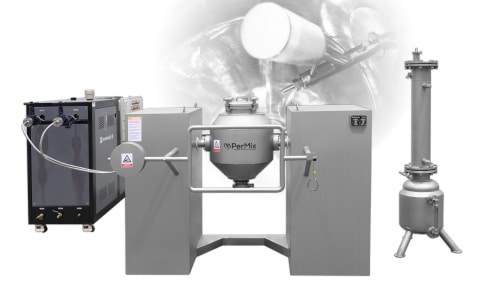
Industrial Mixers
PerMix Vacuum Mixer & Dryer
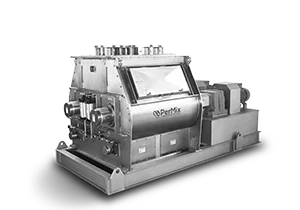
 PerMix Vacuum Mixer and Dryer - Vacuum Mixing and Vacuum Mixers
Best in Innovation • Best In Performance • Best In Quality • Best In Price • Best In Warranty
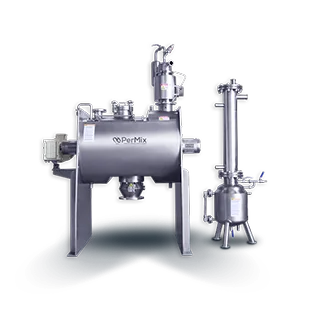
The PerMix series of Vacuum Mixers & Mixers/ Dryers are turbulent mixing reactor-dryers. It is used as a high-speed mixer dryer, chemical reactor or, if both processes are combined, as a dryer-reactor.
Vacuum mixers & dryers are batch processing systems that combine mixing, vacuum drying, and optional heating or cooling in a single, sealed vessel. Instead of transferring material between separate machines, vacuum mixers allow manufacturers to mix powders and liquids, remove moisture or solvents, and condition the product under controlled vacuum—all in one system.
At PerMix, vacuum mixing and drying is not a standalone product—it is a configurable capability that can be applied across nearly all PerMix powder mixer platforms, including:
Ribbon mixers
Paddle mixers (horizontal & vertical)
Plow mixers
Conical screw mixers
Double cone mixers
V-blenders
3-D mixers
This allows manufacturers to select the ideal mixing mechanism and add vacuum drying without compromising process performance.
Vacuum mixers & dryers operate by combining three controlled forces:
Mechanical Mixing
The selected mixer type provides uniform blending of powders, liquids, or pastes.
Vacuum Environment
Reduced pressure lowers the boiling point of water or solvents, allowing evaporation at lower temperatures.
Thermal Control (Optional)
Heating or cooling jackets accelerate drying or protect heat-sensitive materials.
Under vacuum, moisture or solvent is removed gently and efficiently, preserving product integrity while shortening processing time.
Vacuum fundamentally alters how materials behave during processing.
Key effects include:
Faster evaporation at lower temperatures
Reduced oxidation and thermal degradation
Improved drying uniformity
Enhanced solvent recovery
Reduced processing steps
This makes vacuum mixing and drying especially valuable for heat-sensitive, hygroscopic, or regulated materials.
Unlike suppliers that limit vacuum drying to one mixer type, PerMix designs vacuum capability as a system option.
This means manufacturers can:
Choose the optimal mixer for their material behavior
Add vacuum drying without changing mixing mechanics
Scale from lab to production using the same principles
Combine mixing, drying, and conditioning in one vessel
The result is process flexibility without compromise.
Vacuum mixer/dryers are commonly used to:
Mix powders with liquid binders or solvents
Dry wet powders or slurries
Remove residual moisture after washing or coating
Recover solvents under controlled conditions
Prevent oxidation during processing
Reduce product handling and contamination risk
All while maintaining full control over temperature, pressure, and mixing action.
Vacuum mixers & dryers are often misunderstood as a single machine type.
In reality, they are a processing configuration that transforms how powders are mixed, dried, and handled—when applied correctly to the right mixer design.
Understanding this distinction is critical to:
Selecting the correct mixer platform
Avoiding over- or under-engineering
Achieving consistent, scalable results
Vacuum mixers & dryers are chosen when atmospheric mixing and drying simply cannot deliver the required product quality, efficiency, or control. By lowering pressure inside the vessel, manufacturers fundamentally change how heat, moisture, solvents, and oxygen interact with the product.
The result is better product quality, shorter processing times, and fewer processing steps—all while protecting sensitive materials.
Under vacuum, the boiling point of water and solvents drops dramatically.
This allows manufacturers to:
Dry products at significantly lower temperatures
Protect heat-sensitive actives, flavors, nutrients, and APIs
Prevent thermal degradation and discoloration
Maintain functional performance of the final product
This is one of the most important advantages of vacuum drying.
Vacuum accelerates mass transfer.
Key benefits include:
Faster evaporation compared to atmospheric drying
More uniform drying throughout the batch
Reduced risk of overdrying or hot spots
Shorter overall cycle times
This improves throughput without increasing mechanical stress.
Removing air from the vessel dramatically reduces oxygen exposure.
This helps:
Prevent oxidation of sensitive compounds
Preserve color, flavor, aroma, and potency
Extend shelf life
Improve batch-to-batch consistency
For many food, nutraceutical, pharmaceutical, and chemical products, this alone justifies vacuum processing.
Vacuum mixers & dryers eliminate unnecessary transfers.
A single vessel can:
Mix dry powders
Add liquids or binders
Dry the wet mass
Cool the product
Condition it under inert or vacuum conditions
Fewer transfers mean:
Less contamination risk
Less product loss
Less cleaning and downtime
Simpler validation
Hygroscopic powders absorb moisture rapidly from ambient air.
Vacuum processing allows manufacturers to:
Dry and condition materials in a sealed environment
Prevent re-absorption of moisture
Maintain consistent bulk density and flowability
This is critical for powders that must remain stable after drying.
For applications involving solvents:
Vacuum lowers solvent boiling points
Vapors can be condensed and recovered
Emissions are reduced
Regulatory compliance is simplified
This improves sustainability while reducing operating costs.
Vacuum does not replace mixing—it enhances it.
When combined with the correct mixer type:
Drying remains uniform
Agglomeration can be controlled
Product integrity is preserved
Mechanical stress stays low
This makes vacuum drying suitable even for fragile materials.
Atmospheric mixers and dryers often struggle with:
Long drying times
High temperatures
Oxidation damage
Uneven moisture removal
Multiple processing steps
Vacuum processing solves these limitations at the source.
Vacuum mixers & dryers operate by synchronizing mixing mechanics, pressure reduction, and heat transfer inside a sealed vessel. The system is designed so that each variable—mixing, temperature, and vacuum—can be controlled independently, allowing precise tuning for different materials and formulations.
This is not simply “mixing under vacuum.” It is a controlled thermodynamic process.
The process begins in a fully sealed mixing vessel.
Key characteristics:
Airtight construction
Vacuum-rated seals and ports
Isolated bearings and drives
Controlled inlet and discharge points
Once sealed, the vessel becomes a closed processing system—critical for drying efficiency, oxidation control, and solvent recovery.
The selected mixer type provides the mechanical action.
Depending on configuration, this may include:
Convection (ribbon mixers)
Gentle circulation (paddle or conical mixers)
High-energy dispersion (plow mixers with choppers)
Tumble mixing (V-blenders, double cone, 3-D mixers)
The key is that vacuum does not change the mixing principle—it enhances it by improving heat and mass transfer.
Once mixing begins, vacuum is applied.
Under reduced pressure:
The boiling point of moisture or solvent drops
Evaporation begins at lower temperatures
Vapor moves rapidly from the product surface
Vacuum level can be:
Mild (for conditioning or de-aeration)
Moderate (for drying)
High (for sensitive or solvent-based applications)
Pressure is adjusted based on material behavior—not a fixed value.
For drying applications, heating is typically applied via:
Vessel jackets
Hollow shafts or screws (on certain mixer types)
Heating raises the vapor pressure of moisture or solvents, while vacuum lowers their boiling point—a highly efficient combination.
Key advantages:
Lower product temperatures
Uniform heat distribution
Faster drying cycles
Reduced risk of degradation
Cooling can also be applied at the end of the cycle to stabilize the product.
As moisture or solvent evaporates:
Vapors are drawn out of the vessel
Directed to a condenser or recovery system
Condensed into liquid for disposal or reuse
This step:
Prevents re-condensation in the vessel
Enables solvent recovery
Protects the vacuum system
Proper vapor handling is essential for efficiency and compliance.
Drying does not end arbitrarily.
End-point determination may include:
Time-based control
Temperature stabilization
Pressure behavior analysis
Residual moisture testing
Once drying is complete, the product may be:
Cooled under vacuum
Conditioned under inert gas
Discharged directly to packaging or downstream processing
All without exposure to ambient air.
Because mixing, vacuum, and heat are coordinated:
Drying is uniform throughout the batch
Agglomeration can be controlled
Overdrying is avoided
Product quality is preserved
This level of control is impossible with standalone mixers or dryers.
Vacuum capability is not a one-size-fits-all feature. The mixing mechanism determines how heat, vacuum, and mass transfer interact with the material. One of the defining advantages of PerMix is that nearly every powder mixer platform can be configured as a vacuum mixer & dryer, allowing manufacturers to match vacuum processing to the right mixing physics.
Below is how vacuum integration works across mixer types—and when each configuration is best used.
Best for:
Free-flowing to moderately cohesive powders, large batch sizes, efficient convection
How vacuum works here:
Horizontal ribbons provide strong axial and radial circulation
Vacuum accelerates moisture or solvent removal from the moving powder bed
Heating jackets supply uniform thermal input
Advantages:
Fast drying for large batches
Excellent temperature control
Good balance of throughput and gentleness
Typical applications:
Food ingredients, chemicals, polymers, mineral powders, detergents
Best for:
Fragile, heat-sensitive, or moderately variable materials
How vacuum works here:
Low-speed paddles gently lift and circulate material
Vacuum removes moisture without particle damage
Heating remains controlled and even
Advantages:
Low shear with active circulation
Reduced fines and compaction
Broad batch size flexibility
Typical applications:
Nutraceuticals, specialty foods, agricultural products, sensitive chemicals
Best for:
Cohesive materials, wet masses, fast dispersion, granulation, high evaporation rates
How vacuum works here:
Plow tools create a mechanically fluidized zone
Choppers (when used) break agglomerates
Vacuum dramatically increases evaporation rate
Advantages:
Extremely fast drying
Excellent for wet or sticky products
High heat and mass transfer efficiency
Typical applications:
Pharmaceutical intermediates, catalysts, pigments, battery materials, wet granules
Best for:
Gentle drying, wide batch range, shear-sensitive or segregative powders
How vacuum works here:
Slow-moving screw lifts material upward
Gravity returns it downward along the vessel wall
Vacuum removes moisture uniformly with minimal agitation
Advantages:
Very low shear
Excellent for fragile particles
Scales well from lab to production
Typical applications:
Pharmaceutical APIs, nutraceuticals, fine chemicals, specialty powders
Best for:
Free-flowing powders requiring extremely gentle handling
How vacuum works here:
Tumble motion redistributes material
Vacuum drying occurs at low temperature
Heating is applied through the vessel wall
Advantages:
Zero internal shear
Simple geometry and easy cleaning
Ideal for high-purity materials
Typical applications:
Pharmaceutical pre-blends, specialty chemicals, fragile powders
Best for:
Dry blends with controlled particle size and density
How vacuum works here:
Split-and-recombine tumbling
Vacuum removes residual moisture gently
Intensifier bars may assist light wetting or de-agglomeration
Advantages:
Extremely gentle drying
Preserves particle structure
Clean and validation-friendly
Typical applications:
Pharma excipients, nutraceutical blends, specialty foods
Best for:
Segregation-prone, high-value, or formulation-sensitive powders
How vacuum works here:
Multi-axis motion continuously reorients the batch
Vacuum drying occurs evenly throughout the material
Minimal mechanical stress
Advantages:
Excellent uniformity during drying
Very low shear
Ideal for difficult blends
Typical applications:
Pharmaceutical actives, pigments, advanced materials, R&D formulations
Vacuum enhances drying—but it does not change material physics.
Choosing the correct mixer:
Improves drying uniformity
Prevents agglomeration or segregation
Reduces cycle time
Protects product integrity
Choosing the wrong one leads to:
Long drying times
Hot spots or overdrying
Mechanical damage
Inconsistent results
PerMix’s strength is offering vacuum capability across mixer platforms, not forcing a single solution.
Vacuum mixers & dryers demand a higher level of mechanical, thermal, and sealing discipline than atmospheric mixers. Every component must perform reliably under reduced pressure, elevated temperature, and continuous mechanical movement—often simultaneously.
PerMix vacuum mixer & dryer systems are engineered from the ground up to operate as true vacuum-rated process vessels, not retrofitted mixers.
The vessel is the heart of any vacuum system.
PerMix vacuum mixer vessels are designed with:
Reinforced wall thickness to withstand external pressure
Fully welded, leak-tested construction
Rounded internal geometry to eliminate stress points
Structural rigidity to prevent deformation under vacuum
This ensures long-term integrity and consistent vacuum performance.
Vacuum performance is only as good as the sealing system.
PerMix designs include:
Vacuum-rated shaft seals
Bearing isolation from the product zone
Optional double seals with purge capability
High-quality elastomers compatible with temperature and solvents
These features prevent air ingress, protect bearings, and maintain stable vacuum levels throughout the cycle.
Efficient heat transfer is critical for vacuum drying.
PerMix offers multiple jacket configurations:
Full-coverage heating and cooling jackets
Steam, hot water, thermal oil, or glycol service
Zoned jackets for precise temperature control
Jackets are engineered to provide uniform heat transfer without hot spots, enabling faster drying at lower product temperatures.
For certain mixer types, additional heat transfer surfaces are available:
Hollow shafts
Heated screws (conical mixers)
Heated paddles or plows
These options increase heat transfer area and reduce drying time—especially for cohesive or wet materials.
A complete vacuum mixer & dryer is a system, not just a vessel.
PerMix integrates:
Vacuum pumps sized for process requirements
Condensers for vapor removal and solvent recovery
Knock-out pots or recovery tanks
Valves and controls for staged vacuum operation
Proper integration ensures stable pressure, efficient vapor removal, and protection of the vacuum pump.
For solvent-based applications, vapor handling is critical.
PerMix systems can include:
Shell-and-tube or plate condensers
Temperature-controlled condensation
Solvent recovery tanks
Closed-loop vapor handling
This improves sustainability, reduces emissions, and supports regulatory compliance.
Vacuum drying requires precise monitoring.
Typical instrumentation includes:
Pressure sensors
Product and jacket temperature sensors
Vacuum level control
PLC/HMI systems with recipe management
This allows repeatable, validated drying cycles.
Discharge design must preserve product quality after drying.
PerMix vacuum mixers & dryers offer:
Bottom or side discharge valves
Discharge under vacuum or inert gas
Cooling before discharge to prevent condensation
This ensures dried material remains stable and free-flowing.
For regulated or hazardous environments, PerMix offers:
GMP-compliant construction
Polished internal finishes
FDA-compliant materials
ATEX-rated designs (where required)
These features support pharmaceutical, nutraceutical, and chemical processing standards.
Poorly designed vacuum mixers often suffer from:
Air leaks
Inconsistent drying
Long cycle times
Seal and bearing failures
PerMix vacuum mixer & dryer construction eliminates these issues through engineering discipline, not add-ons.
Vacuum mixers & dryers are selected not just for product quality—but for predictable performance as processes move from lab to pilot to full production. Because vacuum fundamentally changes heat and mass transfer, scale-up must be approached with process discipline, not simple geometric assumptions.
PerMix vacuum mixer & dryer systems are engineered so that drying behavior scales as reliably as mixing behavior.
Vacuum performance is governed by the interaction of four variables:
Mixing efficiency
Vacuum level (pressure)
Heat transfer rate
Vapor removal capacity
When these are balanced, vacuum drying becomes uniform, gentle, and repeatable—even for difficult materials.
Vacuum drying typically delivers:
Shorter drying cycles than atmospheric systems
Lower product temperatures
More uniform moisture removal
However, drying time does not scale linearly with batch size.
Key influences include:
Surface area exposed during mixing
Internal heat transfer surfaces
Product porosity and moisture binding
Vapor evacuation efficiency
PerMix systems are sized to maintain drying efficiency as batch volume increases.
Scale-up under vacuum focuses on maintaining thermodynamic similarity, not simply increasing vessel size.
PerMix scale-up methodology emphasizes:
Preserving mixing mechanics (same mixer type)
Maintaining heat flux per unit mass
Matching vacuum levels and pressure profiles
Scaling condenser and vacuum pump capacity appropriately
This ensures lab results translate to production without extended trial-and-error.
Vacuum mixer & dryer performance is highly sensitive to fill level.
Best practices include:
Operating within validated working volume ranges
Avoiding overfilling, which limits surface exposure
Avoiding underfilling, which reduces thermal efficiency
PerMix provides guidance to define optimal batch size for both mixing and drying performance.
Heat input must scale with moisture or solvent load—not just vessel size.
PerMix addresses this through:
Proper jacket surface area scaling
Optional internal heating elements
Zoned temperature control
This prevents slow drying, overheating, or non-uniform moisture profiles.
Vacuum pumps and condensers must be scaled correctly.
Improper scaling leads to:
Vapor bottlenecks
Re-condensation inside the vessel
Inconsistent pressure levels
Longer cycle times
PerMix systems are engineered as complete vacuum processes, not isolated components.
Repeatable vacuum drying is achieved through:
Stable vacuum control
Consistent mixing action
Precise temperature regulation
Recipe-driven PLC control
This minimizes operator variability and supports validated production.
Improperly scaled vacuum systems often result in:
Longer drying times than expected
Product degradation
Excessive energy consumption
Failed process validation
PerMix vacuum mixer & dryer systems are engineered to remove uncertainty from scale-up, protecting both timelines and capital investment.
Vacuum mixers & dryers are applied when mixing and drying must be controlled as a single, integrated process. They are chosen not just for efficiency, but to protect product quality, simplify validation, and eliminate unnecessary transfers between machines.
Below are common real-world workflows where vacuum mixing and drying delivers clear advantages.
Primary challenges:
Heat-sensitive actives
Solvent removal
Oxidation control
GMP compliance and validation
Typical workflow:
Wet Charging or Liquid Addition
Solvents, binders, or wash liquids are introduced during mixing.
Vacuum Mixing
Uniform distribution of liquids across the powder bed.
Vacuum Drying
Solvents removed at low temperature under controlled pressure.
Cooling & Conditioning
Product cooled under vacuum or inert gas.
Closed Discharge
Material discharged without exposure to ambient air.
Why it works:
Low-temperature drying preserves API integrity while reducing solvent handling steps.
Primary challenges:
Moisture control
Oxidation of vitamins and botanicals
Product stability and shelf life
Typical workflow:
Dry Powder Mixing
Light Liquid Addition (oils, extracts, binders)
Vacuum Drying & Conditioning
Cooling Before Packaging
Why it works:
Vacuum prevents oxidation and moisture re-absorption, protecting potency and appearance.
Primary challenges:
Flavor and aroma preservation
Hygroscopic materials
Microbial control
Consistent moisture content
Typical workflow:
Ingredient Blending
Vacuum Drying or Moisture Reduction
Cooling & Stabilization
Discharge to Packaging
Why it works:
Lower drying temperatures protect flavor compounds and reduce discoloration.
Primary challenges:
Solvent recovery
Heat sensitivity
Emission control
Typical workflow:
Reaction or Wet Mixing
Vacuum Solvent Removal
Condensation & Recovery
Final Conditioning
Why it works:
Vacuum accelerates solvent removal while enabling closed-loop recovery.
Primary challenges:
Agglomeration during drying
Uniform moisture removal
Particle integrity
Typical workflow:
Wet Mixing or Coating
Vacuum Drying with Active Mixing
Controlled Cooling
Why it works:
Simultaneous mixing and drying prevent hard agglomerate formation.
Primary challenges:
Solvent removal
Oxygen sensitivity
Moisture control
Typical workflow:
Wet Slurry or Binder Mixing
Vacuum Drying
Inert Conditioning
Closed Discharge
Why it works:
Vacuum drying under inert conditions protects material chemistry and performance.
Primary challenges:
Predictable scale-up
Flexible processing
Process development
Typical workflow:
Lab-Scale Vacuum Trials
Pilot-Scale Optimization
Production Replication
Why it works:
Vacuum systems scale reliably when thermodynamic principles are preserved.
Vacuum mixers & dryers perform best when:
Mixing and drying are treated as one process
Material sensitivity is respected
Heat, pressure, and motion are controlled together
Application-specific workflows result in:
Higher product quality
Shorter cycle times
Fewer processing steps
Reduced contamination risk
Vacuum mixers & dryers sit at the intersection of three core powder-processing functions: size reduction, blending, and moisture or solvent removal. The mistake many manufacturers make is treating these as independent steps. In reality, they are deeply interdependent, especially under vacuum.
Understanding when to mill, when to mix, when to dry—and when to do all three in one integrated system is the difference between a stable process and a constant troubleshooting exercise.
Milling addresses particle size, surface area, and flow behavior before vacuum processing begins.
Milling is typically required when:
Raw materials arrive oversized or inconsistent
Surface area must be increased for faster drying
Particle size must be controlled for downstream blending
Agglomerates must be reduced before wetting or drying
Under vacuum, milling indirectly affects:
Drying rate
Heat transfer efficiency
Uniformity of moisture removal
Poor particle size control upstream almost always results in uneven drying downstream.
Mixing is what makes vacuum drying uniform rather than localized.
Mixing under vacuum solves:
Uneven moisture or solvent distribution
Hot spots during heating
Agglomeration during drying
Inconsistent final moisture content
The correct mixing mechanism ensures that every particle sees the same pressure, temperature, and residence time.
Vacuum drying addresses limitations atmospheric systems cannot overcome.
Vacuum drying is essential when:
Low-temperature drying is required
Oxidation must be avoided
Solvents must be removed efficiently
Hygroscopic materials must be stabilized
Closed processing is required for safety or compliance
Vacuum drying is not a replacement for mixing—it depends on it.
Milling alone may be sufficient when:
Particle size is the only requirement
No liquid is added
Moisture content is already acceptable
Only a single material is being processed
In these cases, adding vacuum adds cost without benefit.
Mixing alone is appropriate when:
Materials are dry and stable
No moisture or solvent removal is required
Atmospheric exposure is acceptable
Vacuum adds no value if drying or oxygen control is not needed.
This is where vacuum mixer & dryers excel.
Typical scenarios include:
Wet powder blending followed by drying
Coating powders with liquids and removing carriers
Washing solids and removing residual moisture
Conditioning hygroscopic materials
Here, mixing and vacuum drying must be engineered together.
This is the highest-value vacuum application.
All three are required when:
Raw materials vary in size and moisture
Liquids are added intentionally or inherently present
Final moisture must be tightly controlled
Scale-up repeatability is critical
In these systems:
Milling prepares the material
Mixing distributes energy, heat, and moisture
Vacuum drying completes the process gently and uniformly
Trying to remove any one of these steps usually increases cycle time, scrap, or rework.
Integrated vacuum processing delivers:
Shorter total process time
Fewer transfers and contamination points
Better moisture uniformity
Lower energy consumption
Easier validation and scale-up
This is why advanced manufacturers design the process first—and the equipment second.
PerMix does not sell “a vacuum dryer.”
PerMix provides:
The correct mixer for the material
Vacuum capability engineered into the system
Heating, cooling, and vapor handling sized for the process
Integration with upstream milling where required
This prevents over-engineering while eliminating performance gaps.
Vacuum processing is not a single machine choice—it is a process strategy.
The most successful systems:
Use milling only where it adds value
Use mixing to control heat and mass transfer
Use vacuum to remove moisture or solvents efficiently
Combine all three when the material demands it
PerMix vacuum mixers & dryers are designed to support this entire decision spectrum, from simple conditioning to fully integrated mixing-drying systems.
PerMix vacuum mixers & dryers are engineered with a fundamentally different mindset: vacuum is not an accessory—it is a core process condition. Many suppliers retrofit vacuum capability onto standard mixers. PerMix designs vacuum operation into the mixer, the vessel, and the process itself.
The difference shows up in drying consistency, cycle time, scalability, and long-term reliability.
Many “vacuum mixer” offerings are simply:
Atmospheric mixers with thicker lids
Undersized vacuum ports
Generic seals not designed for continuous vacuum
Inadequate vapor handling
PerMix vacuum systems are engineered as complete vacuum processes, including:
Vacuum-rated vessels
Proper sealing and bearing isolation
Integrated condensers and recovery
Correctly sized pumps and piping
This ensures stable vacuum levels throughout the entire cycle—not just at startup.
Most manufacturers restrict vacuum drying to one mixer style, forcing customers to compromise on mixing physics.
PerMix allows vacuum configuration across:
Ribbon mixers
Paddle mixers (horizontal & vertical)
Plow mixers
Conical screw mixers
V-blenders
Double cone mixers
3-D mixers
This means:
The material dictates the mixer, not the vendor
Drying performance improves because mixing physics are correct
Scale-up remains predictable
This flexibility is rare—and decisive.
Drying under vacuum is only as effective as the heat transfer system.
PerMix designs feature:
Full-coverage jackets sized for moisture load
Optional internal heating surfaces where appropriate
Uniform temperature distribution
Precise control over heating and cooling rates
Many competing systems struggle with:
Long drying times
Hot spots
Overheated product surfaces
PerMix systems dry faster, cooler, and more uniformly.
Vacuum drying fails when vapor removal fails.
PerMix systems include:
Properly sized condensers
Knock-out pots or recovery tanks
Controlled vapor flow paths
Protection of vacuum pumps
This prevents:
Re-condensation in the vessel
Pump contamination
Pressure instability
Competitors often treat vapor handling as optional. PerMix treats it as mandatory.
Vacuum exposes weaknesses fast.
PerMix designs address this with:
Vacuum-rated shaft seals
Optional double seals with purge
Bearings isolated from the product zone
Materials compatible with heat, solvents, and pressure cycling
This results in:
Longer seal life
Lower maintenance
Consistent vacuum performance year after year
Many vacuum systems perform well in the lab—and fail in production.
PerMix vacuum systems are engineered to scale by:
Preserving mixing mechanics
Scaling heat flux correctly
Matching vacuum levels and pressure profiles
Upsizing condensers and pumps appropriately
This prevents the most common scale-up failures:
Drying times doubling unexpectedly
Product degradation
Failed validation runs
PerMix does not sell vacuum where it adds no value.
Customers benefit from:
Clear guidance on when vacuum is necessary
Recommendations when atmospheric processing is sufficient
Selection of the correct mixer platform first
Integration with upstream milling where required
This protects both process outcomes and capital budgets.
Lower-cost vacuum mixer & dryers often lead to:
Long drying cycles
Inconsistent moisture levels
High maintenance
Limited scalability
PerMix vacuum mixers & dryers deliver:
Shorter cycle times
Better product quality
Reliable scale-up
Long mechanical life
Lower total cost of ownership
Vacuum mixers & dryers are chosen when process control, product integrity, and efficiency matter more than shortcuts.
PerMix vacuum systems deliver:
True vacuum-rated construction
Correct mixer selection for the material
Efficient low-temperature drying
Integrated vapor handling
Predictable lab-to-production scale-up
That’s why manufacturers choose PerMix when vacuum processing is mission-critical, not optional.
PerMix is here to listen to your needs and provide sustainable solutions. Contact us to discover more.
PerMix Vacuum Mixer & Dryer Videos