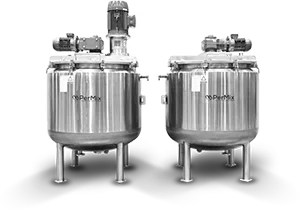
Low inclusion rates (sometimes <1%, sometimes ppm-level with potent compounds)
That combination triggers four classic failure mechanisms:
1) Segregation (the silent assassin) Even if you achieve a great blend inside the mixer, segregation can happen:
during transfer (vacuum conveying, gravity drops)
during discharge (funnel flow vs mass flow)
during bin filling (particle percolation and air entrainment)
during vibration (equipment, forklifts, packaging machines)
2) Agglomeration (fake uniformity) Fine APIs can “look” blended while remaining as micro-clusters. Those clusters become content-uniformity failures when sampled.
“hidden hold-up” that contaminates the next batch or steals yield
4) Over-shear / under-shear (Goldilocks energy problem) Too much energy: attrition, heat, PSD shift, possible polymorph risk for sensitive materials. Too little energy: hot spots, agglomerates survive, CV doesn’t converge.
The API Mixing Workflow (Done Properly)
Step 1: Raw Material Conditioning
Before mixing even begins, many plants:
de-lump APIs (sieve or gentle deagglomeration)
control humidity (static control + flow consistency)
manage temperature (some APIs are moisture/heat sensitive)
PerMix approach: choosing mixer type and options based on whether the powder is cohesive, segregative, fragile, or abrasive—because “powder” is not one material. It’s a behavior.
Step 2: Charging Strategy (How You Load Matters as Much as How You Mix)
Bad charging causes immediate stratification:
dumping API on top → it floats and smears
adding API early into high-flow excipients → it gets buried and never disperses
vacuum loading without controls → API fines deposit in lines and filters
Best-practice charging methods include:
geometric dilution (API first blended into a “pre-blend” excipient fraction)
split charging (API introduced in multiple additions)
vacuum loading with dust-safe filtration and controlled inlet design
PerMix can support these strategies through inlet placement, loading accessories, and designs that reduce dead zones and deposition.
Step 3: Mixing Phase (Particle Engagement, Not Just Bulk Circulation)
This is the core truth: API uniformity requires particle-level interaction, not just moving a pile.
Why legacy mixers struggle
Ribbon mixers are powerful but can create preferential flow paths and dead zones—especially with cohesive APIs.
Tumble blenders are gentle but often slow and sensitive to fill level and PSD mismatch; liquid addition can be tricky.
How PerMix answers with the right mixing physics
Fluidized Zone Mixing (when the formulation tends to segregate or includes low-dose actives) Instead of relying on gravity circulation alone, fluidized-zone designs keep the powder bed continuously reoriented. This helps:
keep light and heavy fractions engaged
reduce density-driven stratification
break weak agglomerates gently
converge CV faster and more reliably
Paddle / Plow Mixing with Intensification (when you need controlled shear + fast convergence) For blends that need deagglomeration without overworking the entire batch, PerMix integrates:
choppers / intensifiers positioned to target clusters
adjustable speeds to dial energy input
options for liquid dispersion where required
Step 4: Liquid Addition (If Applicable): The “Wet Spot” Trap
Some pharma processes require binders, granulation liquids, or functional coating solutions. The #1 mistake is adding liquid as a stream.
Proper liquid addition requires:
atomization (fine droplets)
correct nozzle placement (into active mixing zone, not a dead pocket)
rate control (avoid overwetting and secondary agglomeration)
synchronization (liquid addition + mixing energy profile)
PerMix designs can incorporate spray manifolds and control-friendly systems so “liquid addition” becomes engineered—not improvised.
Step 5: Discharge and Transfer (Where Great Blends Go to Die)
Even perfect in-mixer uniformity can be destroyed by discharge.
Key discharge risks:
ratholing and funnel flow
segregation in downspouts
sifting segregation during vibration
product hold-up that contaminates the next batch
PerMix design focus:
discharge geometry that supports consistent flow
options that reduce hold-up zones
cleaning-aware outlet designs (because discharge is also a cleaning hotspot)
Validation, Sampling, and Why “It Looked Fine” Isn’t a Spec
API mixing performance is measured with:
content uniformity testing
blend uniformity sampling plans
CV targets (especially for low-dose actives)
sometimes PAT tools (process analytical technology) depending on plant strategy
But equipment matters because:
dead zones create hidden failure modes
inconsistent hold-up breaks repeatability
poor cleanability increases cross-contamination risk and downtime
Which brings us to the part most plants feel in their bones: cleaning.
Cleaning Pharmaceutical Mixers: Wet CIP, Dry CIP, and Hybrid Strategies
Cleaning is not “maintenance.” In GMP pharma, cleaning is a validated manufacturing step with compliance implications.
PerMix supports multiple cleaning philosophies depending on:
product toxicity/potency
solubility characteristics
allergen/cross-contamination requirements
available utilities (water, steam, air, vacuum)
turnaround time expectations
1) Wet CIP (Clean-in-Place): When You Need Washdown Certainty
Wet CIP uses water (often with detergent) delivered through spray devices to remove residues.
Where wet CIP shines
sticky residues
water-soluble products
products that require sanitization
facilities standardized on wash validation methods
What makes wet CIP succeed
Wet CIP is only as good as coverage + drainability. A “CIP system” that can’t hit shadow areas is just a confidence machine.
PerMix CIP engineering typically focuses on:
spray device placement and coverage of the full internal envelope
cleaning access to shafts, seals, outlet, and intensifier housings
drain design to prevent pooling
surface finishes that reduce adhesion and speed rinse
Real-world constraints
Wet CIP consumes:
water
effluent handling capacity
time for drying (which becomes a microbial/validation concern in some environments)
So wet CIP is powerful—but not always the fastest path back to production.
2) Dry CIP: When Downtime and Utilities Matter
Dry CIP uses directed air (and/or vacuum-assisted) systems to dislodge and evacuate powder residues without water.
Where dry CIP shines
dry powders that are non-sticky
rapid product changeovers
plants trying to reduce wastewater and downtime
products that clump or degrade with moisture
operations where “wet cleaning” creates drying bottlenecks
PerMix dry CIP advances (the practical version):
strategically placed air nozzles to hit typical build-up zones
air + vacuum logic to remove loosened fines rather than just re-suspending them
designs that avoid “dust traps” and ledges
Dry CIP isn’t just a blower. The trick is to move residues out of the machine, not into the air.
3) Hybrid Cleaning (Dry + Wet): The Fastest Path to Control
This is often the best of both worlds.
A hybrid strategy typically works like:
Dry CIP first to remove bulk powder hold-up quickly (reduces what wet CIP must dissolve)
Wet CIP second for final residue removal, sanitization, and validated endpoint
Optional drying/air purge to return the mixer to service faster
Benefits:
less water usage than full wet CIP alone
faster turnaround than wet-only cleaning
reduced effluent load
better control over residues that are partly soluble and partly adherent
In practice, hybrid cleaning can be a major productivity lever, especially in multi-SKU operations.
PerMix Easy-Clean Mixer Options (Designed for Reality)
Even the best CIP system can’t compensate for a mixer full of crevices.
Easy-Clean is about removing the places residue likes to hide:
simplified internal geometry
reduced ledges and shadow zones
clean-friendly shaft and seal arrangements
faster access to internal tools (intensifiers/choppers) depending on configuration
surfaces and weld practices aimed at cleanability and repeatability
In a pharma setting, Easy-Clean design translates to:
less manual intervention
shorter cleaning cycles
more reliable verification (visual + swab)
reduced cross-contamination risk
higher uptime and more predictable scheduling
Putting It Together: How PerMix Answers the Full API Mixing + Cleaning Problem
PerMix positions API mixing not as a single machine purchase, but as a complete system outcome:
Outcome targets:
reliable low-dose homogeneity
controlled energy input (no overworking)
repeatable discharge behavior
minimized hold-up and dusting
cleanability engineered into the geometry
CIP strategies aligned with your plant constraints (wet, dry, hybrid)
reduced downtime between SKUs
Because the real KPI isn’t “does it mix.” The KPI is validated batches per week, with minimal deviation risk, and fast, documented changeovers.
To provide the best experiences, we use technologies like cookies to store and/or access device information. Consenting to these technologies will allow us to process data such as browsing behavior or unique IDs on this site. Not consenting or withdrawing consent, may adversely affect certain features and functions.
Functional
Always active
The technical storage or access is strictly necessary for the legitimate purpose of enabling the use of a specific service explicitly requested by the subscriber or user, or for the sole purpose of carrying out the transmission of a communication over an electronic communications network.
Preferences
The technical storage or access is necessary for the legitimate purpose of storing preferences that are not requested by the subscriber or user.
Statistics
The technical storage or access that is used exclusively for statistical purposes.The technical storage or access that is used exclusively for anonymous statistical purposes. Without a subpoena, voluntary compliance on the part of your Internet Service Provider, or additional records from a third party, information stored or retrieved for this purpose alone cannot usually be used to identify you.
Marketing
The technical storage or access is required to create user profiles to send advertising, or to track the user on a website or across several websites for similar marketing purposes.