Industrial Mixers
PerMix Applications
Advanced Ceramic & Geopolymer Powder Mixing: How Modern Mixing Technology is Transforming High-Performance Materials Manufacturing
For centuries, ceramics were relatively simple materials. Clay, silica, and mineral powders were blended together, shaped, and fired to produce bricks, tiles, and pottery. Mixing these materials was often straightforward because the powders behaved similarly in terms of density, particle size, and flow characteristics.
But the modern ceramics industry looks very different.
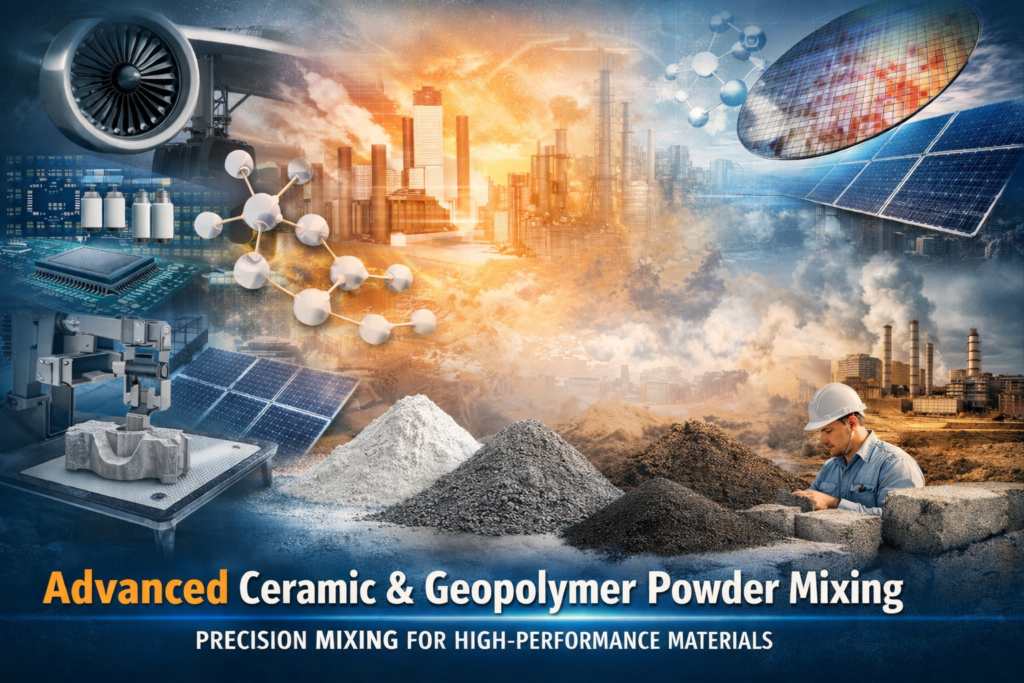
Today’s manufacturers are producing engineered ceramics, advanced powder materials, and geopolymer formulations that power some of the most demanding technologies in the world—from aerospace components and semiconductor manufacturing to advanced batteries, additive manufacturing, and next-generation construction materials.
As these materials have evolved, so have the complexities of mixing them. The difference between blending traditional ceramic powders and mixing modern high-performance materials is profound. Understanding that difference is the first step toward achieving consistent product quality and performance.
This is where advanced mixing technology from PerMix is redefining what is possible in powder processing.
Traditional ceramics typically consist of relatively simple mineral systems. Common examples include:
These powders often share similar particle sizes, densities, and flow properties, which makes them easier to blend using basic mixing technologies.
Historically, equipment such as V-blenders and tumble mixers has been widely used in these applications. These machines operate through simple tumbling motion, allowing powders to cascade and divide repeatedly.
For simple ceramic systems, this type of blending can work reasonably well because the powders behave similarly during processing.
However, modern materials have dramatically changed the equation.
Today’s advanced ceramics are highly engineered materials designed to deliver precise mechanical, thermal, electrical, or chemical properties. These materials include:
Unlike traditional ceramics, engineered ceramic formulations often contain multiple components with very different characteristics.
A single formulation may combine:
Each component can vary significantly in:
These differences create significant challenges during mixing.
Powders naturally tend to segregate rather than mix, especially when particle sizes or densities differ. Heavy particles settle downward, fine particles migrate upward, and cohesive powders form agglomerates.
In high-performance ceramics, even small inconsistencies in powder distribution can affect sintering behavior, strength, electrical properties, and final product reliability.
Another rapidly growing category of advanced materials is geopolymers.
Geopolymer powders are typically composed of reactive aluminosilicate materials such as:
These powders are later activated using alkaline solutions to produce materials with ceramic-like structures and exceptional performance characteristics.
Geopolymers are gaining global attention as:
From a powder processing perspective, geopolymer formulations share many of the same challenges as engineered ceramics.
They frequently contain powders with widely different densities, particle sizes, and reactivity levels, which must be blended with high precision before activation.
If these powders are not mixed properly, the consequences can include:
As geopolymer technology scales from laboratory research to industrial production, advanced powder mixing becomes essential.
Many facilities still rely on V-blenders for ceramic powder blending.
While these machines are useful for simple materials, they rely entirely on gravity-driven tumbling motion. There is no mechanical agitation to actively disperse powders or break apart agglomerates.
This creates several limitations when working with engineered ceramics or geopolymer powders:
In these cases, the equipment may create the appearance of mixing while the powders are actually layering or separating within the vessel.
For advanced materials manufacturing, this can result in inconsistent product quality and performance.
To address these challenges, PerMix has developed Fluidized Zone Mixing technology, designed specifically for complex powder systems.
Rather than relying solely on gravity, these mixers create a mechanically energized mixing environment where powders are continuously lifted, dispersed, and redistributed.
This creates a fluidized mixing zone, where particles behave more like a dynamic flowing mass rather than separate layers.
Within this mixing environment:
This three-dimensional mixing action produces rapid and highly reliable homogenization, even for complex engineered materials.
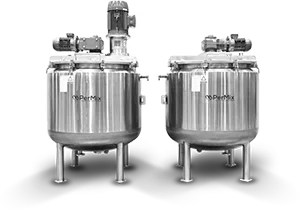
Among the most effective solutions for advanced powder processing is the PerMix Vertical PAM Series Mixer.
The vertical configuration creates strong axial circulation of powders, continuously lifting materials upward and redistributing them throughout the mixing chamber. At the same time, the mixing elements generate radial dispersion, ensuring every particle repeatedly enters the active mixing zone.
This combination produces a powerful three-dimensional mixing pattern that:
For manufacturers producing engineered ceramics, geopolymer powders, battery materials, and additive manufacturing feedstocks, this level of mixing performance is essential.
Advanced powder mixing technologies are becoming increasingly important across a wide range of industries, including:
In these industries, precise powder preparation directly determines the performance of the final product.
As materials science continues to evolve, powder processing technologies must evolve alongside it.
PerMix has positioned itself at the forefront of this transformation by engineering mixing systems specifically designed for complex powder materials and next-generation ceramic technologies.
From engineered ceramics and semiconductor powders to geopolymer materials and additive manufacturing feedstocks, PerMix mixers provide the precision, efficiency, and reliability required for modern advanced materials production.
In today’s world of high-performance materials, mixing is no longer just a processing step—it is the foundation of product performance.
And this is exactly where PerMix leads the industry.
Stay Connected