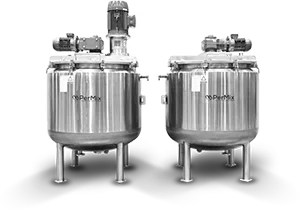
At its core, dry water is not just a product—it is a process-driven innovation.
And that process begins with mixing.
What is Dry Water? (Technical Overview)
Dry water is a powdered dispersion of microscopic water droplets, where each droplet is encapsulated by a layer of hydrophobic (water-repelling) silica nanoparticles.
Behavior: Free-flowing powder with high surface area
Stability: Prevents coalescence of water droplets
Mechanism of Stability:
The hydrophobic silica forms a physical barrier around each droplet, creating a liquid-in-solid dispersion. This prevents droplets from merging and reverting to bulk liquid.
This structure results in:
Extremely high interfacial surface area
Enhanced gas absorption capability
Unique rheological and flow properties
Industrial Applications of Dry Water
Dry water is gaining traction across high-value industries where surface area, encapsulation, and controlled interaction are critical.
1. Carbon Capture & Gas Storage
Dry water can absorb gases such as CO₂ and methane more efficiently than traditional liquids due to its high surface area.
Enhanced gas-liquid interaction
Potential for methane hydrate formation
Applications in energy storage and emissions control
2. Pharmaceutical & Nutraceutical Processing
Encapsulation of active ingredients
Controlled release formulations
Stabilization of moisture-sensitive compounds
3. Food & Flavor Technology
Protection of volatile compounds
Improved dispersion of liquid flavors into powders
Stabilization of emulsions
4. Advanced Materials & Nanotechnology
Functional powders
Reactive surface systems
Carrier systems for catalysts or additives
How Dry Water is Manufactured: A Process Engineering Perspective
Dry water production is not a simple blending operation—it is a highly controlled particle engineering process.
Critical Process Objectives:
Create uniform droplet size distribution
Achieve complete silica coating of each droplet
Prevent agglomeration or coalescence
Maintain flowability and stability
Step-by-Step Process Breakdown
1. Controlled Liquid Introduction
Water is introduced into a high-energy mixing environment under controlled flow rates to ensure proper droplet formation.
2. High-Shear Dispersion
Mechanical energy is applied to break the liquid into micron-scale droplets.
Shear intensity directly impacts droplet size
Uniform energy distribution is critical
3. Hydrophobic Silica Addition
Silica particles are introduced and dispersed simultaneously.
Must achieve rapid and uniform distribution
Surface coverage must be complete to prevent droplet merging
4. Particle Coating & Stabilization
Silica particles adhere to the droplet surface, forming a protective shell.
This step defines final product stability
Insufficient coating leads to collapse into liquid
5. Powder Conditioning & Discharge
Final product must maintain:
Free-flowing characteristics
Minimal agglomeration
Consistent particle size distribution
Key Engineering Challenges
Manufacturers attempting dry water production often encounter:
1. Droplet Coalescence
Insufficient shear or poor silica dispersion leads to merging droplets → loss of powder form.
2. Agglomeration
Over-wetting or uneven coating results in clumping and poor flowability.
3. Inconsistent Particle Size Distribution
Leads to unstable product performance and reduced efficiency in applications.
4. Poor Silica Dispersion
Creates incomplete encapsulation and product instability.
Why Mixing Technology Determines Success
Dry water is fundamentally a mixing-limited process.
Success depends on the ability to:
Generate consistent shear fields
Distribute solids and liquids simultaneously
Maintain a fluidized, high-energy mixing zone
Control residence time and energy input
This is where standard mixers fail—and where engineered solutions are required.
How PerMix Solves Dry Water Processing Challenges
PerMix brings a process-driven approach to advanced material manufacturing, with mixing technologies specifically designed for particle engineering and encapsulation.
To provide the best experiences, we use technologies like cookies to store and/or access device information. Consenting to these technologies will allow us to process data such as browsing behavior or unique IDs on this site. Not consenting or withdrawing consent, may adversely affect certain features and functions.
Functional
Always active
The technical storage or access is strictly necessary for the legitimate purpose of enabling the use of a specific service explicitly requested by the subscriber or user, or for the sole purpose of carrying out the transmission of a communication over an electronic communications network.
Preferences
The technical storage or access is necessary for the legitimate purpose of storing preferences that are not requested by the subscriber or user.
Statistics
The technical storage or access that is used exclusively for statistical purposes.The technical storage or access that is used exclusively for anonymous statistical purposes. Without a subpoena, voluntary compliance on the part of your Internet Service Provider, or additional records from a third party, information stored or retrieved for this purpose alone cannot usually be used to identify you.
Marketing
The technical storage or access is required to create user profiles to send advertising, or to track the user on a website or across several websites for similar marketing purposes.