Industrial Mixers
PerMix Applications
THE HOLY GRAIL OF PROTEIN POWDER MIXING
The challenge in mixing protein powder manufacturing is not blending.
It is achieving absolute uniformity in complex, enriched formulations.
Today’s protein powders are engineered systems made up of ingredients with dramatically different:
From whey protein and plant proteins to cocoa, creatine, vitamins, enzymes, and flavor systems, each component behaves differently during mixing.
This creates a fundamental problem:
Segregation.
Heavy materials settle.
Light materials rise.
Micro-ingredients cluster.
The result is inconsistent flavor, poor solubility, and failure to meet label claims.
WHY TRADITIONAL MIXING APPROACHES FALL SHORT
Most conventional mixers rely on gravity and passive movement.
They cannot overcome:
For standard blends, this may be acceptable.
For enriched protein formulations, it is not.
THE APPLICATION SOLUTION: CONTROLLED FLUIDIZATION
The breakthrough in protein powder mixing comes from changing how particles behave during the process.
Instead of tumbling or dragging powders, the system must create a dynamic environment where:
This is the principle of fluidized zone mixing.
In this state, powders behave like a fluid, eliminating the natural tendency to segregate.
WHAT THIS MEANS FOR PROTEIN FORMULATIONS
When applied correctly, this approach delivers:
This is not incremental improvement.
This is a step change in process capability.
APPLICATION BREAKDOWN: WHAT IS ACTUALLY BEING MIXED
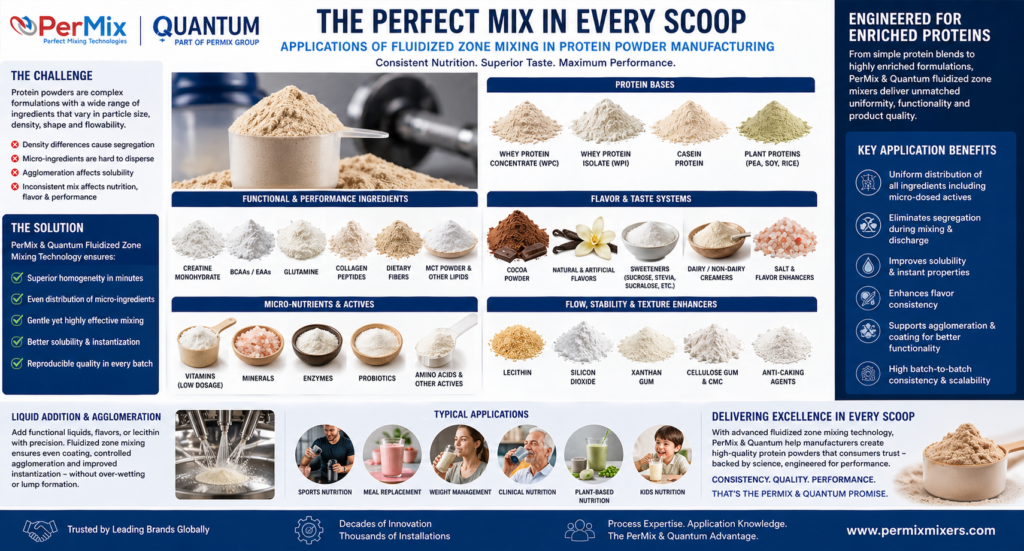
Protein powder systems typically include:
Base Proteins
Whey protein concentrate, whey isolate, casein, and plant-based proteins
Functional Ingredients
Creatine, BCAAs, EAAs, collagen, fibers, and performance additives
Flavor and Taste Systems
Cocoa, natural and artificial flavors, sweeteners, and salts
Micro-Nutrients and Actives
Vitamins, minerals, enzymes, probiotics, and amino acids at very low inclusion rates
Flow and Stability Enhancers
Lecithin, silicon dioxide, gums, and anti-caking agents
Liquid Additions
Flavor oils, lecithin sprays, and functional liquids for instantization
Each of these behaves differently under mixing conditions.
That is where most systems fail.
THE CRITICAL ADVANTAGE: LIQUID ADDITION AND AGGLOMERATION
Modern protein powders are not just blended.
They are engineered for performance.
Liquid addition plays a critical role in:
Without proper mixing dynamics, liquid addition leads to:
In a fluidized mixing environment, liquids are evenly distributed across moving particles, enabling precise coating and controlled agglomeration without defects.
THE RESULT: A PERFECT MIX IN EVERY SCOOP
When the process is engineered correctly, manufacturers achieve:
This is what defines best-in-class protein powder manufacturing today.
PERMIX & QUANTUM: DEFINING THE STANDARD
At PerMix and Quantum, the focus is not on selling mixers.
It is on solving the application.
Through advanced fluidized zone mixing technology, we help manufacturers:
This is why leading brands in sports nutrition, nutraceuticals, and functional foods are moving toward engineered mixing solutions.
Stay Connected