Industrial Mixers
PerMix Applications
Application: Mixing SLES Into Cosmetics
Sodium Laureth Sulfate (SLES) is one of the most widely used surfactants in cosmetic and personal care manufacturing. It is the primary foaming and cleansing agent in:
While SLES delivers excellent performance for consumers, it presents significant engineering challenges during production.
Understanding how to mix SLES properly is critical to achieving clarity, viscosity control, production efficiency, and direct-to-filler processing without extended deaeration time.
SLES is an anionic surfactant. In simple terms, it is a molecule with a hydrophilic (water-loving) head and a hydrophobic (oil-attracting) tail. This dual structure allows it to reduce surface tension, create foam, and encapsulate oils and dirt in micelles so they can be rinsed away.
It is preferred in cosmetics because it offers:
However, that same surface tension reduction that creates luxurious foam also makes SLES extremely prone to entrapping air during mixing.
SLES systems can easily become over-aerated if mixed incorrectly.
Excess air in cosmetic production leads to:
Traditional top-entry high-speed agitation often creates vortexing, which pulls air directly into the batch.
More speed does not mean better mixing. In surfactant systems, excessive turbulence creates instability.
Efficient SLES processing requires controlled shear, closed addition systems, and air management.
The base tank should use controlled, low-vortex agitation such as:
The goal is turnover without vortex formation.
A recirculation loop allows controlled dispersion without surface disruption. The return should be positioned below liquid level to prevent air reintroduction.
Inline rotor-stator or dynamic inline mixers allow:
This eliminates open-top dumping and uncontrolled turbulence.
SLES viscosity follows a salt curve. Adding sodium chloride too quickly or under high shear can cause foaming and instability.
Precision dosing during recirculation ensures viscosity targets are achieved without entrapping air.
For manufacturers who want to move directly from mixing to filling, vacuum-capable systems allow rapid degassing.
Removing air under vacuum stabilizes clarity, density, and pumpability.
A properly engineered SLES mixing system should deliver:
In cosmetic manufacturing, stability equals profitability.
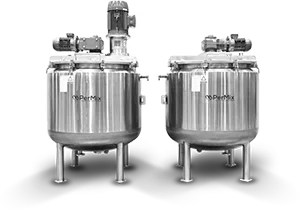
PerMix designs mixing systems specifically engineered for surfactant behavior.
Our solutions include:
Designed for deaeration and immediate filling operations.
Controlled shear, low-air induction, scalable performance.
Cosmetic-grade stainless steel fabrication with hygienic design.
From pilot and R&D to full industrial production.
Recirculation loops, metered dosing systems, temperature control, and automation options.
Matching mixing intensity to product rheology.
PerMix does not treat SLES like water.
We engineer systems around surfactant chemistry.
In cosmetics, foam should appear when the consumer uses the product — not during manufacturing.
With the correct engineering approach, SLES can be mixed efficiently, deaerated quickly, and filled immediately, increasing throughput while maintaining product clarity and stability.
When chemistry meets controlled engineering, cosmetic production becomes predictable.
And predictable processes scale.
Stay Connected