Industrial Mixers
PerMix Applications
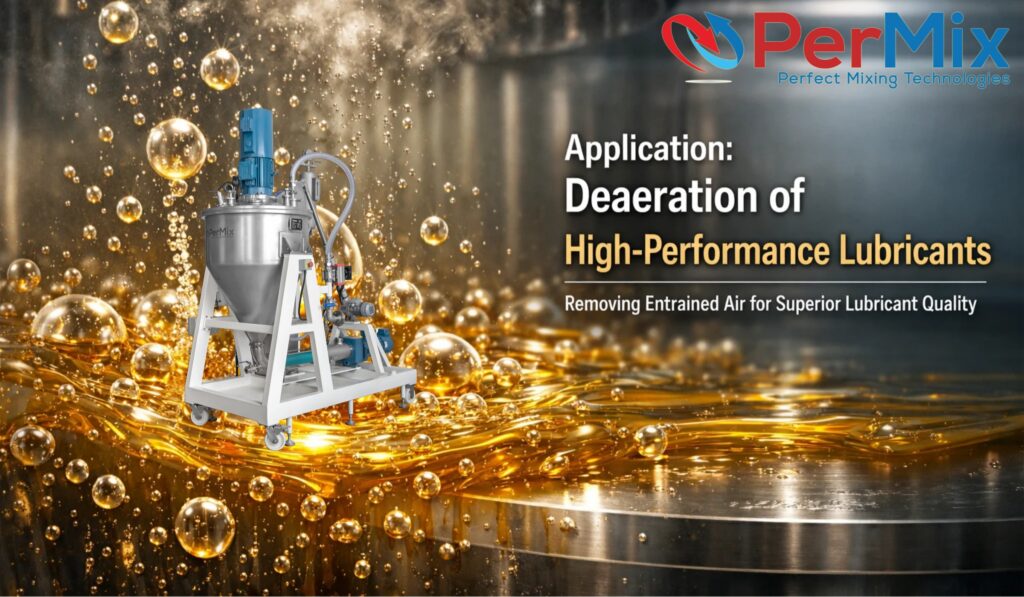
The global lubricant industry is evolving rapidly as manufacturers adopt nanotechnology-driven formulations to improve friction reduction, thermal stability, and load capacity. Advanced lubricants containing graphite, graphene, and engineered nano-additives are redefining performance across automotive, aerospace, energy, and heavy industry.
However, producing these next-generation lubricants requires far more sophisticated processing than traditional grease manufacturing. One of the most critical steps in this process is deaeration—the removal of entrained air and micro-bubbles from the lubricant matrix.
Without effective deaeration, even the most advanced nanotechnology formulations can suffer from instability, poor lubrication performance, oxidation, and inconsistent product quality.
PerMix has developed specialized industrial deaeration systems that address the unique challenges of manufacturing graphene- and graphite-based lubricants, enabling producers to achieve consistent, high-performance products.
Lubricants function by forming a thin film between moving surfaces, reducing friction and wear. Traditional additives such as molybdenum disulfide and zinc dialkyldithiophosphate (ZDDP) have long been used to improve lubrication performance.
Nanotechnology is now pushing these limits further.
Graphite and graphene offer extraordinary lubrication properties due to their layered crystal structures.
Graphite consists of stacked layers of carbon atoms arranged in hexagonal lattices. These layers slide easily over one another, which gives graphite its natural lubricity.
Graphene, a single atomic layer of carbon arranged in a hexagonal lattice, has even more remarkable properties:
• Extremely low friction coefficient
• Exceptional thermal conductivity
• Ultra-high mechanical strength
• Excellent wear resistance
• Ability to form protective tribological films
When dispersed into oils or greases, graphene and graphite nanoparticles can significantly improve:
• Load carrying capacity
• Thermal stability
• Oxidation resistance
• Wear protection
• Energy efficiency
As a result, graphene-enhanced lubricants are now being explored for:
• Automotive engine oils
• Industrial gear lubricants
• Aerospace greases
• Wind turbine lubrication systems
• Electric vehicle drivetrains
• High-load bearings and gears
However, these benefits only materialize if the nano-additives are properly dispersed and stabilized.
Producing advanced lubricants with nano-additives involves several critical processing steps.
The process begins with the base fluid, which may include:
• Mineral oils
• Synthetic oils (PAO, ester, PAG)
• Biodegradable base oils
The base oil is typically heated and conditioned to optimize viscosity and additive solubility.
A variety of additives are introduced to build the final formulation:
• Graphite powders
• Graphene nanoplatelets
• Anti-wear additives
• Corrosion inhibitors
• Thickening agents for grease production
• Stabilizers and dispersants
These ingredients must be carefully dosed and introduced under controlled mixing conditions.
Nanomaterials such as graphene tend to agglomerate due to strong van der Waals forces between particles. To achieve proper dispersion, manufacturers use high-shear mixing equipment, including:
• Inline rotor-stator homogenizers
• High-speed dispersers
• Three-roll mills
• Bead mills
The goal is to break apart particle clusters and distribute graphene sheets evenly throughout the lubricant.
Proper dispersion ensures the nanoparticles can form protective films at friction surfaces.
When manufacturing grease, thickening agents such as lithium soap, calcium sulfonate, or polyurea are introduced.
These thickeners create a semi-solid matrix that traps the base oil and additives.
During this step, intense mixing occurs as the grease structure forms.
Unfortunately, this mixing process also introduces large amounts of entrained air.
Air bubbles are introduced into lubricants through multiple mechanisms:
• High-shear mixing
• Powder addition
• Pump cavitation
• Recirculation systems
• Mechanical agitation
While some bubbles are visible, many are microscopic and remain suspended in the lubricant.
These micro-bubbles can cause serious issues:
Air contains oxygen, which accelerates oxidation reactions in oils, reducing lubricant lifespan.
Air pockets disrupt the formation of continuous lubrication films between metal surfaces.
Entrained air can lead to foaming during operation, particularly in pumps and gear systems.
Air increases product volume while reducing density, creating inconsistencies in filling and packaging operations.
Air bubbles can destabilize graphene dispersions, leading to particle aggregation and sedimentation.
Because graphene formulations often contain extremely small particles, removing entrained air becomes even more critical.
Deaeration removes dissolved and entrained air from lubricants before final packaging.
For graphene and graphite formulations, this step ensures:
• Stable dispersion of nano-particles
• Accurate density and product consistency
• Improved oxidation stability
• Reduced foaming during use
• Enhanced lubrication film formation
• Higher product reliability
In advanced lubricant manufacturing, deaeration is no longer optional—it is a core processing step.
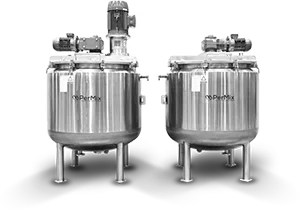
PerMix manufactures advanced industrial deaeration systems designed specifically for viscous fluids, greases, and nanoparticle dispersions.
These systems are engineered to remove entrained air efficiently while preserving product integrity.
PerMix deaerators operate under controlled vacuum conditions that dramatically reduce pressure above the liquid.
When pressure drops, trapped air expands and escapes from the lubricant matrix.
This process allows even microscopic bubbles to rise and collapse.
Unlike aggressive mechanical methods, vacuum deaeration removes air without damaging:
• Graphene structures
• Delicate dispersions
• Grease matrix structures
This ensures the final lubricant retains its engineered performance characteristics.
PerMix deaerators can be integrated into both:
• Batch lubricant production lines
• Continuous lubricant processing systems
This flexibility allows manufacturers to scale from R&D to full industrial production.
PerMix also designs complete lubricant processing systems, including:
• High-shear mixers for nanoparticle dispersion
• Vacuum mixers for grease production
• Inline homogenizers
• Deaeration systems
• Temperature control systems
• Automated dosing systems
This integrated approach ensures every step of the process—from raw material introduction to final packaging—is optimized.
Graphene-enhanced lubricants are rapidly being adopted across multiple sectors.
Improved lubrication reduces friction losses and improves drivetrain efficiency.
Graphene lubricants offer improved thermal resistance and reliability under extreme conditions.
Heavy machinery benefits from enhanced wear protection and longer lubricant lifetimes.
Wind turbines require advanced lubrication systems capable of handling high loads and harsh environments.
Advanced lubricants improve performance and durability in demanding mechanical systems.
The lubricant industry is entering a new era where materials science, nanotechnology, and advanced processing technologies converge.
Graphene and graphite additives promise dramatic improvements in efficiency, durability, and energy savings.
However, these materials also require sophisticated manufacturing processes that ensure dispersion stability and product purity.
Deaeration plays a crucial role in achieving this goal.
With advanced vacuum deaeration systems, PerMix enables lubricant manufacturers to produce stable, high-performance nanotechnology lubricants with consistent quality and reliability.
PerMix designs and manufactures industrial processing equipment for advanced materials and high-performance lubricants.
Our systems support manufacturers working with:
• Graphite
• Graphene
• Nano-additives
• High-performance greases
• Specialty industrial lubricants
From mixing and dispersion to vacuum deaeration and final processing, PerMix delivers the engineering expertise and equipment needed to produce the lubricants of the future.
Stay Connected