Industrial Mixers
PerMix Applications
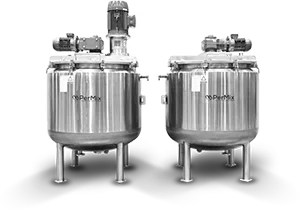
Steam Sterilization Of Powders vs Drying Of Powders Under Vacuum
All right—time to grab the microscope, crank up the magnification, and zoom in on the thermodynamics, microbiology, and process engineering behind these two worlds: vacuum drying/sterilizing with only a jacket vs. vacuum drying/sterilizing with direct steam injection.
This is where the nuances start to matter. Powders behave like unruly crowds: they’re free-flowing until they’re not, they clump when they shouldn’t, and the moment you apply heat, half of them hide from it. So understanding the true internal physics of these processes tells you exactly why steam injection is the superior method.
Let’s dive deeper.
Powder sterilization is essentially an exercise in outsmarting three things:
heat transfer limitations, moisture migration, and microbial resistance.
Each method handles these challenges completely differently.
The vapor or thermal oil in the jacket heats the vessel wall → heat moves from wall → into powder through conduction and a bit of convection (thanks to agitation).
The enemy here is thermal diffusivity — how well a powder transmits heat inward.
Powders have:
• low density
• trapped air
• irregular surface area
• insulating micro-layers
• poor thermal conductivity
This means heat moves slowly into the particle bed.
Even with good agitation:
• material closest to the wall heats quickly
• mid-bed heats moderately
• internal clusters heat very slowly
• any agglomerate is basically a bunker
Sterilization requires uniform internal temperatures.
But with jacket-only heating, the INTERNAL temperature of the powder may lag behind the vessel wall by 10–30°C, sometimes even more.
Microbes in thermal shadow zones survive.
This is why jacket-only “sterilization” is often really pasteurization with blind spots.
Steam has two superpowers:
When steam condenses on a cooler surface, it instantly releases a massive amount of heat (usually 2,257 kJ/kg).
This overwhelms the thermal resistance of powders.
The steam doesn’t just warm the outside—it penetrates porous structures, reaches trapped micro-sites, and heats the powder from the inside out.
Steam flows into:
• void spaces
• powder interstitial gaps
• microchannels
• agglomerated zones
The steam finds every hiding place heat normally can’t reach.
Steam kills microbes faster, deeper, and more uniformly because:
• It eliminates temperature gradients.
• It overwhelms internal microbial shelters.
• It doesn’t rely on slow thermal conduction.
• Moist heat has a much higher lethality than dry heat.
This is why steam sterilization cycles are short, predictable, and validated worldwide.
Moisture removal depends entirely on:
• conduction → heating → evaporation
• vacuum → lowering boiling point
• agitation → exposing new surface area
This works fine for drying, but microbes often survive because the powder never reaches a lethal combination of temperature + time + moisture migration.
Steam adds moisture temporarily—yes.
But under vacuum, that added moisture flashes off extremely quickly after it condenses and delivers its lethal heat.
The process looks like this:
The temporary moisture is a feature, not a flaw**, because microbial lethality is highest in moist heat environments—not dry ones.
Jacket Only:
• Longer heating ramps
• Long soak times
• Longer moisture migration times
• Long overall cycle
Jacket + Steam Injection:
• Heating is immediate
• Lethal temperatures reached quickly
• Moisture migrates rapidly under vacuum
• Cycle time shrinks dramatically
• Total energy consumption often drops
Steam cycles can be 50–80% faster.
• Slow, prolonged heating
• Higher risk of thermal degradation
• More loss of volatile compounds
• Browning reactions in sugars & botanicals
• Potential flavor/aroma drift
• Uneven moisture removal
• Possible nutrient losses in sensitive goods
• Rapid, controlled heating with minimal thermal exposure
• Better preservation of color, aroma, enzymes, and actives
• Better retention of flow properties
• Reduced oxidation (shorter exposure time)
• Superior microbial reduction without product burnout
• Better dispersion and uniformity
Steam is simply gentler, despite being hotter, because the exposure is shorter.
Microbial kill depends on two parameters:
• D-value: time to reduce population by 90% at a given temperature
• Z-value: °C increase required to reduce D-value by 90%
Moist heat:
• has much lower D-values
• requires lower temperatures
• kills microbes far faster than dry heat
This is why your kitchen oven can’t sterilize a medical scalpel — but a steam autoclave at 121°C can.
Steam injection essentially transforms the vacuum mixer into a low-pressure autoclave for powders.
PerMix designs these systems around the actual physical behavior of powders, not the idealized textbook version.
1. Engineered Steam Injectors
Designed for maximum dispersion and penetration without localized wet pockets.
2. Fluidized or Hybrid Mixing Zones
Depending on model, powders float, tumble, and shear in a way that maximizes steam exposure.
3. Precision Vacuum Control
Ensures moisture flashes off and reduces temperature for sensitive ingredients.
4. Dual-Zone Heating (Wall + Steam)
Provides macro and micro thermal control.
5. Full Validation Readiness
Time, temperature, vacuum, steam flow, pressure, CIP/SIP compatibility, and batch records.
6. Hygienic Stainless Construction
316L, electropolished, fully drainable, designed for clean materials.
7. Single Vessel, Multi-Function
Mix → Steam Sterilize → Vacuum Dry → Cool → Discharge
ALL in one unit.
8. Scalable Engineering
Lab → Pilot → Full production with consistent heat profiles.
Jacket heating dries powders.
It can attempt sterilization, but with limited reach and slow heat penetration.
Steam injection sterilizes powders.
Fast. Uniform. Validatable. High lethality. Low degradation.
And PerMix combines both — with vacuum and controlled agitation — to create a Steam Sterilization Vacuum Mixer & Dryer that solves the fundamental problems of powder behavior, microbial resistance, and heat transfer physics.
Stay Connected