Industrial Mixers
PerMix Sigma Mixer
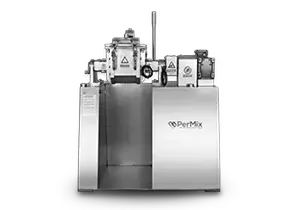
 PerMix Sigma Mixers & Sigma Mixers & Extruders
Best in Innovation • Best In Performance • Best In Quality • Best In Price • Best In Warranty
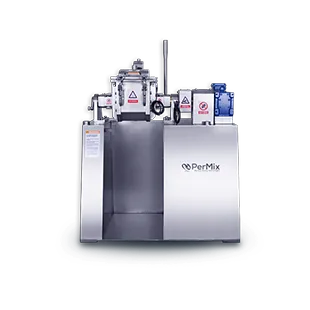
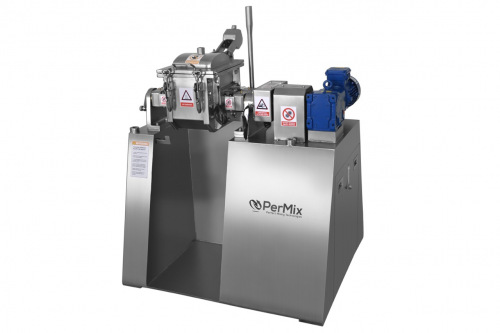
The PerMix PSG series Sigma Mixer, which is also known as the Double Sigma Mixer, or Double Z Blade Mixer, is used for the mixing-kneading of materials with very high viscosity (over 500,000 cps).
A sigma mixer—also called a Z-blade mixer—is a heavy-duty paste mixer engineered for extremely high-viscosity, non-flowing, dough-like materials that resist movement even under planetary or anchor mixing. It uses two counter-rotating sigma (Z-shaped) blades that knead, compress, stretch, and shear material through intense mechanical action.
A sigma mixer extruder builds on this principle by integrating a forced discharge or extrusion system, allowing stiff materials to be continuously pushed out of the mixer after processing—eliminating manual removal and enabling downstream forming or feeding.
At PerMix, sigma mixers and sigma mixer extruders are engineered as maximum-torque paste processors, selected when other paste mixers physically cannot move the product.
Sigma mixers rely on kneading mechanics, not circulation.
During operation:
Two sigma blades rotate at different speeds
Blades intermesh with tight clearances
Material is repeatedly stretched, folded, compressed, and sheared
The mass is forced from one blade to the other
This action continuously breaks internal resistance and forces movement through the batch—even when the material will not flow at all.
Sigma mixers were developed to solve a very specific problem:
What happens when paste becomes too stiff for planetary, anchor, or multi-shaft mixers to move?
They excel when:
Viscosity is extremely high
Material behaves like dough, putty, or rubber
Yield stress dominates the process
Gravity and circulation are irrelevant
Sigma mixers are chosen when torque and compression matter more than shear rate.
Sigma mixers differ from other paste mixers in key ways:
No reliance on material flow
Direct mechanical kneading instead of circulation
High blade-to-material contact pressure
Ability to process near-solid materials
Where a double planetary mixer moves paste, a sigma mixer forces it to deform.
A standard sigma mixer focuses on mixing and kneading, after which material is typically removed by:
Tilting the trough
Manual extraction
Hydraulic discharge
A sigma mixer extruder adds:
A discharge screw or extrusion mechanism
Continuous or semi-continuous forced discharge
Direct feeding to pelletizing, calendaring, or forming equipment
This makes sigma mixer extruders ideal for production environments handling stiff materials at scale.
Sigma mixers and extruders are commonly used for:
Rubber and elastomer compounds
Chewing gum bases
Dough-like food products
Adhesives and sealants with extreme solids loading
Ceramic and refractory pastes
Battery and specialty composite materials
Polymers and mastics
They are selected when material resistance defines the process, not batch size or speed.
At a high level:
High-speed dispersers rely on shear and flow
Planetary mixers rely on torque and circulation
Multi-shaft mixers manage viscosity transitions
Sigma mixers rely on kneading and compression
They are the last line of defense when other mixers reach their mechanical limits.
Sigma mixers are often misunderstood as “old-school” equipment.
In reality, they remain irreplaceable for certain paste applications because:
No other mixer can generate equivalent kneading force
No other design handles such extreme viscosity reliably
No other mixer maintains control when paste becomes nearly solid
Understanding what sigma mixers do prevents costly attempts to force unsuitable equipment into impossible applications.
Sigma mixers and sigma mixer extruders are selected when material resistance overwhelms conventional mixing physics. These machines are not chosen for speed, elegance, or flexibility—they are chosen because other paste mixers physically cannot do the job.
Understanding when sigma mixing is the correct solution—and when it is excessive—prevents both under-engineering and over-engineering.
A sigma mixer is typically the correct solution when one or more of the following conditions apply:
Extremely High Viscosity or Near-Solid Materials
Materials that behave like dough, putty, rubber, or clay and will not circulate under planetary or anchor mixing.
Yield-Stress Dominated Formulations
Materials that resist deformation until very high mechanical force is applied.
Kneading, Compression, and Stretching Are Required
Processes that depend on mechanical working of the mass—not dispersion or circulation.
Very High Solids Loading
Formulations where solids content approaches the mechanical limit of most mixers.
Gravity and Flow Are Irrelevant
Sigma mixers do not depend on material movement by flow—only forced deformation.
Sigma mixers are commonly chosen for:
Rubber and elastomer compounds
Chewing gum and gum bases
Extremely stiff adhesives and sealants
Ceramic and refractory pastes
Polymer mastics and compounds
Certain battery and composite materials
In these cases, torque and compression—not shear rate—define success.
A sigma mixer extruder is preferred when:
Material Cannot Be Discharged by Gravity or Tilting
Extremely stiff pastes resist emptying.
Downstream Forming or Feeding Is Required
Pelletizing, calendaring, extrusion, or molding follows mixing.
Manual Discharge Must Be Eliminated
Production environments require repeatability and operator safety.
Semi-Continuous or Production-Scale Output Is Needed
The extruder transforms a batch mixer into a controlled discharge system.
Sigma mixer extruders are production tools, not just mixers.
Despite their power, sigma mixers are not universal.
They may be unnecessary or inefficient when:
Material Can Still Circulate
Double planetary or multi-shaft mixers may be faster and more flexible.
Fine Dispersion or Wet-Out Is Required
High-speed dispersers or bead mills are better suited.
Viscosity Changes Widely During the Batch
Multi-shaft mixers manage transitions more efficiently.
Gentle Handling Is Required
Sigma mixers are inherently aggressive.
Double planetary mixers move and homogenize viscous pastes
Sigma mixers knead and deform extremely stiff masses
When planetary tools stall, sigma blades keep working.
Multi-shaft mixers manage viscosity transitions
Sigma mixers assume viscosity is already extreme
If dispersion and wet-out are still important, multi-shaft systems are superior.
Using an underpowered mixer where a sigma mixer is required leads to:
Motor overloads
Incomplete mixing
Excessive heat buildup
Mechanical failure
Using a sigma mixer where it is not required leads to:
Longer cycle times
Overworking the material
Reduced flexibility
Sigma mixers are specialists, not generalists.
Sigma mixers and sigma mixer extruders operate at the absolute mechanical limits of paste processing. They are designed to transmit extreme torque, withstand continuous compressive forces, and maintain precise blade clearances under load—conditions that destroy lightly built equipment.
At PerMix, sigma mixers are engineered as maximum-duty kneading machines, not modified mixers.
The defining feature of a sigma mixer is the intermeshing Z-shaped blades.
Key design characteristics include:
Precisely profiled sigma blades for compression and stretching
Asynchronous blade speeds (one blade typically faster than the other)
Tight blade-to-blade and blade-to-trough clearances
Continuous material transfer from one blade to the other
This geometry forces material deformation even when flow is impossible.
Sigma mixers demand enormous torque at low speed.
PerMix designs incorporate:
Oversized gear reducers designed for peak torque loads
Heavy-duty motors sized for continuous kneading duty
Rigid coupling between drive and blades
Smooth torque delivery to prevent mechanical shock
Drives are engineered for worst-case material resistance, not nominal conditions.
The trough must resist deformation under load.
PerMix sigma mixer troughs feature:
Thick-walled construction to withstand compressive forces
Reinforced sidewalls and end plates
Rounded internal profiles to prevent stress concentration
Precision machining to maintain blade clearances
Structural rigidity is essential to prevent blade contact and uneven wear.
Sigma mixers operate in abrasive, adhesive, and chemically aggressive environments.
Available materials include:
Carbon steel for rubber and general industrial compounds
304 stainless steel for food and non-corrosive products
316 / 316L stainless steel for chemical, pharmaceutical, and specialty materials
Surface finishes can be optimized for wear resistance or cleanability.
Thermal control is often critical during kneading.
PerMix sigma mixers can include:
Full-coverage heating and cooling jackets
Steam, hot water, thermal oil, or glycol service
Zoned temperature control for precise heat management
Jackets prevent overheating caused by mechanical working and support controlled reactions.
Extreme loads demand robust bearing design.
PerMix features include:
Heavy-duty bearings sized for high radial and axial loads
Shaft seals designed to handle pressure, heat, and product adhesion
Bearing isolation from the product zone
These features ensure long service life even under continuous duty.
Sigma mixer extruders integrate forced discharge mechanisms.
Design elements include:
Integrated extrusion screws or rams
Controlled discharge rates
Direct feeding to pelletizers, calendars, or forming equipment
This eliminates manual removal and supports production-scale operation.
For batch-oriented systems, PerMix offers:
Hydraulic tilting troughs
Bottom discharge doors (application-dependent)
Assisted discharge options for stiff materials
Discharge method is selected based on viscosity and downstream handling.
Sigma mixers generate massive internal forces.
PerMix frames feature:
Heavy-duty welded steel construction
Reinforced mounting points
Safety guarding and interlocks
Emergency stop systems
These ensure stable, safe operation under maximum load.
Every element of a PerMix sigma mixer is designed to:
Survive extreme torque
Maintain precise clearances
Deliver consistent kneading action
Operate reliably for years under severe conditions
This is what separates true sigma mixers from reinforced general-purpose equipment.
Sigma mixers and sigma mixer extruders live in a different performance universe than any other paste mixer. At this viscosity extreme, flow models break down, RPM becomes almost meaningless, and torque, compression, and mechanical endurance define success. Scale-up here is not about finesse—it’s about respecting physics.
At PerMix, sigma mixer performance is engineered around worst-case material behavior, not optimistic averages.
Sigma mixer performance is governed by four non-negotiable factors:
Available torque at the blades
Blade geometry and intermeshing clearance
Material compression and deformation rate
Heat generation and removal during kneading
If any one of these is undersized, mixing simply stops.
Unlike dispersers or planetary mixers, sigma mixers operate at very low rotational speeds.
Performance is not driven by:
RPM
Tip speed
Flow circulation
Performance is driven by:
Blade force against the material
Compression between blades and trough
Continuous deformation of the mass
Attempting to “speed up” a sigma mixer rarely improves mixing—and often damages the product.
Sigma mixers are selected when viscosity is:
Extremely high
Non-Newtonian
Yield-stress dominated
Near-solid in behavior
As batch size increases:
Torque demand increases exponentially
Mechanical load concentrates at blade tips
Heat generation becomes the limiting factor
PerMix designs size drives and structures for peak resistance, not average load.
Kneading generates heat through:
Mechanical compression
Internal friction
Material deformation
Uncontrolled heat leads to:
Viscosity runaway
Material degradation
Blade adhesion and stalling
PerMix sigma mixers manage this through:
Full-coverage heating/cooling jackets
Controlled blade speed differentials
Optional staged mixing profiles
Thermal discipline is often the difference between a usable batch and scrap.
Sigma mixers do not mix “quickly.”
They mix:
Deliberately
Progressively
Predictably
Mixing time is driven by:
Material stiffness
Solids loading
Required homogeneity
Heat removal capacity
Trying to shorten cycles by increasing force usually backfires.
Scaling sigma mixers is about maintaining kneading physics, not geometry alone.
PerMix scale-up methodology preserves:
Blade shape and intermesh ratios
Compression geometry
Torque per unit batch mass
Heat transfer surface area per unit load
This allows pilot formulations to transfer to production without reformulation, which is critical at this viscosity extreme.
Sigma mixers are highly sensitive to fill level.
Best practices include:
Operating within defined working volume windows
Avoiding underfilling, which reduces blade engagement
Avoiding overfilling, which prevents material transfer between blades
PerMix provides application-specific guidance to lock in optimal fill ratios.
Adding extrusion changes performance dynamics.
Key benefits include:
Controlled, repeatable discharge
Reduced operator intervention
Improved cycle consistency
Direct feeding to downstream processes
Extruder sizing must match peak paste resistance, not average viscosity.
Repeatable sigma mixing requires:
Stable torque delivery
Controlled blade speed ratios
Defined thermal profiles
PLC-driven sequencing (when equipped)
PerMix systems are engineered to repeat mechanical conditions, not just timing.
Poorly scaled sigma mixers lead to:
Blade stalling
Structural deformation
Excessive heat buildup
Incomplete kneading
Catastrophic mechanical failure
At this level, there are no “close enough” designs.
Sigma mixers and sigma mixer extruders are applied when materials reach a mechanical state where flow-based mixing no longer exists. These are not marginal paste applications—these are processes where the product behaves like rubber, dough, putty, or near-solid mass, and must be worked, kneaded, and forced into uniformity.
Below are the real-world workflows where sigma technology is not optional—it is essential.
Primary challenges:
Extremely high viscosity
High filler and carbon black loading
Heat generation during kneading
Uniform dispersion under compression
Typical workflow:
Polymer Charging
Base rubber or elastomer is loaded into the trough.
Filler & Additive Addition
Carbon black, fillers, oils, and additives are introduced.
Sigma Kneading Action
Blades compress, stretch, and shear the mass repeatedly.
Thermal Control via Jacket
Heat is removed or applied to control compound behavior.
Extrusion or Discharge
Material is forced out for downstream calendaring or forming.
Why it works:
Only sigma blades can mechanically deform rubber compounds at this resistance level.
Primary challenges:
Extremely elastic, non-flowing mass
High sugar and polymer content
Heat sensitivity
Typical workflow:
Gum Base Preparation
Ingredient Addition
Sigma Kneading Under Controlled Heat
Extrusion or Slab Discharge
Why it works:
Sigma mixers provide controlled kneading without tearing or localized overheating.
Primary challenges:
Very high solids loading
Yield-stress behavior
Air entrapment
Manual discharge difficulty
Typical workflow:
Resin Charging
Filler & Thickener Addition
Sigma Kneading for Homogeneity
Vacuum Deaeration (When Equipped)
Extrusion or Hydraulic Discharge
Why it works:
Planetary and multi-shaft mixers stall where sigma mixers continue to work.
Primary challenges:
Abrasive solids
Near-solid paste behavior
Uniform particle distribution
Typical workflow:
Binder Charging
Powder Addition
Sigma Kneading Under High Load
Forced Discharge to Shaping or Extrusion
Why it works:
Sigma blades maintain movement where flow-based mixing fails completely.
Primary challenges:
Extreme viscosity
Heat buildup from deformation
Adhesive behavior
Typical workflow:
Base Polymer Charging
Additive & Modifier Incorporation
Extended Sigma Kneading Cycle
Controlled Cooling & Discharge
Why it works:
Sigma mixers maintain uniformity without relying on circulation or gravity.
Primary challenges:
Ultra-high solids loading
Binder dominance
Non-Newtonian behavior
Typical workflow:
Binder & Solid Charging
Sigma Kneading for Structural Uniformity
Extrusion or Transfer to Downstream Forming
Why it works:
Sigma mixers handle rheology that overwhelms planetary and multi-shaft systems.
Primary challenges:
Small batches of extreme materials
Process feasibility testing
Scale-up validation
Typical workflow:
Pilot Sigma Trials
Torque, Heat & Kneading Optimization
Production Replication
Why it works:
Sigma mixing physics scale when compression geometry is preserved.
Sigma mixers perform best when:
Material flow is irrelevant
Deformation defines mixing success
Compression and kneading are required
Discharge must be forced
Application-driven workflows result in:
Uniform structure
Stable rheology
Predictable scale-up
Reduced mechanical failure
At the highest end of paste viscosity, mixer selection stops being a preference and becomes a mechanical necessity. This is where many processes fail—not because the formulation is wrong, but because the mixer physics no longer match material reality.
This section clarifies what each paste mixer actually solves, where it fails, and when sigma mixing is the only viable path forward.
Double planetary mixers are torque-based homogenizers.
They solve:
Bulk movement of viscous pastes
High solids loading
Yield-stress behavior up to a point
Complete vessel sweep
Controlled shear without flow reliance
They fail when:
Material becomes dough-like or rubbery
Internal deformation replaces circulation
Paste resists folding and instead compresses
Torque demand exceeds practical gearbox limits
Planetary mixers move paste.
They do not knead it.
Multi-shaft mixers are transition managers.
They solve:
Liquid-to-paste viscosity evolution
Early-stage dispersion followed by bulk movement
Heat and air control during thickening
Process consolidation in one vessel
They fail when:
Viscosity becomes extreme early
Material no longer flows even under anchor force
Dispersers lose effectiveness entirely
Paste behaves as a solid under compression
Multi-shaft mixers assume some flow remains.
Sigma mixers assume none does.
Sigma mixers are deformation machines.
They solve:
Near-solid paste behavior
Dough, rubber, putty, and mastics
Extreme yield-stress materials
Processes where compression defines mixing
Conditions where gravity and circulation are irrelevant
Sigma mixers do not ask the material to move.
They force it to deform.
This is why sigma mixers continue working long after planetary and multi-shaft mixers stall.
A standard sigma mixer:
Kneads and homogenizes extreme pastes
Requires tilting, rams, or manual discharge
A sigma mixer extruder:
Kneads and forces material out
Enables continuous or semi-continuous output
Feeds directly into forming, calendaring, or extrusion
At production scale, extrusion is not optional—it is what makes sigma mixing viable long-term.
Sigma mixing is required when:
Material does not flow under any condition
Deformation replaces circulation
Paste behaves as a solid under compression
Torque and blade pressure define success
Other mixers physically cannot move the batch
Attempting to avoid sigma mixing here leads to:
Mechanical failure
Burnt batches
Incomplete kneading
Unrecoverable scrap
Sigma mixers should not be used when:
Material still circulates
Dispersion is still dominant
Viscosity transitions matter more than final stiffness
Gentle handling is required
In these cases:
Multi-shaft mixers are more efficient
Planetary mixers are more flexible
Cycle time and control are superior
Sigma mixing is a specialist solution, not a default.
(Dispersion → Multi-Shaft → Sigma)
The most demanding paste systems use multiple mixers intentionally.
A common high-end workflow:
High-Speed Dispersion
Wet-out and agglomerate breakup
Multi-Shaft Mixing
Controlled viscosity rise and homogenization
Sigma Mixing / Extrusion
Final kneading at extreme rheology
This approach:
Protects each machine
Maximizes product quality
Enables predictable scale-up
Eliminates forced compromises
Trying to skip steps usually increases cost, not efficiency.
At PerMix, sigma mixers are positioned correctly:
As end-point machines for extreme paste behavior
As part of a complete paste-processing architecture
As tools selected by material physics—not marketing
PerMix does not push sigma mixers where planetary or multi-shaft systems are sufficient.
And they do not pretend planetary systems can replace sigma mixers when physics say otherwise.
PerMix is here to listen to your needs and provide sustainable solutions. Contact us to discover more.
PerMix Sigma Videos