Industrial Mixers
PerMix Applications
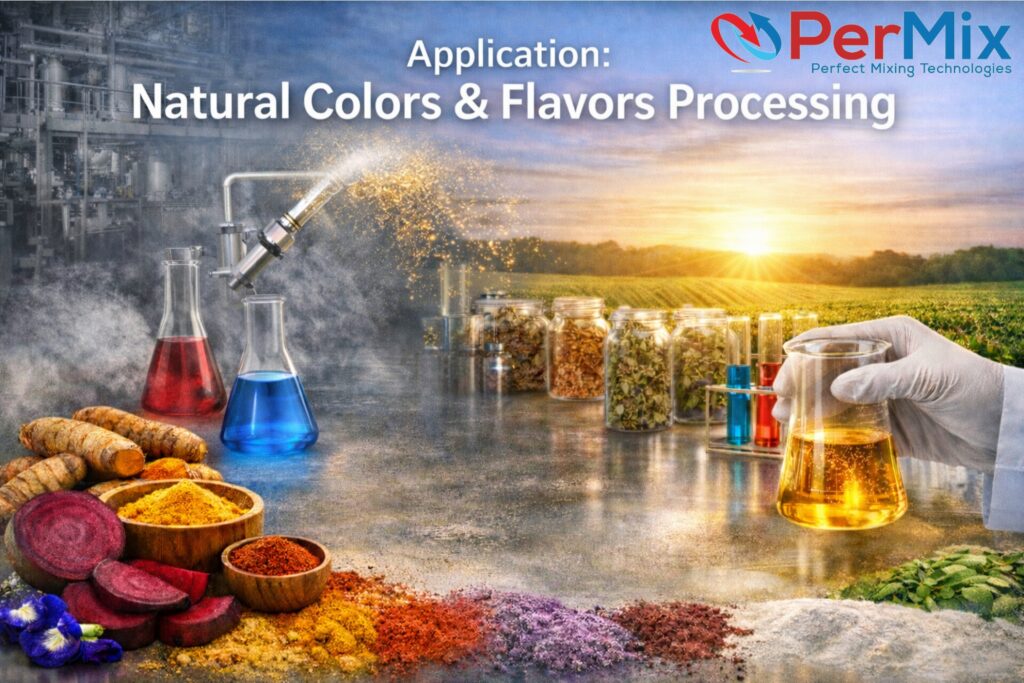
The global food industry is undergoing a major transformation. Consumers are increasingly demanding clean-label products made with recognizable natural ingredients, pushing manufacturers to replace synthetic dyes, artificial flavors, and chemical additives with ingredients derived directly from nature.
Companies like Natura Extracta and other natural ingredient producers are leading this transformation by producing natural colors, flavors, spices, botanical extracts, and functional ingredients used across food, beverage, nutraceutical, and cosmetic industries.
Behind these ingredients lies a sophisticated industrial process that combines botanical extraction, milling, blending, drying, and formulation technologies.
And increasingly, the success of these manufacturers depends on the precision and reliability of the processing equipment they use.
Natural colors and flavors are ingredients derived from plant, fruit, vegetable, spice, or microbial sources and extracted using physical or chemical processes that isolate pigments, aromas, or flavor compounds.
Common natural color sources include:
For example, annatto, extracted from the seeds of the achiote tree, produces orange-red pigments widely used in cheeses, dairy products, snacks, and baked goods.
Natural flavors are produced by isolating aromatic compounds from fruits, herbs, spices, or fermentation processes, creating flavor systems used in foods, beverages, and nutraceuticals.
Major global producers in this sector include companies such as Sensient Technologies, Döhler, Wild Flavors, and David Michael & Co., which supply flavors, colors, and ingredient systems to food manufacturers worldwide.
Producing natural ingredients is a multi-step process involving several key industrial operations.
Production begins with agricultural raw materials such as:
These materials are cleaned, milled, or crushed to increase surface area before extraction.
Grinding and particle size reduction are critical because finer particles dramatically improve extraction efficiency and yield.
The pigments or flavor molecules are then extracted using methods such as:
In many cases, plant materials are crushed or soaked so pigments dissolve into the extraction medium.
For example:
The resulting liquid extracts contain the desired pigments, aromas, and functional compounds.
Natural colors are chemically sensitive. They can degrade when exposed to:
To maintain stability and shelf life, manufacturers concentrate the extracts and often stabilize them through processes such as:
This allows the colors or flavors to be supplied as liquids, emulsions, powders, or granules.
The final stage involves blending the concentrated ingredients into finished products such as:
This stage requires extremely precise mixing technology to ensure:
Natural ingredients present unique engineering challenges compared with synthetic chemicals.
These materials often exhibit:
In addition, the shift away from synthetic dyes is accelerating rapidly due to regulatory pressure and consumer demand.
Food manufacturers worldwide are now reformulating products with natural colors derived from plants, algae, and botanical sources.
This transformation is creating enormous demand for advanced mixing, milling, and powder-handling systems.
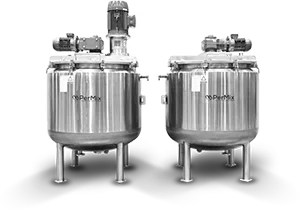
PerMix has become a trusted technology partner for companies producing natural colors, flavors, botanical extracts, spices, and functional ingredients.
PerMix equipment supports the entire manufacturing process.
PerMix mixers ensure uniform blending of:
Technologies commonly used in this sector include:
These systems ensure consistent product quality and batch-to-batch repeatability, which is essential for food and nutraceutical manufacturers.
Natural powders frequently form lumps during processing due to:
PerMix mixers equipped with high-speed choppers eliminate agglomerates and ensure smooth, free-flowing powders.
Many natural ingredients involve spraying liquids into powders, such as:
PerMix mixers use precision spray systems to distribute liquids evenly across powder particles, preventing clumping and ensuring complete absorption.
Certain natural extracts require gentle drying under controlled conditions to preserve delicate pigments and volatile aroma compounds.
PerMix vacuum mixers and dryers allow manufacturers to:
The move toward natural ingredients is not a short-term trend—it is a fundamental shift in food manufacturing.
Consumers, regulators, and global brands are all moving in the same direction: cleaner labels, natural formulations, and plant-derived ingredients.
This shift is already driving innovation across the supply chain, from agriculture and biotechnology to extraction technologies and industrial processing equipment.
Companies like Natura Extracta and their global peers are at the center of this movement.
And behind every successful natural ingredient manufacturer is a reliable processing infrastructure capable of delivering precision, consistency, and scalability.
PerMix supports natural ingredient manufacturers with advanced mixing technologies designed for:
With decades of experience in powder processing and liquid-solid mixing, PerMix provides the engineering solutions that allow natural ingredient producers to scale production while maintaining the highest standards of quality and consistency.
As the world continues moving toward natural colors, flavors, and clean-label ingredients, the need for reliable processing technology will only continue to grow.
PerMix is proud to help power that future.
Stay Connected