Industrial Mixers
PerMix Applications
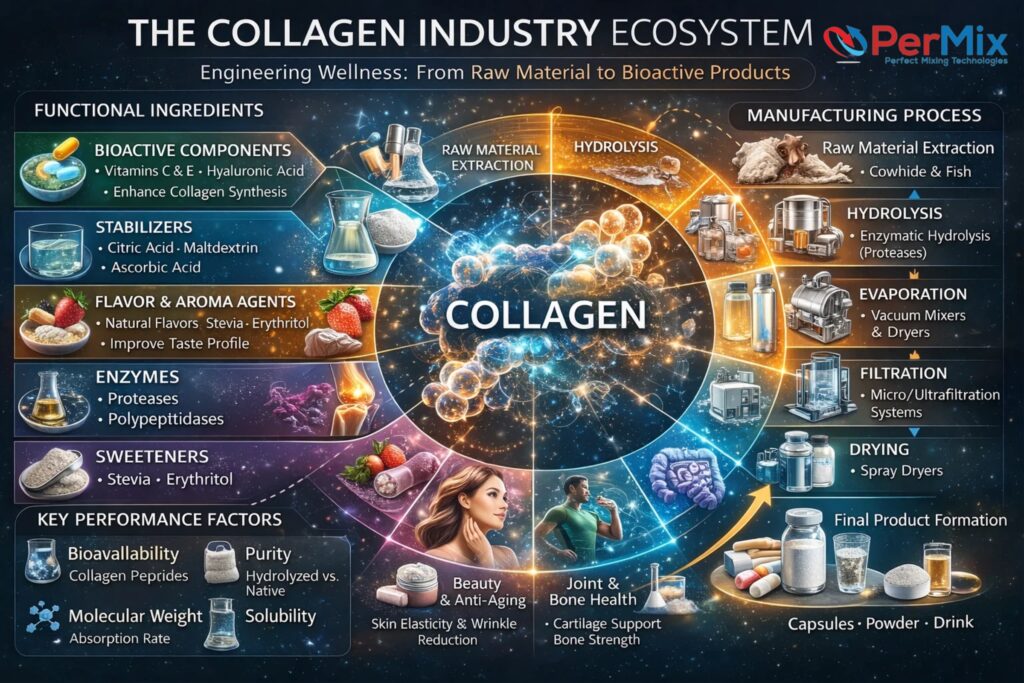
Collagen has become one of the most important bioactive ingredients in the global nutraceutical and functional food industries. Used in dietary supplements, beverages, cosmetics, and medical products, collagen peptides are valued for their high bioavailability, excellent digestibility, and proven benefits for skin elasticity, joint health, and connective tissue repair.
However, the collagen powders seen in consumer products are the result of a complex industrial process that transforms raw biological materials into purified, functional peptides with specific molecular weight distributions.
Manufacturing collagen requires careful control of extraction, hydrolysis, purification, drying, and powder handling processes. Each stage influences the final product’s solubility, digestibility, and bioactivity.
Modern collagen production therefore combines biochemistry, enzymatic processing, and advanced powder processing technology to create high-quality collagen peptides.
Collagen is the most abundant structural protein in the human body, accounting for roughly 30% of total protein mass. It forms the structural framework for skin, cartilage, bones, tendons, and ligaments.
Native collagen molecules are extremely large triple-helix proteins, often exceeding 300 kDa molecular weight. Because of this size, native collagen is difficult to digest and absorb.
To make collagen nutritionally effective, manufacturers break it down into hydrolyzed collagen peptides, which are shorter chains of amino acids that dissolve easily and are rapidly absorbed in the digestive tract.
These peptides typically range between 2,000 and 5,000 Daltons, allowing efficient uptake into the bloodstream.
Most commercial collagen is extracted from animal connective tissue.
Common raw material sources include:
Bovine collagen
Derived from cow hides and bones. It contains high levels of Type I and Type III collagen and is widely used in nutraceuticals.
Marine collagen
Derived from fish skin and scales. It is highly bioavailable and often marketed for beauty and skin health products.
Porcine collagen
Derived from pig skin and connective tissues, frequently used in gelatin and medical applications.
These materials contain collagen embedded within a matrix of fats, minerals, and other proteins that must be removed during processing.
The production process begins by cleaning and preparing the raw material.
Animal hides or fish skins are:
• washed
• trimmed
• degreased
• mechanically reduced in size
Grinding or shredding increases the surface area to improve extraction efficiency.
The collagen is extracted from the connective tissues using either acid or alkaline treatment.
Acid treatment is common for softer tissues such as fish skins, while alkaline treatment is typically used for harder bovine materials.
This step removes non-collagen proteins and helps separate collagen fibers from the surrounding matrix.
The result is a swollen collagen structure ready for enzymatic breakdown.
To produce collagen peptides, the extracted collagen undergoes enzymatic hydrolysis.
Proteolytic enzymes break the long triple-helix collagen molecules into shorter peptide chains.
This step is critical because it determines:
• peptide size distribution
• solubility
• digestibility
• bioactivity
Hydrolysis reactions are typically carried out in temperature-controlled reactors to maintain optimal enzyme activity.
After hydrolysis, the collagen solution contains peptides, minerals, fats, and residual proteins.
Filtration and purification systems remove impurities through:
• microfiltration
• ultrafiltration
• centrifugation
These systems control the final peptide size distribution and ensure high product purity.
The purified collagen solution is then concentrated using vacuum evaporation or membrane concentration systems.
Reducing water content lowers energy consumption in the final drying stage and increases process efficiency.
The collagen concentrate is converted into powder using spray drying.
Spray dryers atomize the liquid into fine droplets that rapidly dry in hot air, producing free-flowing collagen powder.
The drying conditions are carefully controlled to maintain peptide integrity and avoid thermal degradation.
Producing high-quality collagen peptides requires controlling several critical parameters.
The biological activity of collagen peptides is influenced by molecular size. Manufacturers target specific peptide ranges to optimize absorption and functionality.
Hydrolyzed collagen must dissolve quickly in both hot and cold liquids to meet consumer expectations for drink mixes and supplements.
Removing fats, minerals, and unwanted proteins ensures a clean flavor profile and stable shelf life.
Peptides must be small enough to pass through intestinal barriers and enter circulation effectively.
Once collagen is converted into powder, manufacturers face a different set of challenges related to powder handling and blending.
Collagen powders tend to be:
• extremely light
• prone to dusting
• difficult to flow consistently
• sensitive to humidity
When collagen is blended with other ingredients such as vitamins, minerals, sweeteners, or flavoring agents, achieving uniform distribution becomes critical.
This is where advanced powder mixing technologies play an essential role.
High-performance powder mixers allow manufacturers to produce consistent collagen formulations for nutraceutical products.
Industrial mixers are used for:
• blending collagen peptides with vitamins and minerals
• incorporating natural flavors or sweeteners
• creating protein drink mixes
• producing capsule and tablet formulations
Efficient mixing systems ensure uniformity while preventing ingredient segregation.
For large-scale production, specialized powder mixers designed for nutraceutical processing provide:
• gentle mixing to preserve peptide integrity
• uniform ingredient distribution
• high batch repeatability
• sanitary construction suitable for food and pharmaceutical environments
Collagen peptides are now widely used across multiple industries.
Powders, capsules, and drink mixes designed to support joint health, skin elasticity, and bone density.
Ready-to-drink beverages and powdered drink mixes enriched with collagen peptides.
Clinical nutrition products used for wound healing and tissue repair.
Collagen peptides used in skincare formulations designed to improve hydration and elasticity.
Demand for collagen continues to grow rapidly as consumers seek functional foods and wellness products that support healthy aging.
Innovations in enzymatic hydrolysis, peptide engineering, and powder processing technologies are enabling manufacturers to produce more targeted collagen ingredients with specific biological functions.
At the same time, advances in industrial processing equipment are helping manufacturers scale production efficiently while maintaining the highest quality standards.
Collagen manufacturing has therefore become a powerful intersection of biotechnology, process engineering, and nutraceutical science.
Stay Connected