Industrial Mixers
PerMix Applications
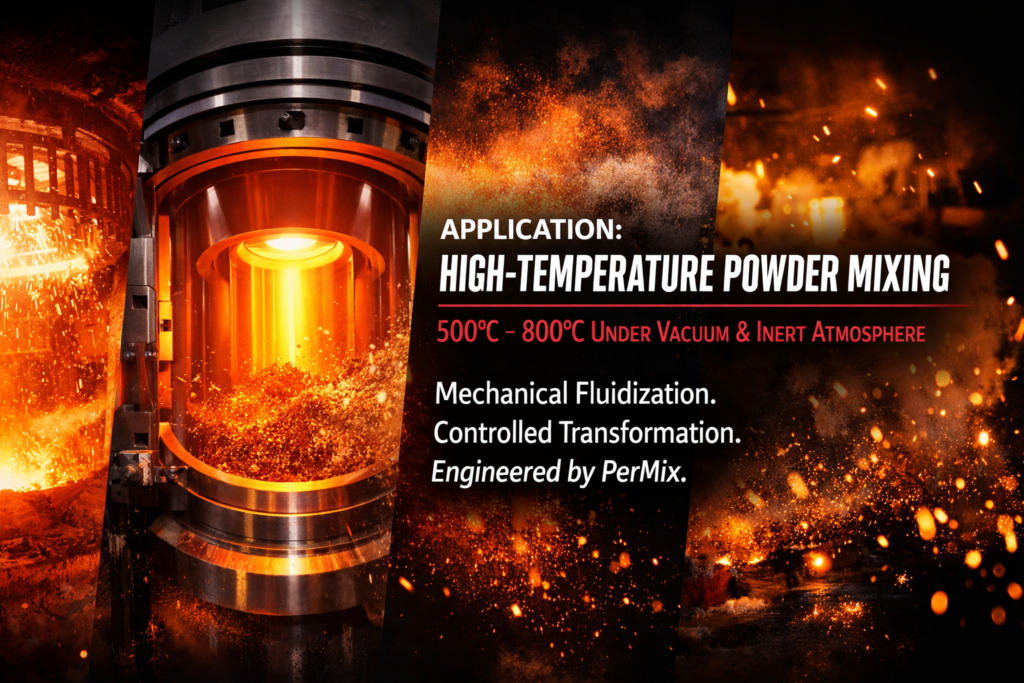
Mixing powders at super heated temperatures: Where Powders Stop Blending and Start Transforming
Powders behave politely at room temperature.
Heat them to 500–800°C and they start rewriting the laws of social conduct.
At those temperatures, you are no longer “just mixing.” You are driving reactions, phase changes, devolatilization, reduction, calcination, carbonization, activation. You are rearranging matter at a structural level.
And that’s exactly why advanced manufacturers go there.
High-temperature mechanical mixing under superheated conditions is used when the process demands:
1. Solid–Solid Reactions
Many ceramic, catalyst, battery, and refractory materials require intimate particle contact at elevated temperature to trigger diffusion and chemical bonding. Heat accelerates reaction kinetics. Mixing ensures uniformity so you don’t get hot spots, incomplete conversion, or inconsistent phase formation.
2. Calcination & Decomposition
Materials like carbonates, hydroxides, and organics release volatiles at elevated temperatures. Mechanical agitation prevents sintering and agglomeration while improving heat transfer.
3. Activation & Carbon Processing
Biochar, carbon black modification, advanced carbons for battery anodes — high temperature + controlled atmosphere + agitation allows precise structural tuning.
4. Pyrolysis & Thermal Treatment
Pharmaceutical intermediates, specialty chemicals, graphene derivatives, advanced materials — superheated environments under vacuum or inert gas allow controlled transformation without oxidation.
5. Preventing Sintering & Channeling
At 600°C, powders love to cake. Mechanical fluidization keeps the bed mobile, increasing surface exposure and ensuring thermal uniformity.
Heat without motion creates clumps.
Motion without controlled heat creates inconsistency.
High-performance processes need both.
This is not bakery-grade mixing. This is advanced materials territory:
These industries don’t just want blending. They want controlled transformation.
At these temperatures, equipment becomes a reactor.
You are no longer choosing between 304 and 316 stainless.
You are selecting high-temperature alloys engineered to resist creep, oxidation, and structural fatigue.
You are no longer using standard thermal oil jackets.
You are implementing electric resistance zones, radiant heating systems, induction heating, or furnace-style hot zones.
You are not simply sealing a shaft.
You are isolating bearings from the hot zone, using cooled seal chambers, inert barrier gas, vacuum-rated mechanical seals, and thermal isolation strategies.
Superheated mixing is not a catalog product.
It is engineered architecture.
PerMix designs pilot and production-scale high-temperature mechanical fluidizing reactors capable of operating in superheated conditions between 500°C and 800°C under:
We approach this challenge using proven platforms adapted for extreme duty:
High-Temperature Vacuum Plow Reactors
Deliver aggressive mechanical fluidization, high heat-transfer efficiency, and prevention of bed sintering.
High-Temperature Paddle Reactors/Dryers
Provide controlled, uniform conduction heating with excellent product mobility.
Custom Mechanical Fluidized Reactors
Engineered with:
We design the system around:
This is how advanced materials are made consistently — not in lab furnaces with hand mixing, but in engineered, scalable reactors that maintain uniformity, reproducibility, and safety.
Manufacturers operating in this temperature range care about:
PerMix builds solutions that bridge lab innovation and industrial production.
Because at 700°C, inconsistency becomes expensive very quickly.
The companies shaping the future of batteries, advanced ceramics, nanomaterials, and specialty chemicals do not gamble on temperature control or mixing uniformity.
They engineer it.
And that is exactly what PerMix does.
Stay Connected