Industrial Mixers
PerMix Applications
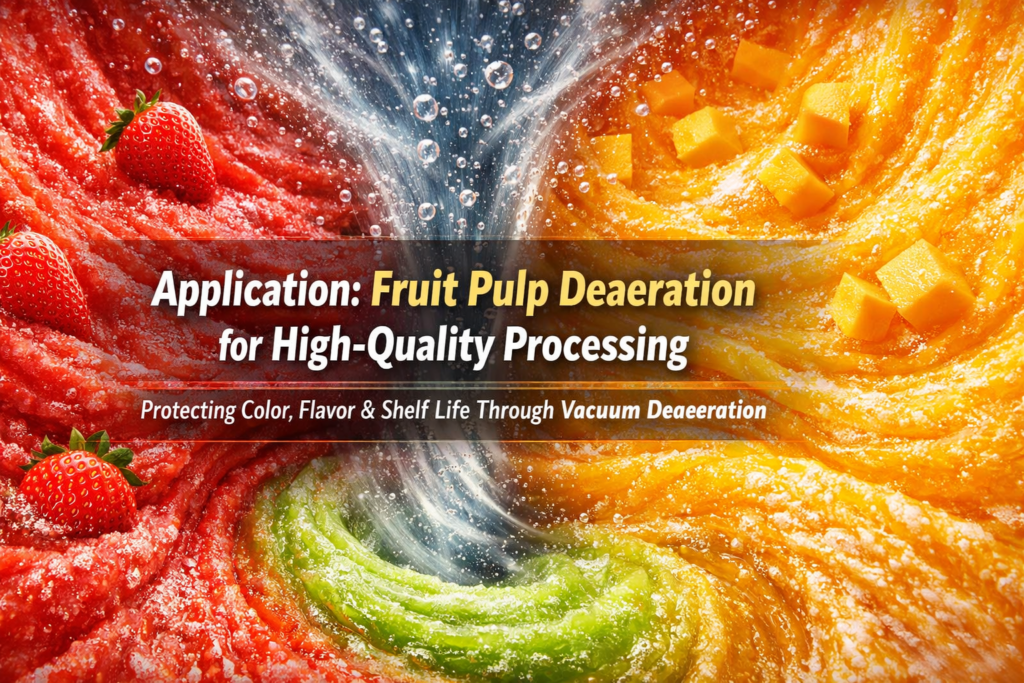
Fruit pulps, purées, and concentrates are used in a wide range of food products, including juices, sauces, yogurts, smoothies, confectionery fillings, and beverage bases. As consumer demand for natural ingredients continues to grow, manufacturers must preserve the fresh color, aroma, and nutritional value of fruits throughout processing.
One of the most critical but often overlooked steps in fruit processing is vacuum deaeration. Removing entrained air from fruit pulp significantly improves product stability, prevents oxidation, and ensures consistent downstream processing.
Industrial processors around the world use vacuum deaerators between the mixing stage and pasteurization to protect product quality and improve manufacturing efficiency.
PerMix vacuum deaeration systems are engineered to address these challenges, providing efficient gas removal for viscous fruit pulps while maintaining sanitary design and precise temperature control.
When fruits are crushed, blended, or homogenized into pulp, air becomes entrained within the product. This occurs due to agitation, pumping, and the natural cellular structure of the fruit itself.
Entrained air introduces oxygen into the product, which triggers several undesirable effects.
Many fruits contain sensitive pigments such as:
• Anthocyanins in berries
• Carotenoids in mango and papaya
• Chlorophyll in green fruits
Oxygen exposure can cause these pigments to degrade, leading to color fading or browning.
Volatile aromatic compounds that give fruits their characteristic flavor can oxidize rapidly when exposed to oxygen, resulting in dull or muted flavor profiles.
When the pulp is heated during pasteurization, trapped air bubbles expand. This can cause excessive foaming, which disrupts thermal processing and may lead to inconsistent pasteurization results.
Air bubbles reduce product density, leading to inaccurate filling during packaging and inconsistent product weight.
Oxidation reactions continue during storage, accelerating spoilage and reducing product stability.
Removing air from fruit pulp before thermal treatment significantly reduces these risks.
Vacuum deaeration works by lowering the pressure surrounding the product. When pressure decreases, the solubility of gases in liquids decreases, causing dissolved gases and entrained air bubbles to expand and escape from the product.
This phenomenon is described by Henry’s Law, which states that the solubility of a gas in a liquid decreases as pressure decreases.
In practical terms, when fruit pulp enters a vacuum deaerator:
The deaerated pulp is then discharged for further processing, typically pasteurization.
In most fruit processing lines, deaeration is placed between mixing and pasteurization.
Typical process flow:
Fruit preparation →
Crushing / pulping →
Mixing / blending →
Vacuum deaeration →
Pasteurization →
Packaging
This positioning provides maximum benefit because:
• Air introduced during mixing is removed before thermal treatment
• Oxidation reactions are minimized before heating
• Foam formation during pasteurization is reduced
• Product density becomes more stable for filling operations
Fruit pulps can vary widely in viscosity depending on fruit type, fiber content, and processing conditions.
Typical viscosity ranges include:
• Fruit juices: 10–100 cP
• Smooth fruit purées: 500–1,500 cP
• Thick pulps and concentrates: 2,000–4,000 cP or higher
Many fruit pulps reach 3,000 centipoise or more, especially products such as mango pulp, banana purée, and tomato paste.
At higher viscosities, air bubbles are more easily trapped within the product. Efficient deaeration therefore requires equipment designed to handle viscous materials while maximizing surface exposure under vacuum.
Fruit pulp is often processed at elevated temperatures before pasteurization.
Typical temperatures include:
Mixing stage: approximately 60°C
Pasteurization stage: approximately 85°C
During vacuum deaeration, a phenomenon called flash evaporation may occur. When pressure drops, a small portion of moisture evaporates, which can cause slight cooling of the product.
To maintain process stability, many industrial deaerators incorporate heating jackets that allow processors to control product temperature during deaeration.
This ensures smooth integration with downstream pasteurization systems.
Vacuum deaeration is widely used across the fruit and beverage industries.
Typical applications include:
Strawberry, mango, peach, apple, and banana purées benefit significantly from oxygen removal to preserve color and flavor.
Deaeration helps stabilize concentrated fruit products used in beverage manufacturing.
Tomato sauces and pastes often contain entrained air from mixing and pumping operations.
Fruit-based beverage concentrates require stable density and consistent flavor profiles.
Fruit components added to yogurt products must maintain their color and flavor during storage.
Implementing vacuum deaeration in fruit processing offers several advantages.
By removing oxygen, pigments remain vibrant and visually appealing.
Aromatic compounds are preserved, maintaining the natural taste of the fruit.
Oxidative degradation reactions are minimized.
Less foam formation leads to more stable thermal processing.
Deaerated products maintain uniform density.
Reduced oxidation slows product degradation during storage.
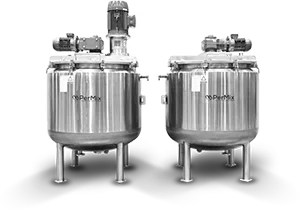
PerMix engineers vacuum deaeration systems designed for viscous food products and sanitary processing environments.
PerMix PDA Series Vacuum Deaerators offer:
• Efficient air removal from viscous products
• Jacketed vessels for temperature control
• Sanitary stainless steel construction
• Gentle product handling to preserve pulp structure
• Integration with mixers, homogenizers, and pasteurization systems
• Custom engineering for specific fruit processing requirements
PerMix systems are used by food processors worldwide to improve product quality and process reliability.
As the global demand for natural fruit products continues to grow, manufacturers must maintain the highest standards of product quality.
Vacuum deaeration plays a vital role in achieving this goal.
By removing entrained air before pasteurization, processors protect the natural characteristics of the fruit while improving manufacturing efficiency.
In many cases, the key to better processing is not adding another ingredient or step.
It is simply removing the air.
Stay Connected