Industrial Mixers
PerMix Applications
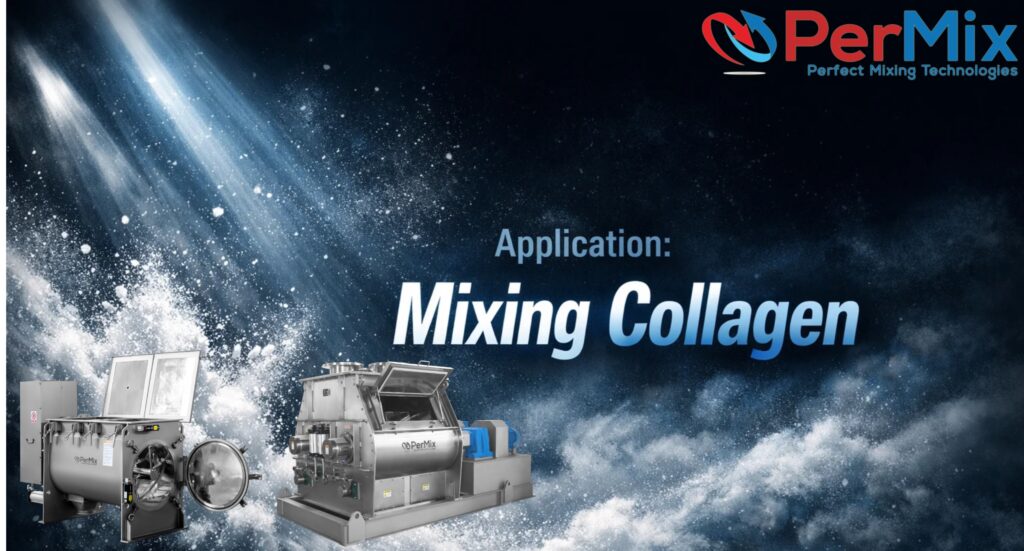
Collagen looks innocent enough. White. Fluffy. Nutritional. The kind of powder that suggests simplicity while quietly plotting chaos inside your mixer.
Co-packers know the truth: collagen and similar nutraceutical powders don’t behave like sugar or flour. They float. They cling. They segregate. They absorb moisture from the air like a sponge with ambition. And when the blend includes vitamins, flavors, sweeteners, enzymes, or plant extracts at low inclusion rates, suddenly mixing becomes a statistical problem instead of a mechanical one.
This is exactly where mixing technology stops being generic steel with a motor — and starts being process engineering.
Collagen powders (and their close cousins: peptides, proteins, functional fibers) bring a specific set of physical challenges:
They are low bulk density, often extremely light and fluffy. They tend to be cohesive, meaning particles stick to each other instead of flowing freely. They are prone to segregation when blended with heavier ingredients. They can be electrostatic, clinging to vessel walls and shafts. They are sensitive to over-shear, which can damage structure, create fines, or impact downstream flow.
In practical terms, this shows up as long mix times, poor CVs (coefficient of variation), hot spots of actives, dusting issues, and batches that look homogeneous until someone samples the bottom.
That last one is the expensive kind of surprise.
Ribbon mixers are everywhere for a reason. They’re simple, cost-effective, and well understood. For many free-flowing powders, they work beautifully.
But collagen is not a free-flowing powder.
A ribbon mixer relies on bulk circulation: material moves axially and radially as the ribbons push product from end to end. This works best when particles readily fall and re-orient under gravity.
With collagen, what often happens instead is:
Material rides the ribbons instead of fluidizing Light particles float while heavier ingredients sink Low-dose actives smear instead of dispersing Extended mixing increases segregation rather than fixing it
You can improve performance with longer times, higher RPMs, intensifiers, or liquid pre-blending — but at some point you’re asking a screwdriver to behave like a scalpel.
This is where PerMix changed the conversation.
Fluidized Zone Mixers don’t rely on gravity and bulk tumbling. They rely on mechanical fluidization — lifting, suspending, and continuously re-orienting particles throughout the mixing zone.
Think less “pushing piles around” and more “temporarily defeating gravity.”
In a PerMix Fluidized Zone Mixer:
Particles are lifted into a dynamic mixing state Contact points between particles constantly renew Light and heavy components stay engaged together Agglomerates are gently broken without over-shear Homogeneity is achieved statistically, not cosmetically
This is especially powerful for collagen blends where inclusion rates can drop below 1% and uniformity isn’t a preference — it’s a regulatory requirement.
Most collagen products are not single-ingredient powders. They’re blends.
Collagen with vitamin C. Collagen with magnesium. Collagen with flavors, sweeteners, probiotics, enzymes, or plant extracts.
These formulations demand true dispersion, not visual uniformity.
Fluidized zone mixing excels because it:
Prevents density-driven segregation Reduces mix times dramatically Achieves lower CVs consistently Handles a wide range of particle sizes in one batch Scales cleanly from pilot to production
For co-packers, that means fewer failed batches, easier scale-up, faster changeovers, and confidence that what’s in the scoop matches the label.
PerMix builds ribbon mixers too — and uses them honestly.
Ribbon mixers remain a solid choice when:
The formulation is free-flowing Ingredient densities are similar Inclusion rates are relatively high The process is forgiving
But when collagen is the base and precision matters, PerMix engineers don’t force a ribbon mixer into a role it wasn’t born for.
They recommend the right physics for the job.
PerMix doesn’t sell mixers in isolation. They engineer mixing outcomes.
For collagen and nutraceutical powders, that means:
Equipment designed around powder behavior, not catalog categories Fluidized zone technology optimized for low-density, cohesive powders Options for dust control, hygienic design, and rapid cleaning Scalable platforms for co-packers managing multiple SKUs Real process understanding, not just stainless steel
The result is blending systems that don’t just mix collagen — they respect it.
Collagen powders expose weak mixing strategies quickly. What looks uniform on top can be wildly inconsistent underneath. Ribbon mixers can work, but they often fight the physics. Fluidized zone mixers work with it.
PerMix leads because they start with how powders behave, not how mixers are traditionally sold.
And collagen, for all its health benefits, demands nothing less than that level of honesty from the equipment behind it.
Stay Connected