Industrial Mixers
PerMix Applications
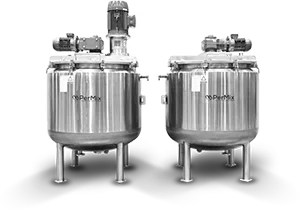
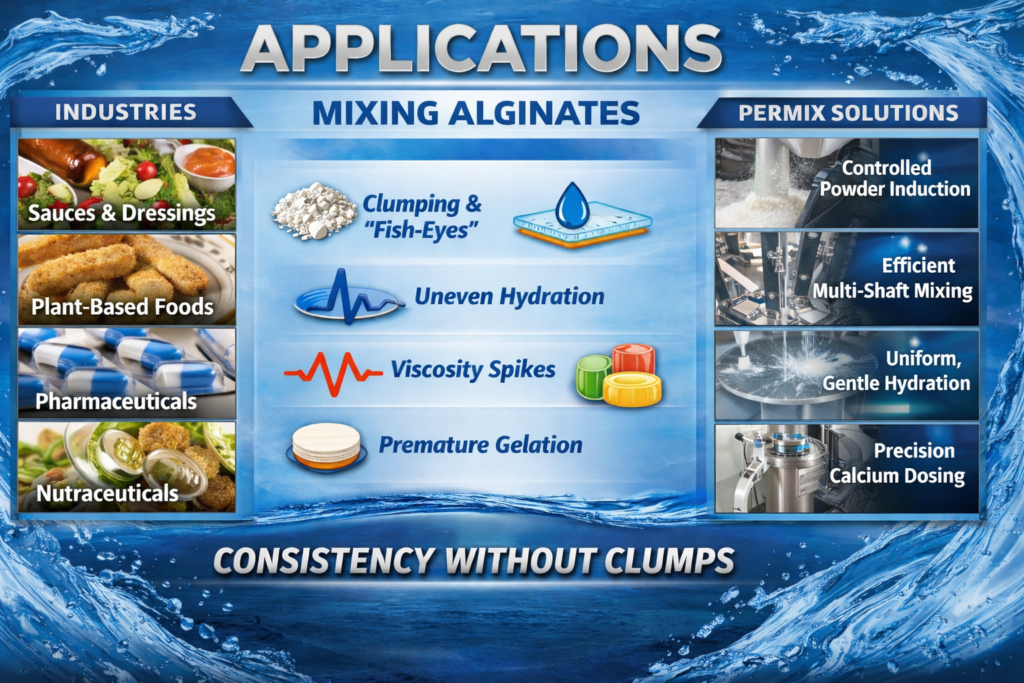
Mixing alginates is one of those jobs that looks simple right up until it isn’t. A white powder, a tank, some water—how hard could it be? Then the clumps appear. Fish-eyes form. Hydration is uneven. Viscosity spikes like a bad heart monitor. Welcome to the wonderfully stubborn world of alginates.
Alginates—typically sodium alginate derived from brown seaweed—are prized because they hydrate fast, build viscosity at low concentrations, and form gels in the presence of calcium. That speed and sensitivity are exactly what make them tricky. If they see liquid the wrong way, even briefly, they punish you with agglomerates that refuse to disperse.
This is where PerMix earns its keep.
Alginates hydrate on contact. The outer surface of each particle swells almost instantly, forming a gel skin that traps dry powder inside. High-speed dumping creates clumps; low energy mixing leaves unmixed pockets. Add calcium too early and you’ve essentially made gummy candy in a tank.
Successful alginate processing demands three things at once:
controlled wetting, uniform dispersion, and gentle-but-complete hydration. Miss any one of those and consistency is gone.
PerMix approaches alginates like a system problem, not a “bigger motor” problem.
First, controlled powder induction. PerMix mixers can be configured with low-shear powder wet-out zones or vacuum-assisted powder induction. This lets alginate particles enter the liquid phase individually, not as a floating powder raft destined to clump.
Second, the right mixing energy—at the right moment. PerMix paddle, plow, and multi-shaft mixers generate bulk movement first, then localized shear only where needed. That combination breaks initial agglomerates without shredding polymer chains, preserving final viscosity and gel strength.
Third, hydration without violence. Once dispersed, alginates don’t need chaos; they need time and uniformity. PerMix designs maintain full tank turnover so every molecule sees the same hydration history. The result is predictable viscosity, batch after batch.
Fourth, calcium control. In food, pharma, and nutraceutical applications, calcium addition is often the final act. PerMix systems allow precise liquid dosing late in the process, preventing premature gelation and giving manufacturers real control over texture and set time.
Food processors rely on alginates for sauces, dressings, restructured foods, and plant-based products where mouthfeel is everything. Pharmaceutical and nutraceutical producers depend on them for controlled release, encapsulation, and suspension stability. In all of these, inconsistency is expensive—scrapped batches, rework, and customer complaints.
PerMix mixers are built to scale alginate processing cleanly from pilot to production, without changing the physics of the mix. What works in R&D behaves the same at 2,000 liters. That’s not magic—it’s geometry, flow paths, and a stubborn respect for how materials actually behave.
The real win isn’t just “no lumps.” It’s repeatability. When alginates behave, formulations tighten, viscosity targets stop drifting, and operators stop babysitting tanks. The process becomes boring—in the best possible way.
And in manufacturing, boring usually means profitable.
PerMix doesn’t just mix alginates. It removes their bad habits, one well-designed batch at a time.
Stay Connected