Industrial Mixers
PerMix Applications
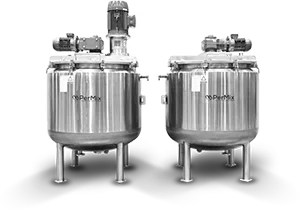

Mixing & Drying Hygroscopic Materials—salts, sugars, proteins, polymers, nutraceutical ingredients, minerals—treat ambient humidity like an all-you-can-eat buffet. They absorb water through capillary action, surface bonding, and vapor diffusion. Once moisture locks in, particle surfaces change, flow behavior shifts, and the material’s entire personality gets… unpredictable.
That unpredictability creates a cascade of problems:
• Clumping & caking: The powder turns into a semi-solid lump that behaves like wet beach sand.
• Loss of flowability: Conveyors stall, feeders bridge, hoppers hang.
• Inconsistent densities: Batches become unreliable and dosing becomes a circus act.
• Reduced product quality: Hygroscopic ingredients lose potency, degrade faster, oxidize sooner, or develop off-colors.
• Microbial risks: Moisture is basically an Airbnb for bacteria, yeasts, and molds.
• Processing issues: Extrusion, tableting, encapsulation, blending—everything suffers when the moisture isn’t controlled.
When drying isn’t done right, everything that comes after becomes harder, slower, more expensive, and less accurate. Moisture is polite enough to stay invisible, but rude enough to ruin your day.
A lot of people think drying is all about heat, but that’s only half the story. Drying is a dance between heat transfer, mass transfer, and agitation efficiency.
A mixer becomes a dryer only when three magic things happen at once:
Not just the ones sitting nearest the jacket. Effective agitation exposes fresh product surfaces continuously so moisture doesn’t hide in the dead zones.
You need good vapor pathways, not a sauna. Proper agitation keeps particles separated, breaking capillary bonds so vapor can leave instead of re-condensing inside the bed.
Hygroscopic materials often degrade under high heat, so the mixer must dry at lower temperatures—achieving faster and safer drying through vacuum.
Vacuum is the cheat code of drying.
Pull the pressure down and suddenly:
• Water evaporates at dramatically lower temperatures
• Drying happens faster
• Sensitive ingredients stay intact
• Agglomeration and caking are reduced
• Oxygen levels drop, protecting color, flavor, potency, and shelf life
The mixer’s geometry, agitation style, and internal tool design determine whether drying happens efficiently—or whether half the batch sits in a corner sulking.
This is where PerMix steps in like a well-prepared orchestra conductor. You bring the hygroscopic circus, and PerMix brings the calm, controlled, “let’s-get-this-done” engineering.
Designed for maximum surface exposure. The paddles lift, fold, and fluidize the material at low RPM, spreading heat uniformly and creating open vapor pathways. Perfect for powders that like to clump when stressed.
Gentle yet thorough axial and radial mixing, ideal when drying while keeping particle integrity intact. Ribbons sweep every corner, eliminating dead zones where moisture loves to hide.
High-performance fluidized-zone mixing. Plows fling material into a weightless state, creating massive heat-transfer efficiency. Moisture leaves fast. Perfect for the stickiest hygroscopic nightmares.
For precision drying at low temperatures with extremely delicate or heat-sensitive materials. Near-wall-scraping and planetary motion keep everything moving without crushing fragile ingredients.
PerMix didn’t just bolt a vacuum pump onto a mixer and call it a day. The engineering is deliberate, modern, and deeply rooted in real-world production problems.
Not just the side walls, but tops, bottoms, cones, and even shafts depending on model. Maximum thermal real estate equals shorter cycles.
From mild vacuum for gentle moisture removal
to
deep vacuum for aggressive drying of extreme hygroscopic ingredients.
Wide sweeps, precise tolerances, high coverage—from high-viscosity paste beds to fluffy powders.
• Load cells to monitor moisture-loss in real time
• Choppers for breaking lumps formed by moisture
• Liquid additive ports for granulation or rehydration steps
• CIP & air/water cleaning systems
• Gas purge for oxygen-sensitive materials
• Explosion-proof designs for hygroscopic materials that are also combustible
Stainless, Hastelloy, Hardox, titanium—you name it. Built to last, easy to clean, and engineered for global compliance.
Drying hygroscopic materials is a battle against physics, humidity, and impatience. But with vacuum, proper geometry, and advanced agitation, you turn a stubborn material into a compliant, flowable, dry, process-ready ingredient.
PerMix vacuum mixers & dryers don’t just dry—they:
• protect product quality
• prevent clumping
• reduce cycle times
• improve downstream performance
• extend shelf life
• increase batch consistency
• and slash energy costs
When the industry brings hygroscopic headaches, PerMix brings vacuum-powered clarity.
And the better your drying is, the better everything downstream becomes.
Stay Connected