Industrial Mixers
PerMix News & Updates
A powder line usually starts showing its weaknesses at the mixer. You see it in long blend times, dusty charging, ingredient segregation, wet spots after liquid addition, or a formula that behaves well in trials and poorly in full production. In many of those cases, the right ribbon mixer for powders can solve the problem efficiently, but only if the machine is matched to the material, the batch, and the production target.
Ribbon mixers remain one of the most widely used batch blending technologies in industrial processing because they are practical, cost-effective, and versatile across a broad range of dry and dry-with-liquid applications. They are especially attractive to manufacturers that need dependable blending without moving into a more complex or higher-cost mixing platform than the process actually requires. That said, not every powder is a ribbon mixer powder, and not every ribbon design delivers the same result.
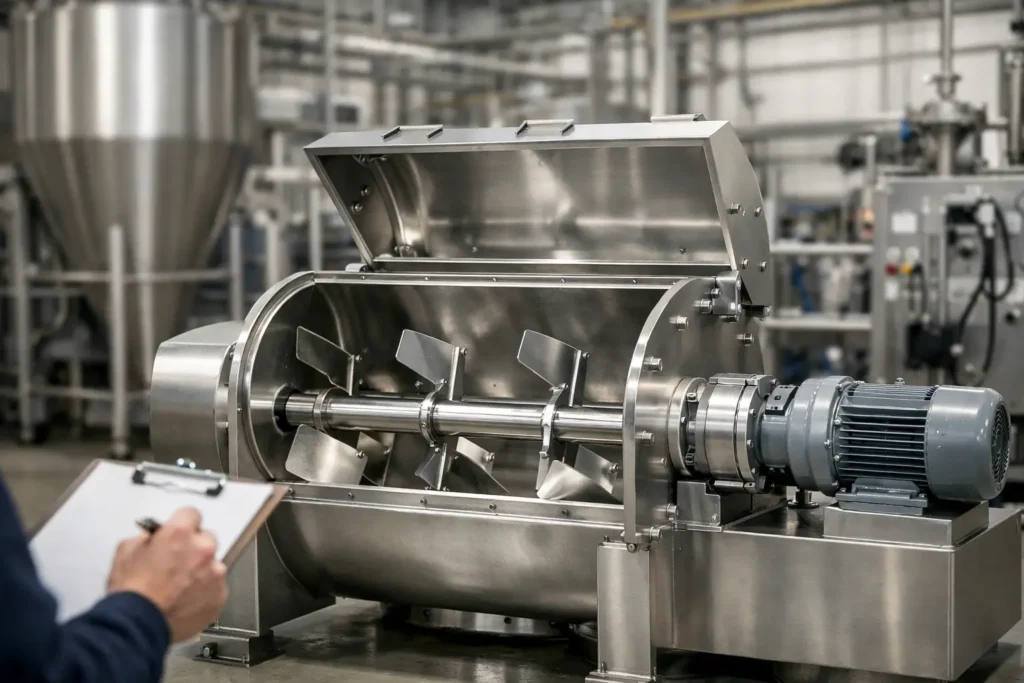
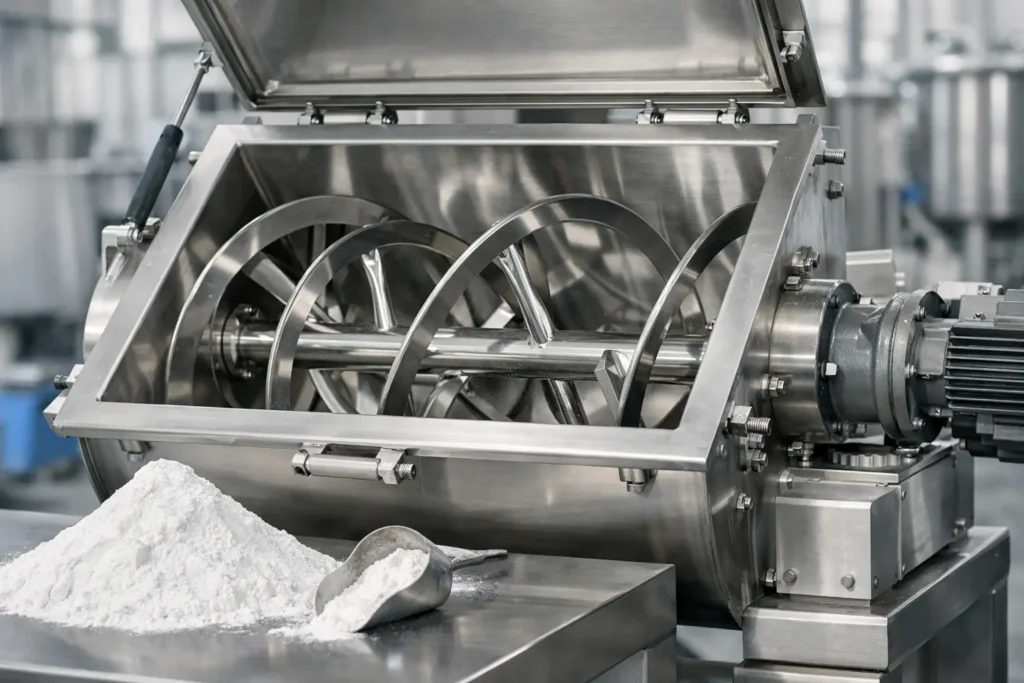
A ribbon mixer uses an inner and outer helical ribbon mounted on a horizontal shaft inside a U-shaped trough. As the agitator rotates, one ribbon moves material in one axial direction while the other moves it in the opposite direction. That counter-flow pattern creates a convective mixing action that turns over the batch efficiently and promotes bulk homogeneity.
For many industrial powders, this is exactly the right kind of movement. Free-flowing and moderately cohesive materials often respond well because the mixer can circulate a large batch volume quickly without excessive shear. This makes ribbon mixers a strong fit for dry food ingredients, chemical blends, mineral products, agricultural powders, detergent mixes, and many nutraceutical premixes.
The other reason ribbon mixers remain popular is economic logic. They offer a strong balance of blending performance, usable capacity, mechanical simplicity, and maintenance accessibility. For plants trying to expand throughput or standardize batch quality on a realistic budget, that balance matters.
A ribbon mixer for powders is usually a good candidate when the process requires consistent batch blending, moderate cycle times, and straightforward operation. If your formula consists mainly of dry ingredients with similar particle size and bulk density, a ribbon mixer is often one of the most efficient places to start.
It is also a practical option when limited liquid addition is required. Many powder processors need to add oils, flavors, binders, or minor liquid ingredients during blending. A properly designed spray system, combined with the right agitator speed and fill level, can distribute those liquids effectively. The key phrase is properly designed. Poor spray placement or overloading liquid into a dry blend can turn even a good mixer into a source of lumps.
Ribbon mixers also work well for applications where batch discharge and upstream-downstream integration are important. They can be configured with load cells, multiple inlets, choppers, jackets, sanitary finishes, vacuum capability in some designs, and discharge valves suited to the product and plant layout. For many processors, the mixer is not a standalone machine. It is a production node that has to fit material handling, weighing, filling, and cleaning requirements.
This is where experienced equipment selection matters. Ribbon mixers are versatile, but they are not universal.
Very fragile particles may degrade if the process requires long blend times or aggressive liquid incorporation. Powders with severe cohesion, extreme density differences, or a tendency to smear may need a different mixing principle. If your product forms hard agglomerates, a paddle mixer, plow mixer, or high-intensity system may produce a better result. If sanitary validation is the priority and changeovers are frequent, the cleaning demands of a standard ribbon mixer design may also become a deciding factor.
Heat-sensitive materials can be another gray area. A ribbon mixer itself is not usually a high-heat process, but friction, cycle time, and jacket conditions still matter. In some formulations, even a small temperature rise can affect flowability, aroma, or active ingredient stability. That does not rule out ribbon mixing. It means the machine should be sized and configured with the process in mind rather than selected from capacity alone.
The first mistake buyers make is focusing only on total vessel volume. Usable working capacity is more important. Ribbon mixers need the right fill level to create proper material movement. Too full, and mixing action becomes restricted. Too empty, and the ribbons may not generate the intended turnover pattern.
Agitator design also deserves close attention. Ribbon width, pitch, clearance, shaft construction, and rotational speed all influence mixing performance. A standard double ribbon may be appropriate for one application, while another formula benefits from modified geometry or additional high-speed choppers. This is especially true when liquid addition or deagglomeration is part of the process.
Discharge design is another practical issue that directly affects efficiency. A mixer that blends well but leaves excessive heel behind can create yield loss, allergen risk, or prolonged cleaning time. Full-width bomb-bay valves, flush outlet designs, and application-specific discharge options can significantly improve batch turnover.
For regulated industries, surface finish, weld quality, shaft sealing, and cleanability are not secondary details. They are part of the equipment decision. Food, pharmaceutical, nutraceutical, and health and beauty manufacturers often need a ribbon mixer designed around sanitation standards, not adapted after the fact.
Before selecting a ribbon mixer for powders, it helps to look beyond the SDS sheet and basic bulk density number. Real mixing performance depends on how the material behaves in motion.
Particle size distribution matters because fine powders and coarse granules do not move the same way. Bulk density matters because dense minerals and light botanicals place very different demands on motor sizing and blend dynamics. Flowability matters because a powder that bridges in storage may also resist circulation in the trough.
Then there is the formula itself. Are there trace ingredients that must distribute evenly at very low inclusion rates? Will liquids be added? Does the material smear on metal surfaces? Does it pack under compression? Does it segregate during discharge? Those are not minor process details. They determine whether a standard ribbon mixer is sufficient or whether the system should be engineered around a more demanding application window.
This is where technical consultation adds real value. A mixer should be selected by application, not by catalog category alone.
A ribbon mixer that performs well in pilot-scale tests still has to perform on the plant floor. Scale-up is not just a matter of making the trough larger. Charging sequence, cycle time, discharge rate, horsepower, and liquid injection method can all change as volume increases.
Operations teams should evaluate the full production cycle, not just mix time. If a batch blends in eight minutes but takes twenty minutes to load, spray, discharge, and clean, the effective throughput may fall short of target. Likewise, if the formulation changes frequently, labor and sanitation time may matter as much as blend uniformity.
Consistency is another major driver. Most manufacturers are not buying a mixer to achieve one good batch. They need repeatable output across shifts, operators, and ingredient lot variations. That is why instrumentation, recipe control, repeatable agitator speed, and predictable discharge performance can be just as valuable as the core mechanical design.
Industrial mixing is full of near-matches. A standard mixer may run the product, but that does not always mean it runs it well. The best results often come from small but meaningful adjustments such as a jacket for temperature control, a sanitary polish, a pressure- or vacuum-rated vessel, a specific seal arrangement, side-entry choppers, or an atomizing spray manifold for liquid addition.
That is especially true for manufacturers working across multiple formulas or planning for growth. A machine that meets today’s batch target but cannot adapt to tomorrow’s product mix may become a bottleneck sooner than expected. Well-engineered customization gives the plant a wider operating range without overcomplicating ownership.
Manufacturers that work with a broad range of powder, paste, and liquid technologies usually bring an advantage here. They can recommend a ribbon mixer when it is the right solution, and they can say so clearly when another mixer type would be better. That kind of guidance protects both performance and budget.
The right supplier should ask specific questions about product behavior, cleaning requirements, batch size, plant utilities, liquid addition, and future production plans. If the conversation stays at vessel volume and motor size, the process has not gone far enough.
Buyers should also expect practical engineering support. That includes attention to mechanical reliability, finish and fabrication quality, lead time, parts support, and commercial value. For many processors, the best equipment decision is not the most expensive machine or the most complex one. It is the mixer that delivers repeatable results, fits the application, and supports the business over the long term.
PerMix approaches ribbon mixing that way – as an engineered production solution rather than a generic machine category.
If you are evaluating a ribbon mixer for powders, the smart move is to start with the product and the process, then work back to the equipment. That is how you get better blending, fewer surprises at scale, and a mixer that earns its place on the line year after year.

Stay Connected