Industrial Mixers
PerMix News & Updates
When a batch starts behaving more like dough, putty, or heavy paste than a free-flowing liquid, standard agitators stop being productive very quickly. A sigma mixer for high viscosity processing is built for that exact problem – moving dense, resistant materials with enough force and control to produce a consistent, workable mass instead of dead zones, overheating, or long cycle times.
High viscosity mixing is a mechanical challenge first and a blending challenge second. Once materials become thick enough to resist flow, the mixer has to do more than circulate product. It has to knead, fold, stretch, compress, and continuously expose fresh material to the blades.
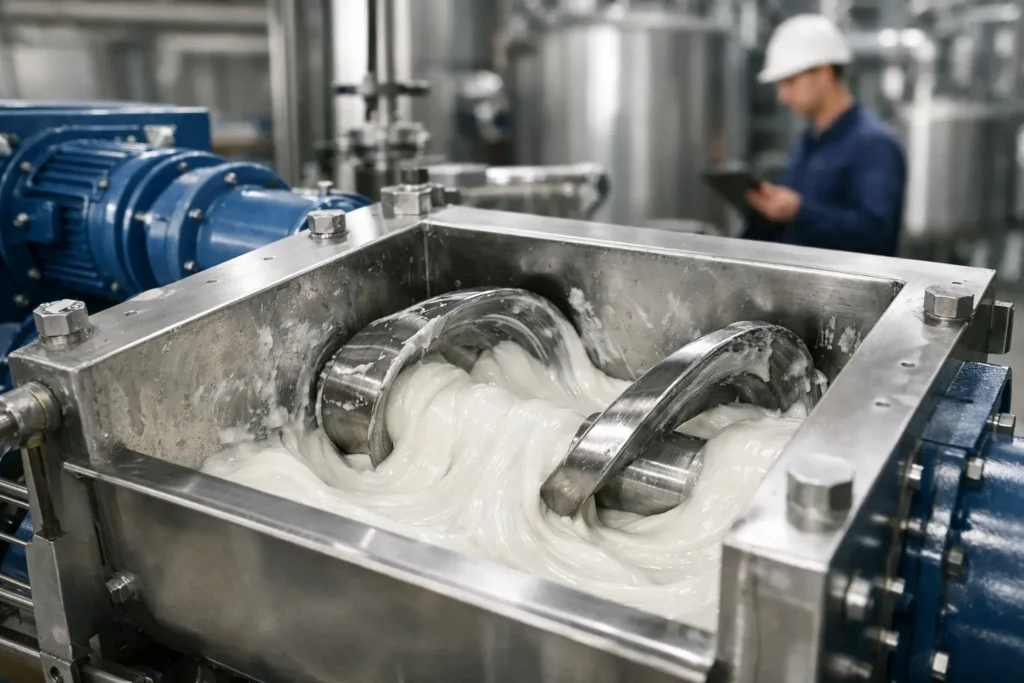
That is where the sigma blade design stands apart. The blades rotate toward each other at differential speeds, pulling material from the chamber walls into the working zone and forcing it through repeated deformation. This action is especially effective for compounds that cling, smear, bridge, or form heavy masses during processing.
In practical terms, sigma mixers are commonly selected for products such as sealants, adhesives, carbon pastes, putties, rubber compounds, heavy confectionery masses, pharmaceutical doughs, cosmetic pastes, and dense chemical formulations. In these applications, a conventional propeller or turbine mixer may spin, but it does not generate the same level of mechanical working on the batch.
Buyers often start with capacity, but capacity alone does not tell you whether the machine will perform. For a high-viscosity application, the better starting point is the material behavior across the full cycle.
A batch may begin as dry powders and liquid binders, then transition into granules, and finally become a cohesive paste. Another process may start with a soft base and become dramatically stiffer as fillers are added. Those shifts affect torque demand, fill level, blade geometry, motor sizing, jacket requirements, and discharge strategy.
Published viscosity numbers can be useful, but they are rarely enough on their own. Many industrial materials are non-Newtonian. Their apparent viscosity changes with shear, temperature, and composition. Some become easier to move once worked. Others tighten rapidly during mixing.
That is why experienced equipment selection looks at more than a single viscosity value. You need to understand whether the product is tacky, elastic, heat-sensitive, abrasive, solvent-based, moisture-sensitive, or prone to entraining air. A sigma mixer that performs well on one heavy paste may not be the best fit for another with very different rheology.
For thick materials, insufficient torque is one of the most expensive sizing mistakes. A machine may appear properly sized by batch volume yet still struggle under real production conditions. Slow, forceful blade movement is often more valuable than higher blade speed.
This is especially true when formulations are loaded with fillers, solids, or elastomeric components. The mixer has to maintain movement through the most demanding stage of the cycle, not just the easiest one at startup. That usually means selecting a drive system with a meaningful safety margin rather than a motor sized only to nominal conditions.
Overfilling reduces blade exposure and can limit the folding action that makes sigma mixers effective. Underfilling can also reduce efficiency because the batch may not engage the blades and trough geometry as intended. The best working volume depends on the material, blade design, and discharge method.
For that reason, procurement teams should not treat total vessel volume as usable production volume. The productive batch size is the one that delivers repeatable mixing, acceptable cycle time, and reliable discharge.
A sigma mixer is not one interchangeable category. Mechanical configuration changes process results.
Standard sigma blades are widely used because they provide strong kneading and folding action across many paste and dough applications. Tangential or dispersion-oriented blade designs may be better where faster incorporation, stronger shear, or different flow behavior is needed. The correct choice depends on whether the process priority is homogenization, particle wetting, dispersion, plasticization, or simple mass formation.
Trough construction also matters. Jacketed troughs support heating or cooling during mixing, which can be essential when viscosity is temperature-dependent. A formulation that is nearly immobile at room temperature may process efficiently once warmed to a controlled range. On the other hand, some products generate frictional heat and must be cooled to prevent quality loss, phase change, or premature reaction.
Discharge deserves just as much attention. Manual removal may be acceptable for small laboratory or specialty batches, but production environments usually need more efficient options. Tilting trough discharge is common and effective for many heavy products. Extrusion discharge can be the better choice when the material is extremely stiff or when downstream feeding must be more controlled. Bottom discharge designs may also be considered depending on plant layout and product behavior.
Thick materials do not forgive poor thermal control or inconsistent cycle timing. A few extra degrees of heat, a delayed ingredient addition, or inadequate deaeration can change final texture, density, or downstream processability.
For many paste applications, jacketed mixing is not optional. It is how the process stays within a workable viscosity window. In chemical and adhesive manufacturing, temperature control may determine whether fillers disperse properly or remain partially incorporated. In food or confectionery applications, it can affect texture and handling. In pharmaceutical and personal care processing, it may be tied directly to product consistency and batch repeatability.
A vacuum sigma mixer can be a strong advantage when the product traps air, contains volatile components, or requires moisture control. Entrained air can compromise density, appearance, filling accuracy, and shelf life. Under vacuum, the mixer can improve deaeration while also supporting solvent recovery or low-moisture processing, depending on the application.
The order and rate of addition matter more in high-viscosity mixing than many teams expect. Adding powders too quickly can create hard lumps and overload the drive. Adding liquids too late can extend cycle time. For some formulations, staged addition is the difference between a smooth batch and a difficult one. The mixer should support the way the formulation actually needs to be built, not force operators into inefficient workarounds.
A sigma mixer for high viscosity production is particularly valuable when product consistency depends on mechanical working, not just blending. In adhesives and sealants, that may mean proper filler incorporation and controlled temperature rise. In rubber and polymer compounds, it may mean enough torque to handle highly resistant masses. In food production, it may mean uniform dough development or confectionery paste preparation without damaging the product.
In pharmaceuticals, nutraceuticals, and health and beauty applications, the decision often comes down to repeatability, sanitary design, and the ability to process difficult semi-solids without batch-to-batch variation. In chemical manufacturing, the priorities may shift toward abrasion resistance, corrosion compatibility, jacket performance, and safe handling of reactive or solvent-based systems.
The common thread is simple: when the material resists movement, equipment design has to do the work.
The most productive equipment discussions are built around process data, not just a request for a mixer of a certain size. A supplier should be able to evaluate the full application, including batch weight, bulk density, ingredient sequence, operating temperature, target cycle time, discharge expectations, and cleaning requirements.
It is also worth discussing how the process may change over time. Many plants buy for the current formula and then discover six months later that a higher-solids version, a new package size, or a broader product range pushes the mixer beyond its comfort zone. The better investment is a system sized for real production needs with enough engineering flexibility to support growth.
This is where an application-focused manufacturer adds value. PerMix approaches sigma mixer selection with that practical engineering mindset – matching blade design, drive strength, vessel configuration, temperature control, and discharge method to the actual demands of the material and the plant.
There is no single best sigma mixer for every heavy product. The right machine depends on how your material behaves at startup, at peak viscosity, and at discharge. It depends on whether heat helps or hurts, whether air removal is necessary, and whether the batch needs kneading, dispersion, or both.
If your process involves dense pastes, dough-like masses, or highly resistant compounds, a sigma mixer is often the most direct path to better mixing quality and more reliable throughput. The smartest next step is not guessing by vessel size. It is defining the process clearly enough to choose a mixer that will still perform when the batch becomes difficult.
Stay Connected