Industrial Mixers
PerMix News & Updates
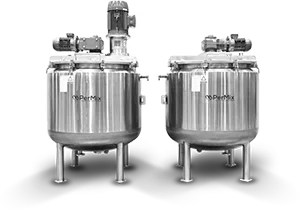
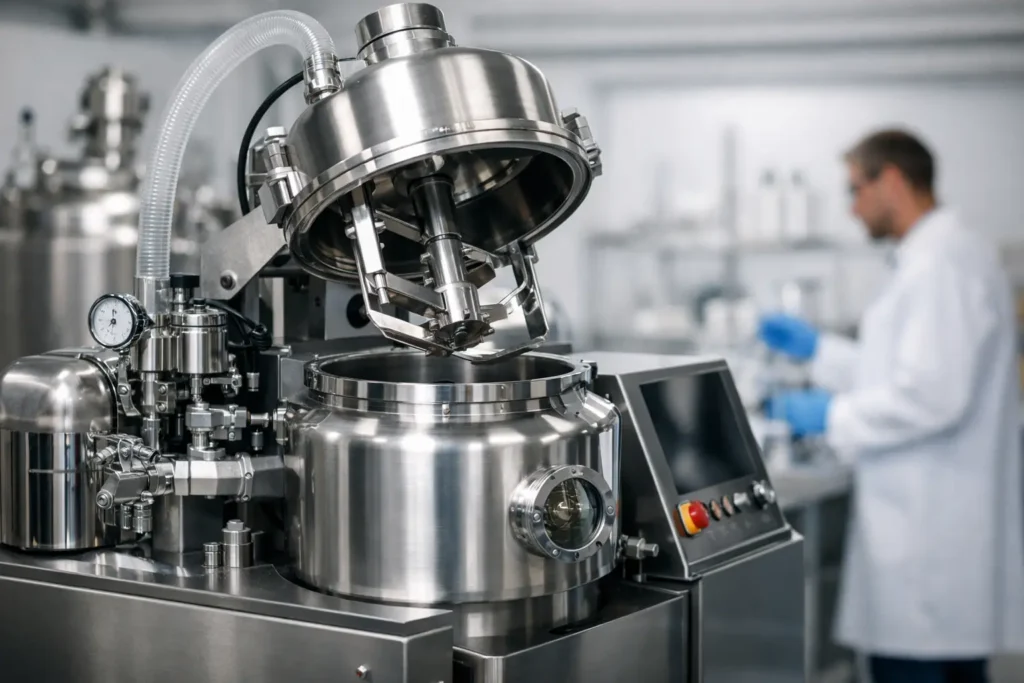
Air in a batch rarely looks like a serious production problem until it starts showing up everywhere else – inconsistent density, foam, surface defects, poor filling accuracy, weak bond lines, or shorter shelf life. That is where a vacuum mixer for deaeration earns its place. In many liquid, paste, and semi-solid applications, removing entrained air during mixing is not a finishing detail. It is a core process requirement that directly affects quality, throughput, and repeatability.
A standard mixer can blend ingredients well and still leave the process vulnerable if the formulation traps air easily. High-viscosity materials, powders added into liquids, surfactant-containing systems, and temperature-sensitive products all create conditions where bubbles become difficult to remove once they are dispersed. Vacuum mixing addresses that issue at the source by combining agitation with controlled pressure reduction, allowing air and gas to release while the product is being processed.
A vacuum mixer for deaeration is designed to mix product while pulling vacuum on the vessel headspace, reducing the pressure around the material so entrained air can expand, rise, and escape. In practical terms, that means fewer voids in the final batch and more stable product behavior downstream.
This matters across a wide range of production environments. In cosmetics, deaeration helps improve appearance, filling consistency, and texture in creams and gels. In adhesives and sealants, it can reduce pinholes and improve application performance. In pharmaceuticals and nutraceuticals, it supports dose consistency and cleaner processing for sensitive formulations. In chemical manufacturing, it helps maintain product density and reduces defects that can show up later in coating, dispensing, or packaging operations.
The value is not limited to bubble removal alone. Vacuum processing can also improve wet-out of powders, reduce foam formation, and support cleaner incorporation of ingredients that would otherwise create aeration under atmospheric conditions.
Air enters a batch in more ways than many plants expect. It can come from aggressive agitation, poor powder induction, recirculation design, vessel geometry, or the product itself. Materials with higher viscosity are especially prone to holding bubbles because air cannot easily rise out of the mass once it is dispersed.
That creates a chain reaction on the production floor. Batch volume may look higher than it really is. Filling weights can drift. Heat transfer becomes less predictable. Pumping and dispensing may become erratic. Products that should appear smooth and dense can develop defects after packaging, curing, or storage.
The cost is often hidden in rework, slower cycles, and inconsistent QA results rather than one obvious failure. That is why process engineers often look at deaeration not as a cosmetic improvement, but as a control point for overall production stability.
The basic principle is straightforward, but the result depends heavily on equipment design. A well-engineered vacuum mixer balances agitation, shear, vessel geometry, and vacuum level so that gas can escape without compromising the formulation.
Under vacuum, bubbles expand and become easier to release from the product matrix. At the same time, the mixer keeps the batch moving so trapped air does not remain isolated in dead zones. Anchor agitators, planetary designs, high-shear emulsifying heads, and scraper systems may all be used depending on viscosity and process goals.
This is where application fit matters. A low-viscosity liquid may deaerate effectively with moderate agitation and simple vessel design. A heavy paste, putty, or gel may require a more specialized configuration with wall scraping, tighter tolerances, and stronger torque to expose entrained air throughout the vessel. The best result comes from matching mixer architecture to product behavior, not from applying vacuum alone.
Plants sometimes focus too heavily on the vacuum rating itself. Deep vacuum can help, but it is not automatically better for every product. Some materials expand aggressively under reduced pressure and may foam if agitation is not controlled. Others become more temperature-sensitive or change rheology during the cycle.
That means effective deaeration usually depends on the full process window: vacuum level, mixing speed, shear intensity, batch temperature, cycle time, and ingredient addition sequence. A capable system gives operators the control needed to manage those variables consistently.
The strongest candidates for vacuum deaeration are products where trapped air directly affects final performance or appearance. Creams, ointments, lotions, toothpaste, gels, mastics, silicone compounds, coatings, epoxies, resins, and slurry-based products are common examples. So are formulations that include fine powders, thickeners, pigments, or actives that tend to introduce air during charging.
Food production can also benefit, especially in sauces, fillings, and viscous prepared products where texture and density matter. That said, the exact sanitary design, cleanability, and process controls required will vary by market. A pharmaceutical vessel and a chemical vessel may both operate under vacuum, but they will not necessarily share the same construction details, finish standards, or validation expectations.
This is one reason custom application review matters. The right mixer for deaeration in one industry may be the wrong choice in another, even if the batch viscosity looks similar on paper.
For most buyers, the equipment decision should start with the material, not the machine catalog. Viscosity range, batch size, density changes, solids loading, temperature limits, and cleaning requirements all affect what configuration will perform reliably.
Agitator style is one of the biggest decision points. Anchor and scraper agitators are often effective for viscous products because they keep material moving at the wall and improve heat transfer. Planetary systems are well suited to heavy pastes and difficult blends where full-batch movement is critical. High-shear heads may be necessary if dispersion or emulsification is part of the same process, but they must be integrated carefully so they do not create more aeration than the vacuum system can remove.
Vessel geometry also matters. A poorly proportioned tank can leave stagnant zones where air remains trapped. Seal design, vacuum integrity, and condenser or filtration options can become important depending on vapor load and the nature of the ingredients.
From an operations standpoint, discharge method deserves close attention. A mixer can produce an excellent batch and still create downstream problems if the product is difficult to unload. Bottom discharge valves, tilt discharge, extrusion-style discharge, and transfer compatibility should all be reviewed against actual plant workflow.
For industrial users, consistency from batch to batch is usually more valuable than peak performance on a single trial. That makes controls essential. Operators need to manage speed, vacuum level, process time, and often jacket temperature in a repeatable way.
If the process includes powder charging under vacuum, heating and cooling, or multiple mixing stages, the control package should support those sequences without relying too heavily on manual intervention. Better control usually means better product uniformity, less operator dependency, and fewer surprises at scale.
Vacuum deaeration is highly effective, but it is not a universal answer. Some products can be deaerated after mixing through separate vacuum deaerators or holding tanks, and in certain lines that may be a better fit than a fully integrated vacuum mixer. The right choice depends on whether mixing and air removal need to happen simultaneously for the formulation to behave properly.
There is also a capital and maintenance consideration. Vacuum-ready vessels, seals, drives, and controls are more specialized than basic open-tank mixers. For some plants, that added investment is easy to justify through reduced rejects and faster cycle stability. For others, especially lower-volume operations, the return depends on how severe the aeration problem really is.
Process sensitivity is another factor. If the product is highly volatile, shear-sensitive, or prone to foaming under vacuum, testing is essential. Good equipment selection is rarely about finding the strongest possible mixer. It is about finding the best balance of shear, turnover, vacuum exposure, and thermal control for that product.
Industrial mixing problems are rarely solved by generic specifications alone. Two materials with similar viscosity can respond very differently once powders are introduced, vacuum is applied, or the batch is scaled from pilot to production. That is why serious buyers evaluate more than motor size and vessel volume.
A strong equipment partner will look at the whole process – formulation behavior, production targets, sanitation needs, utility availability, discharge requirements, and future capacity plans. For manufacturers that need dependable performance without overspending, that engineering approach matters. PerMix focuses on that balance by combining broad mixer options with application-specific design, practical customization, and budget-conscious value.
If deaeration is affecting quality, yield, or throughput, the right next step is not guessing at vacuum level or overmixing the batch. It is defining what the product needs to become stable, repeatable, and commercially efficient, then selecting equipment built to do exactly that.
Stay Connected