Industrial Mixers
PerMix News & Updates
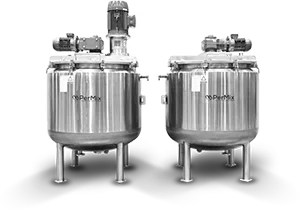
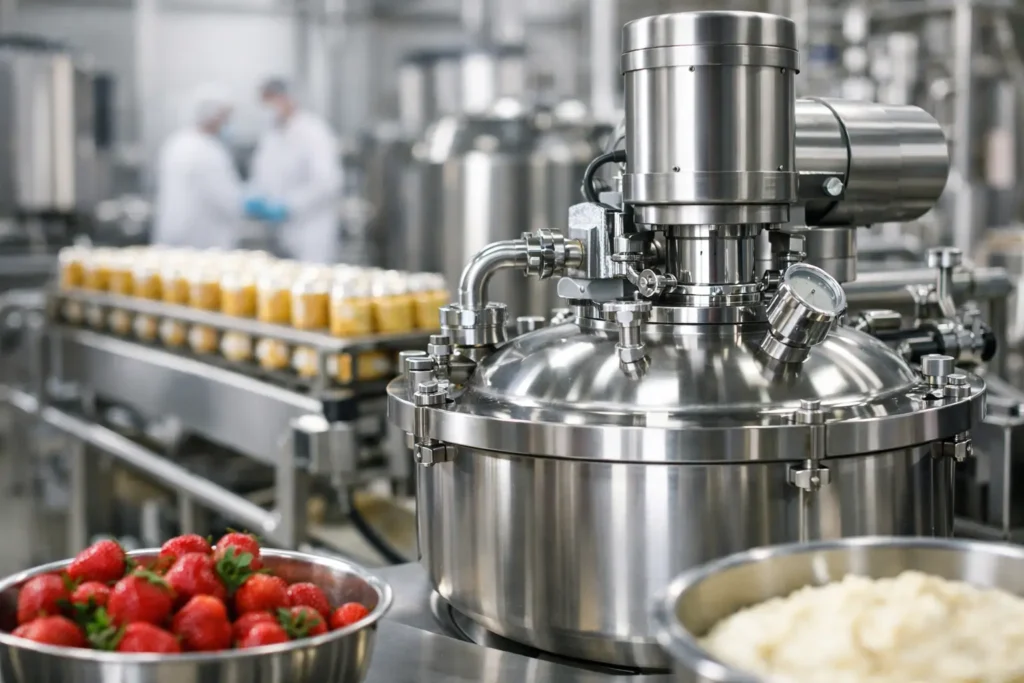
A sanitary mixer for food processing is not just a vessel with an agitator attached. In a production plant, it directly affects product safety, batch consistency, changeover time, labor demands, and how confidently you can scale output without creating new sanitation risks. If the mixer is hard to clean, creates dead zones, or applies the wrong level of shear, the cost shows up quickly in rejects, downtime, and compliance pressure.
In food manufacturing, sanitary design is practical before it is theoretical. The mixer must handle the product as required, but it also has to support cleaning, inspection, and repeatable operation under real plant conditions. That means smooth product-contact surfaces, weld quality that does not trap residue, proper gasket selection, and geometry that reduces hold-up and stagnant areas.
A sanitary mixer also has to match the product category. A low-viscosity beverage blend, a salad dressing emulsion, a protein slurry, a seasoning pre-mix, and a high-viscosity paste do not behave the same way in the tank. The wrong mixing technology can still move material, but it may not produce the texture, dispersion, or uniformity the process requires.
That is where many buying decisions go off track. Teams focus on tank volume first, then motor size, and only later address how the product actually flows, how ingredients are added, and how the equipment will be cleaned between SKUs. For food plants running multiple formulations, sanitation and application fit should be near the top of the evaluation, not treated as secondary details.
Food processors often use stainless steel as shorthand for sanitary construction, but material selection alone does not guarantee hygienic performance. Surface finish matters. Internal welds matter. Seal design matters. Drainability matters. The mixer should be built to minimize crevices, eliminate unnecessary horizontal ledges, and support complete product removal wherever possible.
For wet cleaning environments, clean-in-place capability may be essential. For other applications, clean-out-of-place procedures can still work well if the design allows fast access and reliable inspection. The right answer depends on your validation requirements, product changeover frequency, labor model, and the consequences of allergen carryover.
This is also where plant reality matters. A mixer that looks sanitary on paper but requires excessive disassembly for cleaning can become a bottleneck. On the other hand, a fully automated sanitary system may be more than some operations need, especially if batch frequency is lower and products are less sensitive. Good equipment selection balances hygienic design with operating economics.
The best sanitary mixer for food processing depends heavily on what you are mixing and what the finished product has to look like.
For low- to medium-viscosity liquid products, an agitator-based sanitary vessel may be enough if the goal is blending, suspension, or simple ingredient incorporation. These systems are common for sauces, syrups, brines, dairy bases, and liquid foods where bulk turnover is more important than aggressive particle size reduction.
For emulsions and fine dispersions, higher shear technology may be required. Dressings, cream-based products, flavor emulsions, and certain beverage systems often need a rotor-stator mixer, inline homogenizer, or vacuum emulsifying setup to create stable, repeatable structure. In these applications, sanitary design must be paired with process intensity. A highly sanitary low-shear mixer will still miss the mark if the product needs droplet reduction or rapid powder wet-out.
For viscous products, pastes, fillings, and heavy food masses, anchor mixers, planetary mixers, sigma mixers, or other heavy-duty systems may be more appropriate. These applications are less forgiving because poor flow patterns can leave unmixed pockets, temperature variation, or ingredient streaking. Sanitary execution becomes more demanding as viscosity rises, since cleanability becomes harder when product clings to surfaces and accumulates around shafts, seals, and discharge areas.
Powder and dry blend applications bring a different set of concerns. If you are producing seasoning blends, baking premixes, nutritional powders, or dry food ingredients, the mixer still needs sanitary construction, but the design priorities shift toward full discharge, dust control, inspection access, and avoidance of cross-contamination. Ribbon mixers, paddle mixers, or plow mixers can all be suitable depending on fragility, throughput, and liquid addition requirements.
Before requesting quotations, define the process with enough detail to avoid a generic machine recommendation. Start with the product itself. Viscosity range, bulk density, particle size, temperature sensitivity, fat content, sugar level, and abrasive characteristics all influence the right mixer configuration.
Next, look at the process targets. Are you blending for homogeneity, dispersing powders into liquid, creating an emulsion, deaerating under vacuum, heating and cooling in the same vessel, or adding inclusions without damaging them? Each objective points toward different impeller styles, vessel shapes, and auxiliary features.
Then consider production realities. Batch size is not the same as working capacity, and a mixer that performs well at full volume may not perform well at partial fill. Changeover frequency, allergen management, washdown procedures, and available utilities should all shape the final design. So should the expected production trajectory. If growth is likely, a mixer sized only for current output may become an expensive short-term fix.
Most failures are not dramatic mechanical breakdowns. They are slow operational disappointments. The mixer runs, but batch times are longer than expected. Product consistency varies from operator to operator. Powders fisheye during addition. Residue remains after discharge. Cleaning takes too long. Maintenance has to replace seals too often. None of these problems look severe in isolation, but together they weaken throughput and margin.
That is why application engineering matters. A strong supplier should ask detailed questions about formulation, rheology, cleaning method, temperature control, fill levels, and downstream packaging. If the recommendation is based only on volume and horsepower, the process risk is high.
For example, a processor making a pumpable sauce may need gentle blending in one phase, then higher shear during emulsification, then vacuum deaeration before filling. Treating that as a single-step mixing task can lead to a machine that does one part well and compromises the rest. In many cases, the best answer is not a standard mixer alone but an integrated processing system with the right vessel, agitator, shear device, and controls.
Buyers should look past broad claims and review specific details. Product-contact surfaces should be appropriate for the application and cleaning protocol. Internal geometry should support drainage and reduce entrapment. Shaft seals should be selected for both hygiene and durability. Ports, nozzles, spray devices, and instrumentation should be positioned to support cleaning rather than create blind spots.
Documentation also matters. For regulated or audit-sensitive food environments, you may need material traceability, surface finish data, weld quality standards, and FAT support. If your team has to validate cleanability or maintain strict records for customer audits, the equipment package should support that burden rather than add to it.
Controls deserve attention as well. Recipe management, repeatable mixing speed, timed ingredient addition, heating and cooling integration, and operator-friendly cleaning sequences can make the difference between a technically acceptable mixer and a dependable production asset.
Standard equipment has a place, especially for straightforward applications with stable formulations. But food processing is rarely as simple as the catalog example. Product families expand. Ingredients change. Retail and foodservice formats create different viscosity and texture targets. Plants consolidate lines and ask one machine to handle multiple SKUs.
In that environment, customization is often the more cost-effective path. A modified agitator, sanitary high-shear head, jacketed vessel, vacuum capability, load cells, or specialized discharge arrangement can prevent years of workarounds. The upfront price may be higher than a basic off-the-shelf unit, but the operating return is usually clearer when the system actually fits the process.
This is where experienced manufacturers such as PerMix can add measurable value. Broad mixer selection matters because it reduces the temptation to force every application into the same machine category. A supplier with real depth in powder, liquid, and paste mixing is better positioned to recommend the right sanitary solution instead of the most convenient one.
A sanitary mixer for food processing should be judged by what it delivers on the plant floor: cleanability, batch repeatability, product quality, uptime, and room to grow. If the design supports your formulation, your sanitation program, and your production targets at the same time, it is doing its job. If it solves one problem while creating three more, it is not the right machine, no matter how polished the specification sheet looks.
The strongest projects start with a clear process definition and a supplier willing to challenge assumptions before equipment is built. That usually leads to fewer surprises, faster startup, and a mixer that keeps paying back long after installation.
Stay Connected