Industrial Mixers
PerMix News & Updates
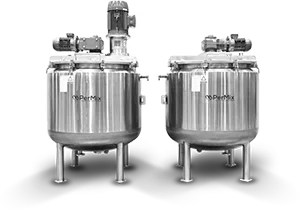
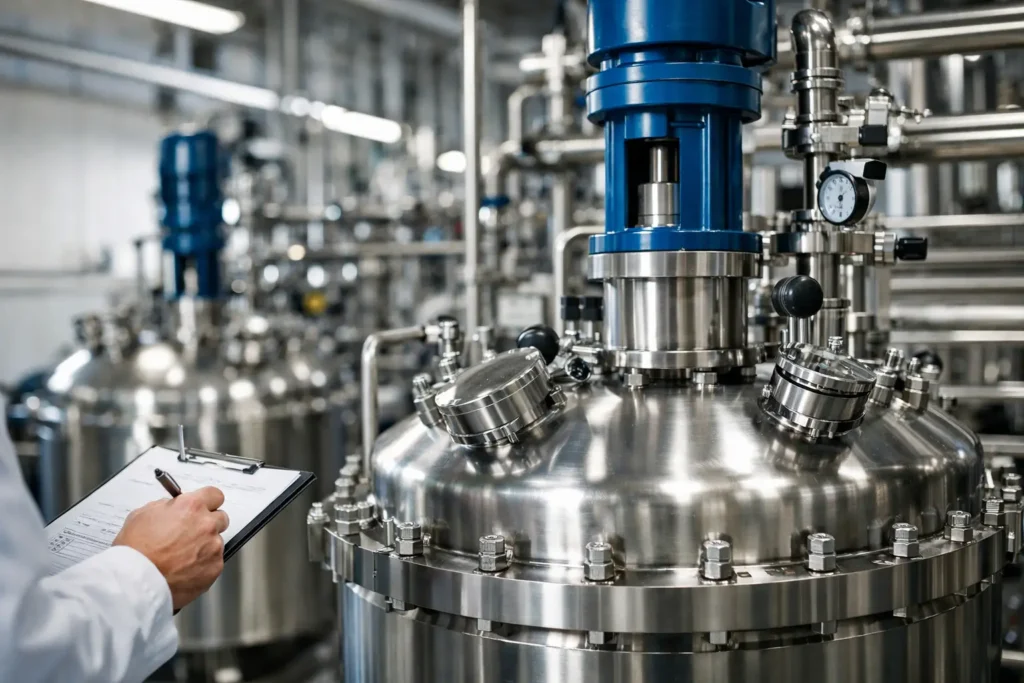
A reactor that looks right on paper can still become the bottleneck on the plant floor. Poor heat transfer, the wrong agitator, limited cleanability, or weak controls integration can turn a capital purchase into a daily production problem. That is why selecting a chemical reactor vessel manufacturer is not just about fabrication capacity. It is about choosing an engineering partner that understands your process, your materials, and your production targets.
In chemical manufacturing, reactor performance is tied directly to yield, cycle time, operator safety, and product consistency. The vessel itself matters, but so do agitation geometry, jacket design, pressure and vacuum ratings, seal selection, materials of construction, instrumentation, and discharge configuration. Buyers who focus only on shell dimensions or initial price often miss the factors that drive total operating value.
A capable chemical reactor vessel manufacturer should provide more than a tank with an agitator mounted on top. The real job is to translate process requirements into a vessel system that performs under actual production conditions. That starts with understanding whether the application is blending, dissolution, emulsification, polymerization, crystallization, heating, cooling, gas dispersion, or a multi-stage batch process.
Each of those duties places different demands on the reactor. A low-viscosity liquid blend may require efficient axial flow and moderate heat transfer. A higher-viscosity chemical mass may need stronger torque, wall-sweeping action, and tighter temperature control. A reactive system involving exotherms may need fast heat removal and controls that reduce risk during critical phases. The manufacturer should be able to discuss these points in practical terms, not generic sales language.
That process knowledge also affects equipment configuration. For example, a jacketed reactor may be sufficient for one application, while another may require half-pipe coil construction or internal coils for thermal response. One product may tolerate a standard top-entering agitator, while another demands a dual-motion system or high-shear mixing head. These are not minor options. They shape throughput, repeatability, and maintenance burden over the life of the equipment.
The strongest suppliers do not force every project into a standard design. They start with the application. Batch size, viscosity curve, solids loading, heat sensitivity, corrosiveness, vapor control, cleaning method, and plant utility availability all influence reactor design.
This is where many purchasing decisions go wrong. A standard vessel can be attractive because lead time and price look favorable. But if the reactor struggles with temperature uniformity, foam control, solids wet-out, or complete discharge, the cost comes back in lost production time and quality variation. A vessel that is less expensive upfront can be more expensive to own.
A manufacturer with broad mixing and vessel experience is usually better positioned to solve these issues because reactor design rarely exists in isolation. Agitation, thermal transfer, vacuum capability, and downstream handling are connected. If your process includes powder induction, liquid addition, solvent recovery, or deaeration, the vessel should be designed as part of the full process path rather than as a standalone component.
Materials of construction are usually the first checkpoint, and for good reason. The vessel may need stainless steel for corrosion resistance and cleanability, or it may require specialty alloys, glass lining, or other protective approaches depending on chemistry. The right answer depends on both product compatibility and cleaning chemistry. A manufacturer should be ready to discuss corrosion allowance, finish requirements, gasket compatibility, and long-term maintenance implications.
Agitation design deserves equal attention. Impeller type, speed range, motor power, gearbox sizing, shaft stability, and baffle arrangement all influence how the process behaves. In many chemical applications, the wrong agitator does not fail immediately. It underperforms quietly through longer batch cycles, dead zones, incomplete dispersion, or inconsistent reaction conditions.
Thermal performance is another area where details matter. Jacket style, heating and cooling media, insulation, surface area, and control response all affect cycle times. If your process is heat-sensitive or strongly exothermic, ask the manufacturer how the vessel design supports temperature control across changing viscosities and fill levels. A reactor that performs well at lab scale may behave very differently in production if heat transfer was not engineered properly.
Pressure and vacuum ratings should also be reviewed against real operating conditions, not ideal assumptions. Consider startup, shutdown, cleaning, inerting, venting, and upset scenarios. The same is true for seals and mechanical design. The right seal system depends on pressure, solvents, emissions concerns, and maintenance expectations.
A good chemical reactor vessel manufacturer should ask hard questions early. What is the full batch cycle? How does viscosity change during reaction? Is there solids charging under vacuum? Do you need CIP capability? Is there a need for load cells, condensers, reflux systems, vapor handling, or explosion-proof components? What are the future throughput targets?
Those questions are not meant to complicate the sale. They are how a manufacturer protects your production line from a poor equipment fit.
Customization can range from simple nozzle modifications to fully engineered systems with integrated heating, cooling, controls, and multi-stage agitation. Not every process needs a custom reactor, and standardization can absolutely make sense when the application is straightforward. But where chemistry is sensitive or production demands are high, a custom-designed vessel often provides better long-term value because it reduces workarounds on the plant floor.
The right partner should also balance engineering ambition with commercial reality. Overdesign is a real problem. Some suppliers specify features that add cost without improving process outcomes. Others strip designs down too far and leave the customer with an underperforming vessel. The best manufacturers find the practical middle ground – strong performance, appropriate customization, and pricing that respects capital budgets.
Buyers should look beyond appearance. Fabrication quality includes weld consistency, dimensional control, jacket integrity, shaft alignment, surface finish, documentation, and testing procedures. If the application is regulated or safety-critical, documentation standards become even more important. Material traceability, pressure test records, finish verification, and inspection protocols should be part of the conversation.
Controls integration is another indicator of manufacturer capability. Many reactor issues are not strictly mechanical. They come from poor sensor placement, weak control logic, limited visibility into batch conditions, or awkward operator interfaces. A manufacturer that understands processing will think about controls as part of performance, not as an afterthought.
Lead time and service support also matter. A lower-priced vessel can lose its advantage quickly if startup support is weak, replacement parts are difficult to source, or technical guidance disappears after shipment. Chemical processing equipment is a long-term asset. The manufacturer should be prepared to support commissioning, troubleshooting, and future optimization.
A serious supplier should be able to explain why a given agitator, jacket type, or seal arrangement is appropriate for your chemistry. They should discuss trade-offs clearly. For example, a high-shear design may improve dispersion but increase heat input. A larger heat transfer surface may improve cycle time but add fabrication cost. A glass-lined reactor may offer corrosion resistance but comes with different mechanical and maintenance considerations than stainless steel.
It also helps to ask how the supplier approaches scale-up. Lab success does not guarantee production success, especially when reaction kinetics, heat removal, or rheology change with volume. Manufacturers with broad process equipment experience are often more credible here because they understand how upstream and downstream conditions influence reactor behavior.
For many plants, the best choice is not simply the company with the largest facility or the lowest quote. It is the manufacturer that can connect engineering decisions to measurable production outcomes – higher throughput, better consistency, safer operation, easier cleaning, and less downtime.
PerMix approaches this from a practical equipment standpoint: match the vessel, mixing system, and process design to the application first, then build around performance, quality, and budget. That is typically where the best capital decisions are made.
A reactor vessel is rarely just a piece of hardware. It becomes part of daily output, labor efficiency, quality control, and expansion planning. If the system is engineered correctly, operators spend less time compensating for process instability. Maintenance teams deal with fewer avoidable issues. Production managers get more predictable scheduling. Procurement sees better life-cycle value, not just a lower invoice.
That payoff comes from choosing a manufacturer that understands both fabrication and process reality. The right partner will ask better questions, challenge weak assumptions, and design for how your plant actually runs.
If you are comparing suppliers, look for the one that speaks most clearly about your process, not just their equipment. That is usually where the smarter reactor investment begins.
Stay Connected