Industrial Mixers
PerMix News & Updates
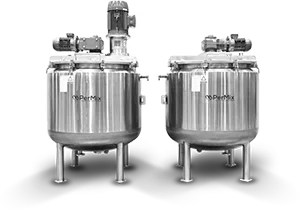
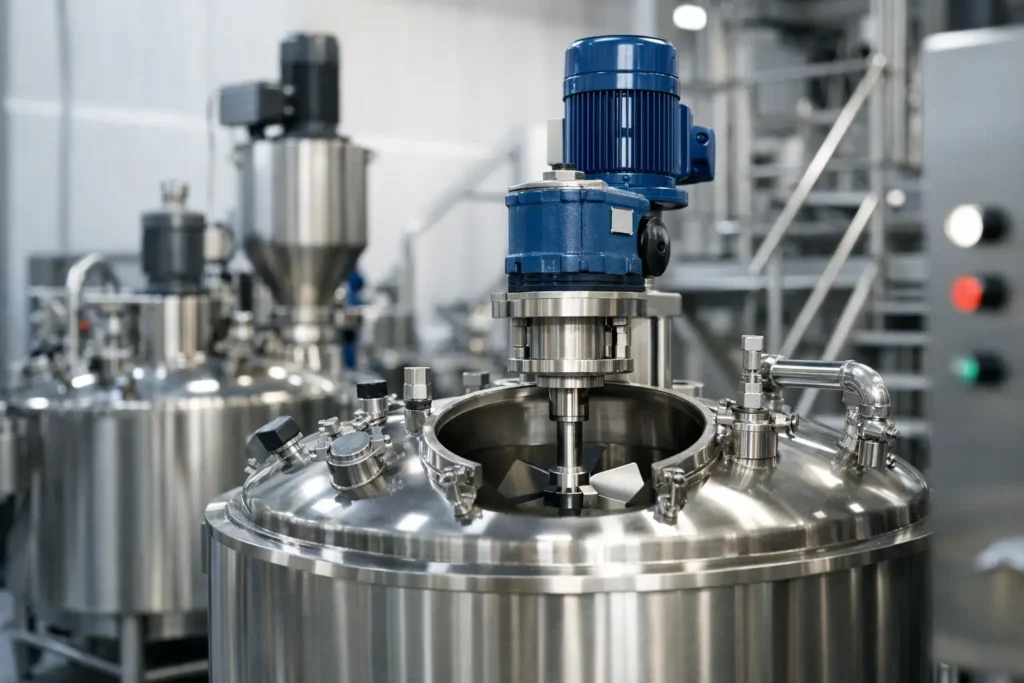
A mixing system that works in a pilot run can fail fast on a production floor. Powders bridge, liquids foam, heat builds where it should not, and a simple ingredient addition turns into a bottleneck. That is why custom industrial mixing systems matter. They are not about adding complexity for its own sake. They are about matching equipment design to real material behavior, plant constraints, and business targets.
For manufacturers, the cost of a poor fit shows up quickly. Batch times stretch. Cleaning takes too long. Product uniformity drifts. Operators compensate with workarounds that create inconsistency and raise labor costs. In regulated industries, the wrong system can also create validation problems, sanitation concerns, or repeatability issues that affect the entire process line.
Standard mixers have a place. If the product is straightforward, the batch size is stable, and the process variables are well understood, an off-the-shelf machine may do the job. But many production environments do not stay that simple for long.
A custom system is built around the application, not the catalog page. That includes the material form, target throughput, discharge requirements, heating or cooling loads, liquid addition rate, dust control, vacuum needs, and downstream integration. The result is better process control and fewer compromises at startup.
This matters across industries. A food producer may need gentle blending with sanitary construction and full cleanability. A chemical processor may need aggressive dispersion, corrosion-resistant materials, and controlled temperature rise. A pharmaceutical or nutraceutical manufacturer may need repeatable mixing under containment or vacuum, with strict attention to validation and batch traceability. The core need is the same – consistent performance under actual operating conditions.
The best custom industrial mixing systems are not simply modified tanks with a different motor. They are engineered process solutions. That distinction matters because mixing performance depends on more than agitator style.
Mixer geometry is one of the first variables. Vessel shape, aspect ratio, headspace, wall clearance, and discharge design all affect flow patterns and usable capacity. Two systems with the same motor horsepower can produce very different results if one has dead zones, poor turnover, or an outlet that leaves valuable product behind.
Agitation design is equally critical. Ribbon mixers, paddle mixers, plow mixers, sigma mixers, high shear mixers, homogenizers, and emulsifiers all solve different process problems. The right choice depends on whether the goal is blending, dispersion, deagglomeration, emulsification, kneading, or vacuum deaeration. In many cases, a combination of actions is needed. That is where custom engineering becomes especially valuable.
Drive configuration also deserves more attention than buyers sometimes give it. Variable speed control, torque capacity, startup load, and the ability to handle viscosity changes through the batch can determine whether a system performs consistently or struggles at scale. A mixer that looks adequate on paper may stall, shear-sensitive material may degrade, or batch times may increase dramatically once production volumes rise.
A common buying mistake is selecting a mixer style first and asking process questions later. The better approach is to begin with the product and production goals.
Material characteristics should lead the discussion. Particle size distribution, bulk density, moisture sensitivity, viscosity curve, tackiness, tendency to form lumps, and response to shear all affect mixer selection. So does the order of ingredient addition. A dry powder blend that receives a low-volume liquid spray behaves very differently from a fully wet slurry or a high-viscosity paste.
Production requirements come next. Batch size range, batches per shift, changeover frequency, sanitation standard, available floor space, ceiling height, utility access, and automation level all shape the final design. There is no value in specifying a high-performance system if it cannot be installed efficiently, cleaned within the required window, or fed consistently from upstream equipment.
This is where an experienced mixing equipment partner changes the outcome. The goal is not to sell the most complicated system. The goal is to identify the level of customization that improves performance enough to justify the investment. Sometimes that means a fully integrated skid with controls, jacketed vessel, load cells, vacuum capability, and automated ingredient handling. Other times it means adapting a proven mixer platform with the right agitator, seals, finish, and discharge arrangement.
Not every feature needs to be custom. The highest return usually comes from solving the points where standard systems create the most waste or variability.
Ingredient incorporation is one example. If powders float, dust, or clump when introduced into liquid, the mixer may need a different inlet design, rotor-stator arrangement, or recirculation loop. If a paste system traps unmixed pockets near the vessel wall, blade geometry and sidewall sweep become more important than adding raw horsepower.
Thermal control is another. Products that are heat-sensitive, reactive, or viscosity-dependent often require jacketed vessels and carefully matched agitation. Too little movement reduces heat transfer. Too much shear can damage product structure. The right balance depends on the formulation and the processing window.
Discharge is often underestimated during equipment selection. A mixer that blends well but empties poorly creates yield loss, sanitation problems, and unnecessary labor. Custom outlet size, valve style, vessel slope, screw assistance, or bottom-entry design can make a major difference, especially with cohesive powders and viscous materials.
Controls and automation also deserve a practical look. Advanced controls can improve repeatability, but only if they match the operator environment and plant workflow. Some facilities need recipe management, data logging, and network integration. Others need durable, straightforward controls that reduce training time and simplify maintenance. Better automation is not always more complicated. Sometimes it is just better aligned with the plant.
There is no perfect mixing system for every objective. Most projects involve trade-offs, and the best decisions come from making those trade-offs visible early.
Higher shear can shorten batch time and improve dispersion, but it may increase heat generation or damage fragile particles. Larger vessels can support growth, but if minimum batch size is too low relative to vessel volume, blend quality may suffer. Sanitary polish, clean-in-place features, and specialty materials improve compliance and cleanability, but they also affect capital cost and lead time.
The same applies to flexibility. A system designed to run many different products may not deliver the absolute best performance for one very narrow application. On the other hand, a highly specialized setup can become limiting if the product line changes. That is why process engineers and procurement teams should evaluate both current requirements and the likely next phase of production.
When buyers compare suppliers, the machine itself is only part of the evaluation. Engineering depth matters just as much as fabrication quality.
A capable supplier should be able to discuss material behavior in practical terms, not generic language. They should ask how the product changes during the batch, where current failures happen, what utilities are available, how operators clean the system, and what downstream equipment depends on discharge consistency. If those questions are missing, the design process is probably too shallow.
Manufacturing capability also matters. Custom work must still be repeatable, serviceable, and supported after installation. That means sound mechanical design, appropriate quality control, and realistic guidance on maintenance, spare parts, and operating limits. The best results come from suppliers that combine broad equipment range with application-specific engineering rather than forcing every process into one machine family.
PerMix approaches this space with that full-spectrum mindset. For manufacturers evaluating powder, liquid, and paste applications, the advantage is clear – broader equipment choices, stronger process matching, and custom engineering built around performance, quality, price, and long-term value.
The return on custom equipment is rarely limited to faster mixing. It often includes better batch consistency, reduced waste, lower cleaning time, improved operator efficiency, safer material handling, and fewer scale-up surprises. Those gains compound over time.
In some plants, the biggest win is throughput. In others, it is product quality or reduced labor. For regulated sectors, it may be better documentation, repeatability, and confidence during audits. That is why the right system should be judged by total process impact, not purchase price alone.
If your current mixer gets acceptable results only when the best operator is running it, that is a signal. If scale-up changes product quality, that is a signal. If cleaning takes longer than the batch itself, that is a signal too. Custom engineering is most valuable when it removes those recurring constraints and turns mixing into a controlled, predictable part of production.
The best place to start is with the process data you already have – formulation behavior, batch targets, pain points, utility limits, and growth plans. A well-designed system should fit the product, the plant, and the business you expect to run two or five years from now.
Stay Connected