Industrial Mixers
PerMix News & Updates
When a batch runs long, powders stop flowing, or liquid addition turns a free-flowing blend into lumps, the problem is rarely just the recipe. More often, it is a mismatch between the process and the industrial mixing equipment on the floor. For plant managers and process engineers, that mismatch shows up as lower throughput, inconsistent quality, operator workarounds, and maintenance that comes too often.
The right mixer does more than move material. It controls how ingredients meet, how energy is applied, how heat is managed, and how consistently a process performs from pilot scale to production. That is why selecting equipment by horsepower or vessel size alone usually leads to compromises later.
In production environments, mixing is not a single task. It may involve blending dry powders to a tight uniformity target, dispersing solids into liquids, emulsifying immiscible phases, kneading high-viscosity pastes, or running under vacuum to remove entrapped air. Each duty asks for a different mechanical approach.
A ribbon mixer, for example, is often a strong fit for dry powder blending where gentle but efficient convective movement is needed. A paddle mixer may be better when fragile particles need lower shear or when a broader range of bulk densities is involved. Plow mixers can deliver more aggressive fluidization and faster mixing, especially when liquid addition or deagglomeration is part of the process. Sigma mixers are built for heavy, viscous materials that simply will not move properly in standard batch blenders.
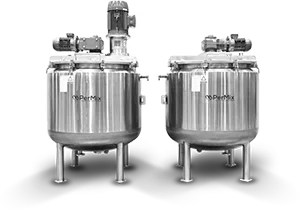
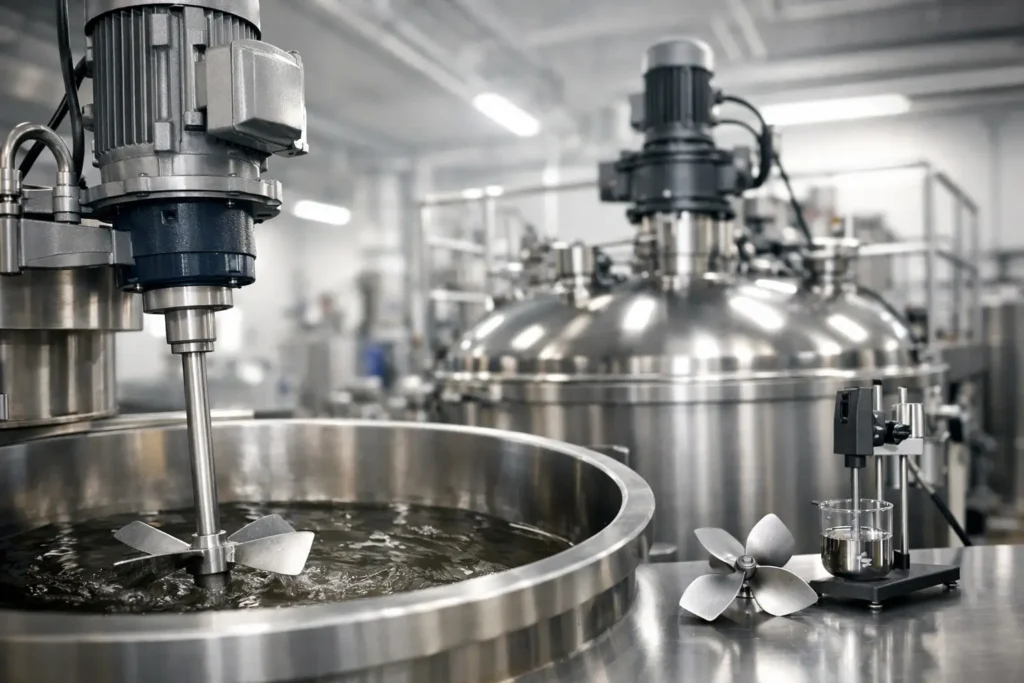
For liquid and semi-solid applications, the decision gets even more application-specific. Homogenizers and emulsifiers are selected for droplet size reduction and stability. Vacuum mixers help when air inclusion affects appearance, density, or downstream filling. Reactors and process vessels add another layer because mixing must work alongside heating, cooling, pressure control, and chemical reaction requirements.
That is the practical reality: there is no single best mixer in the abstract. There is only the best equipment for a defined product, process, and production target.
Most equipment selection problems begin with a simple assumption that turns out to be false. A material that looks free-flowing in a sample bag may bridge at scale. A liquid that seems easy to blend may require more shear to stabilize than expected. A paste may change viscosity dramatically during the cycle. Good mixer selection starts by asking harder questions earlier.
Many facilities first look for the mixer type they already know. That can be useful if the process is proven, but it can also lock the team into a poor fit. Material characteristics should lead the discussion: particle size, bulk density, moisture sensitivity, flowability, abrasiveness, stickiness, temperature response, and viscosity across the full process.
This matters because the same batch size can behave very differently in the same vessel. A nutraceutical powder blend with light excipients and active ingredients does not move like a mineral premix. A cosmetic cream base does not develop like an adhesive compound. Equipment geometry, agitator style, and discharge design all need to reflect that reality.
Sometimes the target is uniformity. Sometimes it is speed. Sometimes it is controlled shear or repeatable liquid addition without over-wetting. In regulated sectors, cleanability and validation may carry as much weight as output. In commodity production, reliability and cost per batch may dominate.
Those priorities affect equipment choice. A faster mixer is not automatically the better investment if it damages particle integrity or complicates cleaning. Likewise, a sanitary design may be essential in one plant and unnecessary cost in another. The right answer depends on what success actually means on the line.
Pilot success does not guarantee production success. Mixing time, fill level, peripheral speed, power draw, and heat transfer can shift when a process moves from development to a large batch platform. This is one of the most common reasons manufacturers revisit equipment decisions after purchase.
A better approach is to evaluate scale-up during the selection phase. That includes batch range, production frequency, ingredient addition sequence, discharge requirements, and whether future formulas are likely to stretch the machine beyond the first application. Buying exactly for today’s product can become expensive if tomorrow’s product requires vacuum capability, higher shear, or a different sanitary standard.
Industrial mixing equipment covers a wide range of technologies, but the selection logic becomes clearer when grouped by process duty.
Ribbon mixers are widely used for dry blending and are often chosen for their balance of performance, simplicity, and cost. Paddle mixers can offer gentler handling and strong batch consistency across diverse materials. Plow mixers are often selected when faster cycles, liquid spray addition, or higher-intensity mechanical action are needed. Granulators may be integrated when controlled agglomeration is part of the target process rather than a defect to avoid.
For low- to medium-viscosity products, the focus is often circulation, dispersion, and shear management. Homogenizers and high-shear mixers are used when particle size reduction, emulsion quality, or stable dispersion is critical. Deaerators and vacuum systems become important when entrained air affects appearance, fill accuracy, shelf life, or downstream packaging performance.
Heavy materials require equipment that can generate torque and maintain movement across the entire mass. Sigma mixers, planetary systems, and specialized vacuum kneaders are common choices here. These applications are less forgiving because poor agitator selection quickly creates dead zones, overheating, or long cycle times that destroy efficiency.
When mixing occurs alongside thermal processing or chemical conversion, the vessel and the agitator have to work as a system. Baffle design, jacket performance, pressure rating, seal arrangement, and agitation profile all influence final results. In these cases, buying a mixer and vessel separately without a coordinated engineering approach often creates avoidable process limitations.
Every mixer design involves trade-offs. Higher shear can reduce droplet or particle size, but it may also increase heat and affect sensitive ingredients. A more aggressive blender can shorten cycle times, but it may increase wear when abrasive solids are involved. Large batch equipment may improve labor efficiency, but only if changeover time and cleaning do not erase the gain.
Discharge is another area where small design decisions have a big production impact. A mixer that blends well but discharges poorly can leave usable material behind and slow the next batch. Access for cleaning, seal selection, shaft support, and controls integration also deserve more attention than they often get in early discussions.
Cost should be viewed the same way. The lowest purchase price is not necessarily the lowest operating cost. Downtime, spare parts consumption, inconsistent batches, and limited flexibility can make inexpensive equipment expensive over its service life. Many manufacturers are better served by application-specific engineering and a machine built to the process than by a generic unit that almost fits.
The strongest equipment suppliers do more than quote a mixer model. They ask how the product behaves, how the plant runs, what utilities are available, what standards must be met, and how the process may evolve. That level of consultation matters because industrial mixing equipment is rarely a plug-and-play decision.
For buyers across food, chemical, pharmaceutical, cosmetic, bio, and agricultural manufacturing, the value is not just in product breadth. It is in having access to multiple mixer technologies, custom engineering options, and realistic guidance about what each design will and will not do. That is where an experienced supplier can prevent under-specifying, over-specifying, or selecting a machine that solves one problem while creating two new ones.
PerMix has built its position around that practical model: broad mixing technology, application-driven design, and pricing that respects budget without giving away performance. For operations teams trying to improve consistency, scale output, or handle difficult materials with more confidence, that combination is not a marketing extra. It is part of the equipment value.
The best buying decision usually comes from treating mixing as a process engineering issue, not just an equipment purchase. When the machine matches the material, the duty, and the production plan, the gains show up where they matter most – in throughput, quality, and fewer problems on the floor. If your current process is asking operators to compensate for equipment limitations, that is usually the clearest sign that the mixer should be rethought before the next expansion does it for you.
Stay Connected