Industrial Mixers
PerMix News & Updates
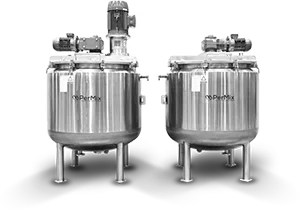
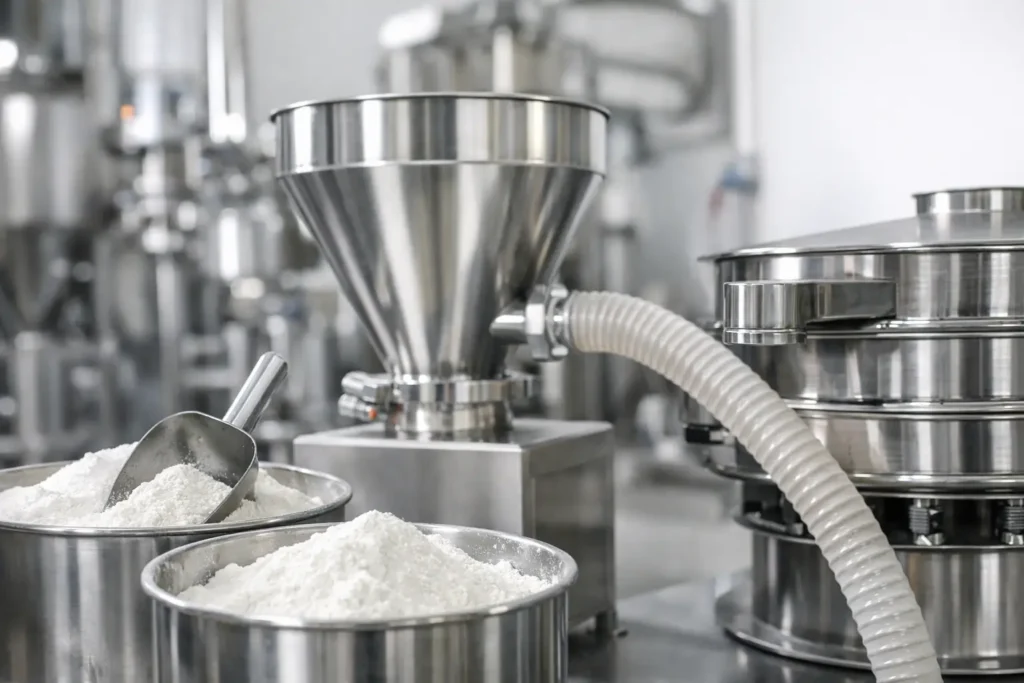
A powder line rarely fails because of one dramatic mistake. More often, problems build slowly – segregation after discharge, dusting during transfer, hot spots in drying, poor liquid distribution, or a mill that creates too many fines. That is why powder processing equipment should never be selected as a generic category purchase. It has to match the way your material behaves under real production conditions.
For plant managers and process teams, the cost of a mismatch shows up quickly. Batch times drift. Cleaning takes longer than expected. Product quality becomes operator-dependent. Capacity on paper does not translate to capacity on the floor. The right equipment choice reduces those problems at the source by aligning machine design with bulk density, particle size distribution, flow characteristics, moisture sensitivity, and the level of process control the application actually requires.
In most facilities, powder handling is not one step. It is a sequence that may include feeding, conveying, sifting, mixing, drying, milling, granulating, agglomerating, and discharge into downstream packaging or further processing. Each stage affects the next. A mixer that leaves dead zones can overload a mill with inconsistent feed. A dryer that over-processes can change flowability and hurt packaging performance. An aggressive milling step can alter dissolution, reactivity, or bulk density.
This is why equipment should be evaluated as part of a process, not as isolated machines. Throughput matters, but so do residence time, shear profile, heat transfer, cleanability, containment, and how the equipment behaves at partial loads. In regulated or hygiene-sensitive industries, surface finish, validation support, and sanitary access are just as important as output.
Mixing is often the critical control point in powder production. Ribbon mixers are widely used for free-flowing powders and moderate batch sizes where efficient convective blending is needed at a practical price point. Paddle mixers offer gentle but effective movement and are often a strong fit when fragile particles, slurry additions, or wider material variation are involved. Plow mixers are well suited to applications that need faster mixing, high-intensity choppers, or controlled liquid incorporation for agglomeration and densification.
The best choice depends on more than blend time. You need to consider fill level, ingredient ratio, particle size differences, and whether the process includes liquid addition. Fine actives at low inclusion rates demand a different mixing strategy than commodity dry blends. If the formula tends to smear, compact, or build on surfaces, discharge geometry and internal clearances become major factors.
Drying equipment has to remove moisture without damaging the product. Vacuum dryers can be a strong fit for heat-sensitive powders because they lower the temperature needed for evaporation. Other dryer types may be better when the priority is continuous throughput or a specific final moisture profile. The key question is not simply how fast a dryer can run, but how consistently it can achieve the moisture target across the entire batch or stream.
Powders that cake easily or form lumps during drying may need agitation, lump breaking, or tighter thermal control. In some cases, the drying step changes the downstream mixing or milling requirement. That is a common point of missed coordination during equipment selection.
Milling is where many powder lines either gain control or lose it. The goal may be deagglomeration, particle size reduction, narrow distribution, or improved blend uniformity. Different mill designs deliver very different outcomes in terms of shear, heat generation, and fines creation. A system that works well for one food powder may be completely wrong for a pharmaceutical intermediate or a mineral-based chemical.
Material hardness, abrasiveness, heat sensitivity, and target particle distribution should drive mill selection. So should the upstream condition of the feed. Wet, inconsistent, or poorly blended feed can make even a well-sized mill perform badly.
Some powders process better once the particle structure is changed. Granulation and agglomeration can improve flow, reduce dust, increase bulk density, and support more uniform dosing or tableting. But these systems require close control of binder addition, shear, and moisture. If the process window is narrow, the machine alone will not solve the problem. The full application design matters.
The fastest way to overpay for powder processing equipment is to buy for rated capacity alone. Nameplate output is useful, but it does not capture real-world material behavior. A better evaluation starts with the product and the process objectives.
First, define what success looks like. That may be blend uniformity within a tight variance, moisture reduction to a specific endpoint, a target particle size range, or a batch cycle that fits labor and shift constraints. Then identify the material traits that could interfere with that target. Cohesive powders, broad particle size distributions, electrostatic behavior, and sensitivity to shear or temperature all affect equipment performance.
Next, look at operating realities. Will the line run one product or many? Is rapid cleanout required? Are operators dealing with allergen changeovers, solvent recovery, or explosive dust concerns? Does the process need vacuum, heating, cooling, or inline liquid injection? These are not accessories. They can change the machine platform entirely.
Scale-up also deserves a hard look. A process that works in a pilot vessel can shift at production volume because powder movement, heat transfer, and liquid distribution do not scale perfectly. That is why application testing and engineering review are so valuable. An experienced equipment partner should be able to discuss not just machine features, but the behavior you can expect as batch size increases.
One common mistake is choosing a machine because it worked for a similar product. Similar is not the same. A small difference in fat content, moisture pickup, particle shape, or active concentration can change the process significantly.
Another mistake is underestimating discharge and downstream transfer. Many mixing or drying systems look effective until the product reaches the outlet. Bridging, rat-holing, or segregation at discharge can erase the gains made inside the vessel. The equipment has to move the powder out as reliably as it processes it.
A third issue is treating customization as optional when the application clearly requires it. Standard equipment is often the right answer, but not always. Jacketed vessels, special rotor designs, sanitary finishes, vacuum construction, wear-resistant materials, and custom controls can be the difference between acceptable performance and dependable long-term production.
Good powder processing equipment is engineered hardware. Great results come from pairing that hardware with application knowledge. Process teams need suppliers who understand how powders behave when mixed with trace liquids, when exposed to vacuum, when heated under agitation, or when milled after partial drying.
That expertise shortens the path to a working solution. It helps avoid overspecifying expensive features that do not improve results, while also identifying the options that truly matter for safety, product integrity, and maintenance. In industrial production, the best value is not the lowest purchase price. It is the equipment that delivers consistent output, practical service life, and a stable process window.
For manufacturers running in food, chemical, pharmaceutical, nutraceutical, and related markets, that usually means working with a supplier that offers broad equipment coverage and the ability to tailor designs around the application. PerMix approaches powder systems from that standpoint – engineering first, process fit first, and commercial value without sacrificing performance.
The right machine should solve the current problem without creating the next one. If your product mix is expanding, if batch sizes are increasing, or if sanitation expectations are rising, the equipment should leave room for that growth. Sometimes that means selecting a mixer with a wider operating range. Sometimes it means planning for integrated feeding, vacuum capability, or controls that support recipe management and repeatability.
There is always a trade-off. More flexibility can mean a higher initial investment. Higher intensity can mean more wear or more heat. Simpler designs can reduce cost but limit process range. The point is not to avoid trade-offs. It is to make them deliberately, with clear process priorities.
When powder systems are selected that way, equipment stops being a recurring production headache and starts doing what it should have done from the start – delivering predictable, efficient, scalable performance. That is the standard worth buying for.
Stay Connected