Industrial Mixers
PerMix News & Updates
A mixer that performs well in trials can still create problems on the plant floor if the production mode is wrong. That is why the batch vs continuous mixing decision matters early. It affects throughput, residence time, operator involvement, changeovers, cleaning, capital planning, and ultimately the consistency of the finished product.
For many manufacturers, this is not a theoretical comparison. It is a practical equipment decision tied to specific material behavior, plant layout, and production targets. Food processors may need frequent recipe changes and validated cleanouts. Chemical producers may prioritize steady high-volume output. Pharmaceutical and nutraceutical operations may need strict control, traceability, and repeatability. The right answer depends on the process, not on a trend.
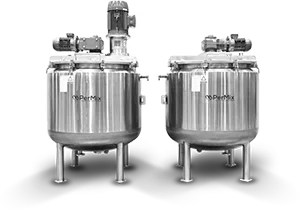
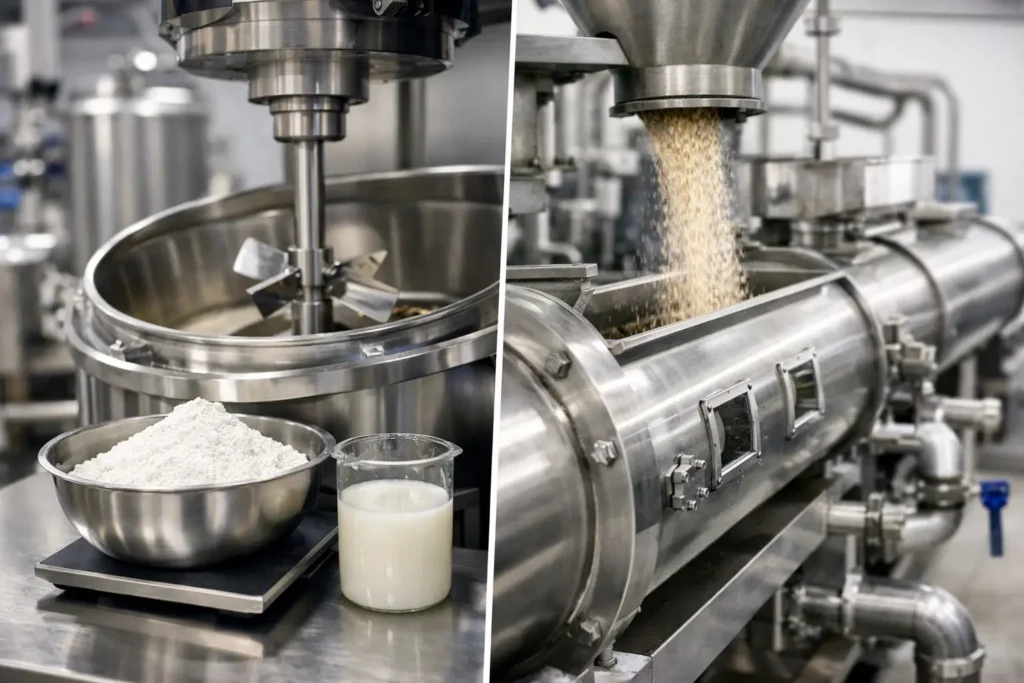
Batch mixing processes a defined quantity of material in a discrete cycle. Raw materials are charged, mixed for a set time, discharged, and then the cycle repeats. This approach gives operators clear control over each lot and makes it easier to isolate production records, adjust formulas, and manage product changes.
Continuous mixing feeds materials into the system at a controlled rate while mixed product exits continuously. Instead of one complete lot at a time, the process runs as an ongoing stream. Performance depends heavily on stable feed rates, residence time control, and equipment design matched to the material.
On paper, the distinction seems simple. In practice, the gap is larger. Batch systems are often chosen for flexibility. Continuous systems are often chosen for efficiency at scale. But those are only starting points.
Batch mixing remains the preferred choice in many industrial plants because it handles variation better. If your production schedule includes multiple SKUs, seasonal formulations, customer-specific blends, or small to mid-size runs, a batch process usually gives better operational control.
This is especially true when ingredients do not behave consistently. Powders with poor flow, minor ingredients added at very low percentages, fragile particles, or formulations that require staged liquid addition often benefit from the tighter intervention possible in batch processing. Operators can adjust mix time, sequence, shear level, temperature, or vacuum conditions within each cycle.
Traceability is another major advantage. In regulated industries, lot segregation matters. A batch mixer creates a natural production record because each cycle corresponds to a measurable quantity of product. If an issue appears downstream, it is easier to contain and investigate a single batch than a continuous production stream that may have been running for hours.
Cleaning and validation also tend to favor batch operation when product changes are frequent. A plant running several formulas in one shift may lose any theoretical efficiency gain from continuous production if sanitation and line clearance become burdensome.
That said, batch mixing has limits. Throughput is constrained by vessel size and cycle time. Charging, mixing, discharging, and cleaning create downtime between runs. Labor demands can be higher, especially if the process relies on manual additions or operator judgment.
Continuous mixing is built for stable, repetitive production. If the formula is established, ingredient feed can be controlled accurately, and output demand is high, a continuous process can reduce handling and improve line efficiency.
The biggest benefit is throughput. Material moves through the system without the repeated stop-start pattern of batch cycles. This can lower overall production time, reduce in-process inventory, and support downstream operations that also run continuously.
Continuous mixing can also improve consistency when feed systems are precise and the mixer is properly engineered. Instead of relying on one cycle reaching a target endpoint, the system maintains a steady-state process. For manufacturers producing the same product over long campaigns, that can translate into reliable uniformity and lower cost per unit.
Space and integration are also important. In some plants, a continuous mixer fits more naturally into a larger automated line with metering, conveying, granulation, drying, or packaging systems. The result is a cleaner process flow with less intermediate handling.
Still, continuous mixing is not automatically the best in performance for every plant. It requires process discipline. Feed fluctuations, density shifts, ingredient segregation, and startup or shutdown transitions can all affect quality. If the upstream and downstream systems are not equally stable, the mixer cannot solve that problem on its own.
The most useful batch vs continuous mixing comparison starts with the material and the production objective.
If the formula includes many ingredients with different bulk densities, particle sizes, or flow properties, batch processing often provides more forgiveness. If the process needs intensive shear, vacuum deaeration, emulsification, or controlled thermal input over time, batch designs may offer more precise manipulation.
If the product is simple, demand is high, and the line must deliver predictable output for extended runs, continuous operation becomes more attractive. This is common in large-volume powder blending, some chemical processes, and applications where throughput is the main constraint.
Target batch size also matters. A company producing 500-pound pilot lots, then 2,000-pound commercial orders, and then switching formulas the same day has very different needs than a plant making one product around the clock. The first operation usually values flexibility. The second often values efficiency and automation.
Process sensitivity is another deciding point. Some products have narrow quality windows. A slight shift in moisture, particle distribution, or liquid addition can create rework or waste. In those cases, the right answer depends on where control is strongest. Sometimes that is batch. Sometimes it is a well-instrumented continuous line.
Procurement teams often begin with capital cost, but the better comparison includes total operating impact. A lower-priced mixer is not necessarily the more economical system if it increases labor, extends cycle time, or creates product loss.
Batch systems may have lower entry complexity, especially for flexible plants or smaller production volumes. They can also allow phased expansion. A manufacturer may start with one batch mixer, validate the process, and scale capacity with additional units or larger vessels as demand grows.
Continuous systems may justify higher initial engineering and integration effort when volume is high enough to capture the return. Reduced labor per unit, less handling, and more consistent output can create a strong business case. But the economics depend on utilization. An underused continuous line is an expensive compromise.
This is where application engineering matters. The best in quality equipment still has to fit the actual production model. Overspecifying a system for future demand that may not arrive can be as costly as undersizing one for current needs.
Food and nutraceutical producers often lean toward batch systems because allergen control, recipe variation, and sanitation are central to operations. Ribbon mixers, paddle mixers, plow mixers, vacuum mixers, and granulation systems are often selected based on ingredient behavior and required cleanability.
Chemical manufacturers may use either model depending on product volume and process complexity. High-volume, stable formulations can be strong candidates for continuous mixing, while specialty chemicals often benefit from batch control, especially when reaction timing, viscosity changes, or liquid incorporation are critical.
Pharmaceutical and health and beauty manufacturers usually place heavy emphasis on validation, repeatability, and containment. In many applications, batch operation supports those priorities. In others, continuous processing can offer excellent consistency if the feed systems, controls, and documentation architecture are fully aligned.
The mixer type and the production mode must be evaluated together. A ribbon mixer in batch service behaves differently from a continuous paddle or plow design. A high-shear system, sigma mixer, homogenizer, or emulsifier introduces another layer of process logic tied to viscosity, dispersion target, and product structure.
That is why equipment selection should begin with application data, not assumptions. Material density, particle size distribution, moisture level, shear sensitivity, feed variability, cycle target, discharge method, cleaning protocol, and downstream integration all shape the right recommendation.
At PerMix, that engineering-first approach is central to delivering the best in innovation, performance, quality, and value. The right system is not simply batch or continuous. It is the design that matches how your product needs to move, blend, and scale in a real production environment.
If your operation depends on agility, recipe control, and lot traceability, batch mixing is often the stronger fit. If your business is pushing for high-volume, repeatable output with stable demand, continuous mixing may offer better long-term efficiency. Many plants also live in the middle, where a hybrid strategy makes the most commercial sense.
The smartest choice is the one that supports your material, your quality target, and your production economics at the same time. Before committing to a machine, define the process you need it to support. That is where better mixing decisions start, and where long-term production gains are actually made.
Stay Connected