Industrial Mixers
PerMix News & Updates
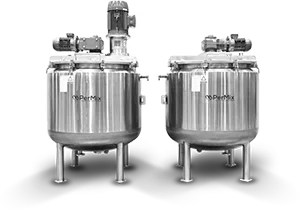

A pilot batch that looks perfect in the lab can fail fast on the plant floor. The usual problem is not the formula. It is the assumption that any batch mixer for scale up will behave the same way at 10 liters, 500 liters, and 5,000 liters.
Scale-up mixing is where production economics, product quality, and equipment design meet. If the mixer is wrong for the material or the process target, you see it quickly – longer cycle times, poor dispersion, dead zones, heat buildup, inconsistent bulk density, or rework that erodes margin. A successful scale-up plan starts with matching mixer mechanics to how the product actually behaves in a larger vessel.
A batch mixer for scale up is not just a larger tank with a larger drive. It needs to reproduce the result that matters most at commercial volume. Sometimes that means blend uniformity. In other cases, it means wetting powders without lumping, dispersing minor ingredients evenly, controlling shear on fragile particles, or maintaining temperature while mixing under vacuum.
That is why scale-up should always begin with the process requirement, not with nominal batch size alone. A food manufacturer may care most about protecting particulate integrity and sanitation. A chemical producer may need aggressive dispersion and controlled heat transfer. A pharmaceutical or nutraceutical plant may be balancing uniformity, validation, cleanability, and lot-to-lot repeatability. The right answer depends on the application.
The most common mistake is treating all mixing as if it were a single duty. It is not. Blending free-flowing powder, dispersing cohesive solids into liquid, and kneading high-viscosity paste are different jobs, and each calls for a different mixer geometry and energy profile.
When batch size increases, the product does not simply take longer to mix in direct proportion. Vessel diameter changes, bed depth changes, impeller tip speed changes, wall effects change, and ingredient addition behaves differently. Even discharge can become a process variable if the larger mixer retains more material or allows segregation during unloading.
This is where many scale-up projects lose time. A lab mixer may create an excellent result because the operator can compensate manually, ingredient additions are slower and more controlled, and the mass is small enough that minor inefficiencies do not show up. At production volume, those same inefficiencies become expensive.
For example, a ribbon mixer that performs well for dry blending may not be the best fit once liquid addition becomes critical at larger batch sizes. A plow mixer may reduce cycle time for some powders because of its high-intensity mechanical fluidization, but that added energy may not suit fragile or heat-sensitive materials. A paddle mixer may offer a gentler action, yet take longer depending on the fill level and the target uniformity.
There is no universal best mixer. There is only the best mixer for the product, the batch size, and the production objective.
The first question is not how many cubic feet the mixer holds. It is how the product behaves under load. Free-flowing powders, cohesive powders, pastes, slurries, and multi-phase products each respond differently to agitation. Bulk density can shift during scale up. So can flowability, especially when fines, oils, or hygroscopic ingredients are involved.
If the product forms agglomerates, requires de-aeration, or changes viscosity during processing, the mixer must be selected around that behavior. The same is true when temperature sensitivity is part of the process window. Some products tolerate aggressive shear. Others lose value when overworked.
Higher speed is not automatically better. In some applications, a faster mixer shortens the cycle and improves dispersion. In others, it creates particle damage, over-heating, or poor repeatability. Scale-up decisions should account for tip speed, agitator design, power per unit volume, and the actual residence time required to reach specification.
This is one of the reasons application testing is so valuable. It helps determine whether the target result comes from shear intensity, total mixing time, or a specific sequence of ingredient addition and agitation.
Most industrial mixers have an effective operating range, not a single fixed capacity. Running too low can reduce contact between the agitator and product mass. Running too high can impair movement, increase load, and create uneven mixing. A batch mixer for scale up should be sized for the real production range, including current volumes and planned growth.
That matters for plants that expect product line expansion. If the next two years may require larger lots, the mixer should support that path without sacrificing current performance at lower fill volumes.
Ribbon blenders are often a strong choice for dry powders and powder blends that need consistent, economical batch processing. They are widely used because they offer dependable performance across many applications. Still, they are not the answer for every product, especially when high-intensity dispersion or difficult liquid incorporation is central to the process.
Paddle mixers are often selected where gentler mixing action is preferred. They can help reduce product degradation while maintaining good blend quality. For fragile materials or formulations where particle preservation matters, that trade-off may be worthwhile even if cycle time is slightly longer.
Plow mixers are typically favored for more demanding powder applications, especially where faster blending, higher intensity, or liquid addition is required. Their mechanical action can improve performance with more difficult materials, though the higher energy input needs to be matched carefully to the product.
For high-viscosity products, sigma mixers, double planetary mixers, or other heavy-duty paste mixers are usually more appropriate than standard powder or liquid equipment. And when liquid processing involves emulsification, homogenization, vacuum deaeration, or heat transfer, a purpose-built liquid mixer or reactor system is often the right route.
The point is simple: scale-up works best when equipment class matches process duty from the start.
Ingredient addition sequence has a major effect on scale-up success. A mixer may be mechanically capable, yet still underperform if powders are charged too quickly, liquids are introduced in the wrong zone, or binders are added before proper solids movement is established. Many production problems blamed on equipment are actually process-integration issues.
Discharge design also deserves attention. If the product tends to segregate, smear, bridge, or stick, discharge time and cleanout can affect throughput more than the core mix cycle. The same applies to sanitary construction, surface finish, seals, and cleanability in regulated or allergen-sensitive environments.
Controls matter as well. Variable speed drives, automated timing, load monitoring, vacuum capability, heating and cooling jackets, and recipe-based controls can all improve repeatability. In scale up, repeatability is not a feature. It is the basis of yield, quality, and scheduling confidence.
A good scale-up decision is rarely made from a brochure alone. It requires evaluation of material properties, batch objectives, target throughput, plant layout, utility availability, cleanability requirements, and budget constraints. That is why experienced engineering consultation has real commercial value.
The best equipment suppliers do more than quote a standard machine. They review the application, identify likely risks, and recommend the mixer design, options, and configuration that fit the process. In many cases, a customized solution delivers better long-term economics than forcing a standard platform into a demanding application.
This is where a full-range manufacturer has a clear advantage. When one supplier can offer ribbon mixers, paddle mixers, plow mixers, vacuum mixers, reactors, homogenizers, and other process equipment, the recommendation can be driven by fit instead of by a narrow product catalog. PerMix approaches scale-up that way – with application-led engineering, broad equipment selection, and practical attention to performance, price, and long-term reliability.
Before moving forward, operations and engineering teams should ask a few direct questions. Can the proposed mixer reproduce the required product result at commercial scale, not just process the volume? What fill range will it handle effectively? How will it perform with future formulations that may be stickier, lighter, denser, or more shear-sensitive? And what will maintenance, cleaning, and changeover look like under actual plant conditions?
Those questions help expose whether the machine is truly suited for scale up or simply large enough to hold the batch.
The right mixer does more than mix. It protects product quality, supports throughput targets, and gives the plant room to grow without rebuilding the process a year later. That is the standard worth buying against.
Stay Connected