Industrial Mixers
PerMix News & Updates
When a powder blend fails, the problem rarely starts in the lab. It shows up on the production floor – long cycle times, ingredient segregation, inconsistent bulk density, dusty transfer points, or liquid additions that turn into hard lumps. That is why choosing the best industrial powder blenders is not about finding one machine with the strongest specs on paper. It is about matching blender design to material behavior, batch size, process goals, and plant realities.
For most manufacturers, the right answer depends on what the powder needs during blending. Some formulations need gentle convective mixing to protect particle size. Others need higher shear to break agglomerates or distribute small liquid additions. Some products require fast discharge and easy sanitation. Others need vacuum capability, heating, cooling, or pressure-rated construction. The best blender is the one that solves the process, not the one with the broadest brochure claims.
The best industrial powder blenders deliver repeatable uniformity, practical throughput, and dependable operation over years of production. That sounds straightforward, but buyers know the trade-offs are real. Faster mixing can mean more particle attrition. A sanitary design can add cost. A versatile blender may handle multiple products well, but not optimize one critical formulation as tightly as a machine built around a specific application.
In industrial environments, performance has to be measured against business outcomes. A powder blender should reduce batch variability, support labor efficiency, minimize changeover time, and fit within upstream and downstream process constraints. It should also be engineered for the actual material – free-flowing powders behave very differently from cohesive, aerated, heat-sensitive, abrasive, or moisture-reactive blends.
That is why experienced buyers look beyond horsepower and vessel volume. They focus on mixing mechanism, fill level, residence time, cleanability, discharge efficiency, and how the equipment behaves once real ingredients hit the chamber.
Ribbon blenders remain one of the most widely used options for dry powder blending because they offer a strong balance of cost, simplicity, and batch consistency. Their inner and outer helical ribbons move material in opposing axial directions while also creating radial movement, making them effective for many free-flowing to moderately cohesive powders.
For food, chemical, agricultural, and general industrial applications, ribbon blenders are often a practical first choice. They handle large batch sizes economically and can also accommodate limited liquid addition when the formulation allows it. The trade-off is that they are not always the best fit for highly cohesive powders, fragile particles, or applications that demand ultra-fast discharge with minimal residual hold-up.
Paddle blenders are often selected when a gentler mixing action is required. Their counter-current mixing pattern can produce highly uniform blends while reducing shear compared with more aggressive designs. This makes them attractive for fragile ingredients, low-density materials, and formulations where particle integrity matters.
They are also valuable when manufacturers need a versatile machine that can process powders, granules, and certain wet-solid applications. In many plants, the advantage is not just blend quality. It is flexibility across product lines. The consideration is that performance depends heavily on the formulation, especially if there is significant liquid addition or strong agglomeration.
Plow mixers are a strong contender when the process calls for more intensive mechanical action. Their plow-shaped mixing elements fluidize and project material into a high-energy mixing zone, making them effective for difficult powders, liquid addition, coating, and fast batch cycles. With optional high-speed choppers, they can also break down lumps and improve dispersion.
This category is often among the best industrial powder blenders for applications that are not truly simple dry blending. If the product tends to clump, if minor liquids must be incorporated evenly, or if process time is critical, a plow mixer may outperform lower-intensity designs. The trade-off is complexity and cost. High-intensity mixing is valuable, but not every product needs it.
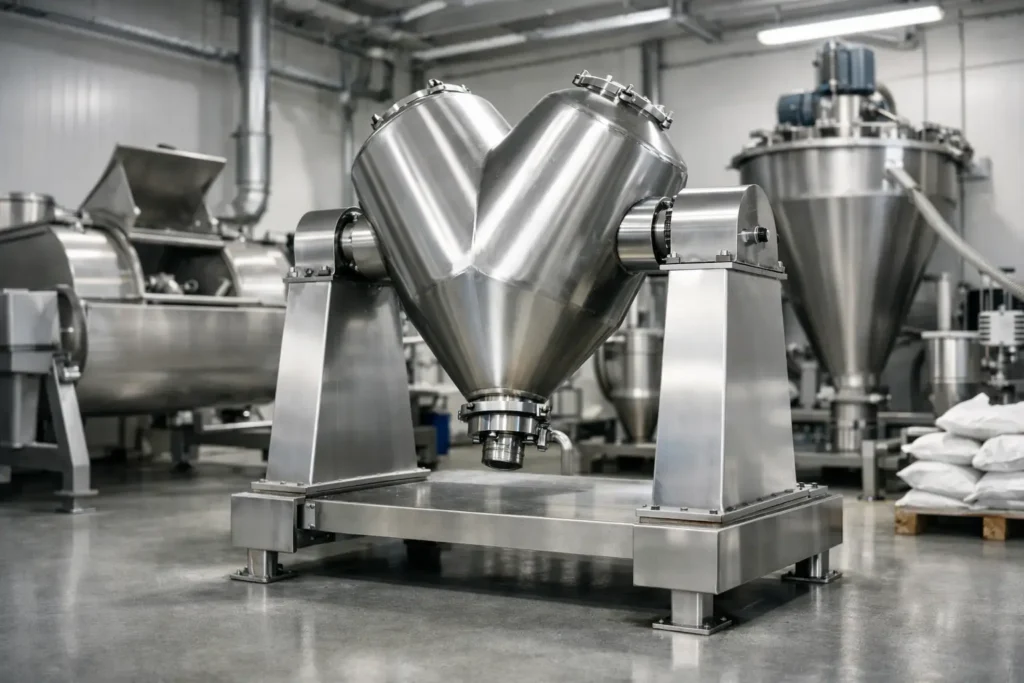
For very gentle blending of free-flowing powders, tumble-style blenders such as V blenders can be highly effective. They rely on diffusion and repeated division of the product mass rather than strong mechanical agitation. In pharmaceutical, nutraceutical, and specialty chemical operations, this can be an advantage when avoiding heat build-up or particle degradation is important.
These blenders are not usually the best choice for cohesive materials or large liquid additions. They also may require more attention to fill level and formulation characteristics. But for the right powder, they provide clean, low-shear mixing with straightforward validation benefits.
Vertical screw designs are especially useful when handling large volumes, density differences, or applications where gentle but thorough circulation is needed. The screw lifts material vertically while gravity returns it downward, creating full-batch turnover with relatively low power consumption.
They are commonly selected for specialty chemicals, plastics, minerals, and other bulk solids applications. In facilities where floor space, discharge configuration, or large-batch homogeneity matters, these blenders can be a strong fit. The main question is whether the product requires more aggressive action than a vertical system typically provides.
The selection process should begin with the material, not the machine category. Ask how the powder flows, whether it tends to bridge or cake, how sensitive it is to shear, and whether the formulation includes trace ingredients or liquid binders. A blender that performs well with flour and seasoning may struggle with protein concentrates, metal powders, pigment systems, or fine pharmaceutical excipients.
Batch size matters, but usable working capacity matters more. Industrial blenders do not perform at full geometric volume. The real operating range depends on the mixer design and the material’s behavior. Buyers who size only by total vessel capacity often end up with longer mix times, poor movement, or incomplete discharge.
Cleaning requirements should be addressed early. In food, pharma, nutraceutical, and personal care manufacturing, access for inspection and washdown can be as important as blend uniformity. Sanitary welds, polished surfaces, shaft seals, spray systems, and clean-out doors all affect maintenance time and production uptime. A lower equipment price can be erased quickly by difficult changeovers.
Liquid addition is another critical factor. Many dry powder processes are not truly dry. Flavor oils, vitamins, active ingredients, surfactants, or binders may need to be sprayed into the batch. Some blender types accept this easily. Others can create wet pockets, build-up, or extended cycle times. If liquid addition is part of the process, it should be treated as a core design requirement rather than an accessory feature.
Uniformity is the obvious metric, but it is not the only one. A good blender should achieve target homogeneity within a practical time window and maintain that performance from batch to batch. Repeatability often matters more than a single best-case test result.
Discharge efficiency is equally important. If valuable product remains trapped in the vessel, operators lose yield and spend more time cleaning. Poor discharge also creates cross-contamination risk. The best industrial powder blenders are designed to move product effectively during mixing and empty efficiently at the end of the cycle.
Reliability should not be treated as a generic promise. Ask about drive design, bearing protection, seal options, structural strength, and fabrication quality. In abrasive or high-duty applications, these details determine whether the equipment will hold tolerance and performance over time. This is where engineering quality shows up as lower ownership cost.
Controls and integration also affect real performance. Recipe management, timed liquid addition, automated discharge, safety interlocks, and compatibility with feeders or downstream packaging systems can improve consistency just as much as the mixer geometry itself.
The strongest powder blender suppliers do more than quote a standard model. They ask for bulk density, particle size, moisture content, fill level, throughput targets, cleaning protocol, and regulatory requirements. They want to understand whether you are blending a simple dry premix or building a multi-stage process with heating, vacuum, deagglomeration, or granulation.
That engineering conversation is where expensive mistakes are avoided. A standard ribbon blender may be exactly right for one facility and completely wrong for another producing a sticky nutraceutical blend with oil addition and frequent allergen changeovers. The best outcome comes from application fit, not assumptions.
This is also why manufacturers often work with broad-line equipment partners rather than single-design specialists. A supplier with multiple blender platforms can recommend the right process path more objectively. PerMix approaches powder mixing that way – with a wide range of blender types, custom engineering options, and performance-focused design tailored to the application rather than forced into one machine family.
If you are comparing industrial powder blenders, focus less on broad marketing claims and more on how each design handles your formulation, your cleaning standard, and your production targets. The best machine for your plant may be a straightforward ribbon blender, a gentle paddle mixer, or a high-intensity plow system with liquid addition capability. What matters is repeatable performance, practical maintenance, and equipment built for the way you actually run batches.
A good buying decision should make the next five years easier, not just get the current project approved.
Stay Connected