Industrial Mixers
PerMix News & Updates
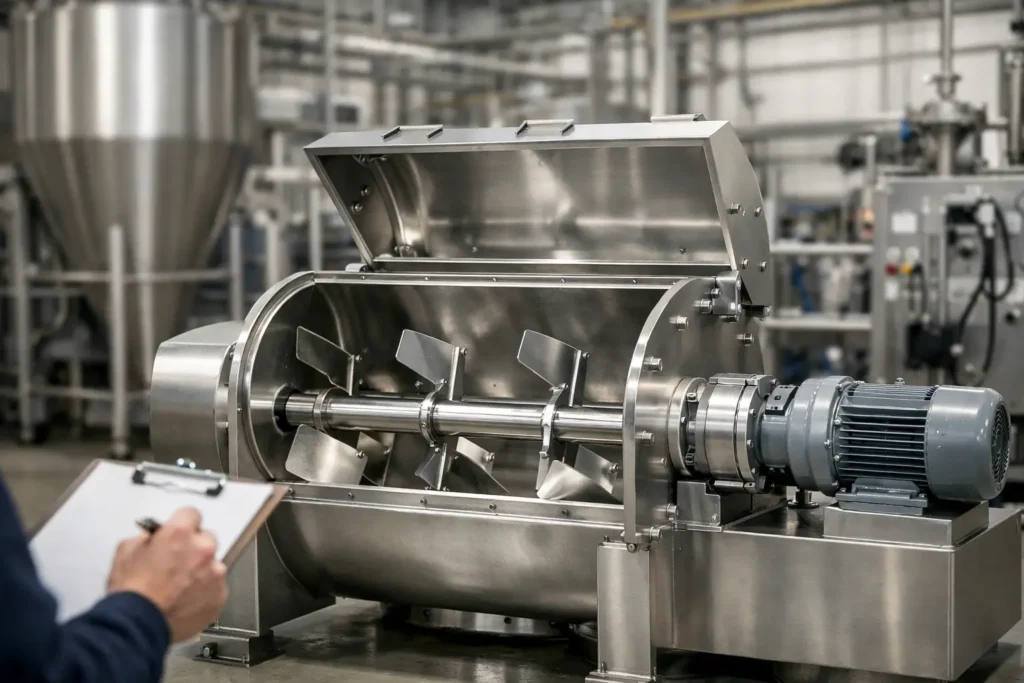
When a product misses particle size, flows poorly, or degrades under heat, the milling method is often part of the problem. In wet milling vs dry milling, the right choice is not academic – it directly affects yield, downstream mixing, cleaning requirements, energy use, and final product performance.
For plant managers and process engineers, the decision usually comes down to one question: what happens to the material during size reduction, and what will that do to the rest of the process? A milling system does not operate in isolation. It influences pumping, blending, drying, packaging, stability, and, in regulated environments, validation and sanitation.
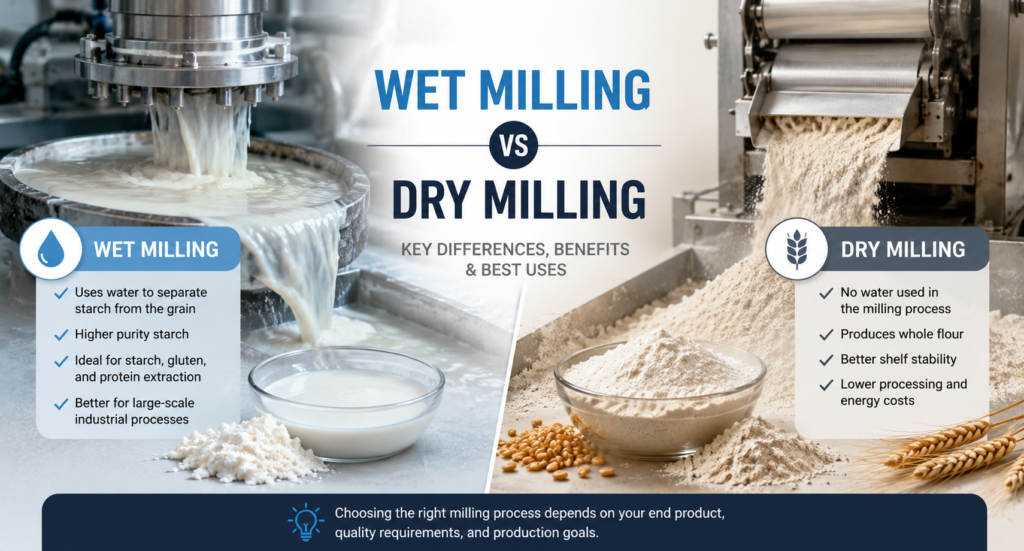
At the simplest level, dry milling reduces particle size without adding a liquid phase, while wet milling processes the material in a slurry or liquid vehicle. That single difference changes nearly everything else.
Dry milling is commonly used for powders, granules, and friable solids where free-flowing handling is required. It often makes sense when the product must remain dry for storage, blending, tablet compression, or direct packaging. Wet milling is more common when the target is a fine dispersion, a stable suspension, or a controlled particle size in a liquid system.
The real comparison is less about which method is better and more about which method better supports your material behavior and production goals. Some products respond well to impact or shear in a dry state. Others generate too much heat, dust, or agglomeration unless liquid is introduced.
Dry milling is typically the more straightforward route when the upstream and downstream process is already powder-based. If your production line handles dry ingredients from receiving through final blending or filling, staying dry avoids extra unit operations.
That matters in food, nutraceutical, chemical, and agricultural applications where adding liquid would trigger a need for dewatering or drying later. If the material can be milled to the required size without melting, smearing, or excessive fines, dry milling is often the faster and lower-cost option.
Dry milling also simplifies some aspects of material handling. You avoid slurry tanks, transfer pumps, liquid balance control, and the cleaning demands that come with wet product contact. In many facilities, that translates to a smaller footprint and lower process complexity.
But dry milling has limits. Heat buildup can become a serious issue with heat-sensitive materials, fatty products, plastics, waxy compounds, and certain active ingredients. Dust control is another major factor. Fine powder generation affects housekeeping, explosion protection, operator safety, and product loss. Material that cakes easily or carries static can also become difficult to process consistently in a dry system.
Dry milling is usually favored when throughput, simplicity, and direct integration with dry blending are the priority. It can reduce capital tied to liquid handling infrastructure and eliminate the need for a downstream drying stage. For many bulk solids, that is a strong commercial advantage.
It may also be the better fit when contamination risk from added process liquid is unacceptable, or when the finished product must remain completely dry to preserve shelf life and flow properties.
Wet milling becomes attractive when particle size targets are tighter, temperature control matters more, or the material simply does not behave well in dry form. By introducing a liquid phase, wet milling can reduce dust, improve heat dissipation, and support finer particle reduction in difficult applications.
This is especially relevant in pharmaceuticals, specialty chemicals, coatings, cosmetics, and some food applications where particle size distribution affects stability, texture, dissolution, color development, or bioavailability. If the end product is already a suspension, emulsion, cream, or liquid formulation, wet milling can fit naturally into the process.
Wet systems often produce more uniform dispersions, particularly for materials prone to agglomeration. Instead of trying to fracture dry clusters and then redisperse them later, the process breaks them down while suspended. That can improve consistency in downstream mixing and shorten total processing time.
The trade-off is that wet milling introduces more process variables. Viscosity, solids loading, fluid chemistry, pumpability, residence time, and cleaning all matter. If the final product must be dry, the benefits of wet size reduction have to justify the added cost and complexity of moisture removal.
Wet milling often performs better when the product is heat-sensitive, cohesive, abrasive in dry form, or difficult to classify after milling. It can support finer end points and tighter control over dispersion quality. In some processes, it also improves product handling by turning a dusty or inconsistent powder into a manageable slurry.
For high-value formulations, the improved control can outweigh the added system complexity.
The most common mistake in evaluating wet milling vs dry milling is focusing only on target particle size. Particle size matters, but it is only one variable in a larger manufacturing equation.
Heat is a major differentiator. Dry milling can generate more frictional heat, which may alter sensitive ingredients, soften materials, or change moisture balance. Wet milling generally controls temperature more effectively, although high-energy systems can still raise product temperature if not properly designed.
Contamination risk works both ways. Dry milling reduces the microbiological concerns associated with liquids, but it can increase airborne particulates and cross-contamination risk if containment is poor. Wet milling suppresses dust but adds cleaning demands and, in some sectors, stricter hygienic design requirements.
Energy and operating cost are also more nuanced than they first appear. Dry milling may look simpler, but if it requires extensive dust collection, inerting, cooling, or repeated passes, operating cost can climb. Wet milling may consume more resources through pumping, liquid handling, and drying, but it can reduce rework and improve first-pass quality.
Then there is throughput. Dry systems can be highly efficient in bulk powder applications, but not if the material bridges, smears, or blinds the screen. Wet systems may process difficult materials more consistently, though viscosity limits and solids content can become bottlenecks.
The right milling method usually starts with the material, not the machine. Friable crystals, brittle granules, and free-flowing powders are often strong candidates for dry milling. Heat-sensitive, sticky, elastic, or highly cohesive materials often need a wet approach or at least a closer review.
Moisture sensitivity is another checkpoint. Some products absorb water, react with it, or lose stability in a wet environment. In those cases, wet milling may be ruled out immediately. On the other hand, materials that oxidize in dusty air or create handling problems in dry form may be safer and more stable in slurry processing.
Target specification matters just as much as raw material behavior. If your acceptable particle size range is broad, dry milling may be enough. If the application requires a narrow distribution, better deagglomeration, or improved suspension quality, wet milling often offers more control.
This is why pilot testing matters. Production teams can save substantial time and cost by evaluating not just milled particle size, but also flow, temperature rise, slurry behavior, downstream blending response, drying load, and cleanout time.
Milling decisions should align with the entire production system. A wet mill paired with poorly designed transfer, holding, and clean-in-place capability can create more problems than it solves. A dry mill feeding an inconsistent powder stream into downstream blending can do the same.
The strongest process designs treat milling as one part of an integrated line. Feed method, discharge method, batch or continuous operation, sanitary construction, automation level, and future scale-up all matter. In many facilities, the best answer is not just selecting wet or dry milling, but pairing the chosen method with upstream conditioning and downstream mixing that stabilize the process.
That is where an experienced equipment partner adds value. Companies such as PerMix work across mixing, drying, milling, granulation, and process vessel design, which makes it easier to evaluate the full production path rather than treating the mill as a stand-alone purchase.
If your product must stay dry, your target size is achievable without excessive heat or fines, and your line is built around powder handling, dry milling is often the most efficient and economical path. If your material is heat-sensitive, difficult to deagglomerate, or destined for a liquid or semi-solid formulation, wet milling may deliver better product quality and more stable processing.
For many manufacturers, the answer is not obvious at the start. That is normal. Good process decisions come from matching material behavior, product specs, cleaning requirements, and production economics – not from assuming one milling method is universally superior.
The most useful next step is simple: look at what the material needs to become, not just what it is today. That shift usually points you toward the right milling strategy faster than any rule of thumb.

Stay Connected