Industrial Mixers
PerMix News & Updates
A high shear mixer that performs well in a lab can become a bottleneck on the plant floor. That is why evaluating the best high shear mixers is less about brand hype and more about process fit, batch size, product behavior, cleaning requirements, and scale-up risk.
For manufacturers working with emulsions, suspensions, powders into liquids, or materials that resist wet-out, the right high shear mixer can cut batch times, improve consistency, and reduce downstream problems. The wrong one can add heat, trap air, damage sensitive ingredients, or leave operators fighting the same dispersion issues every shift. The practical question is not which mixer looks best on paper. It is which design delivers the shear profile your process actually needs.
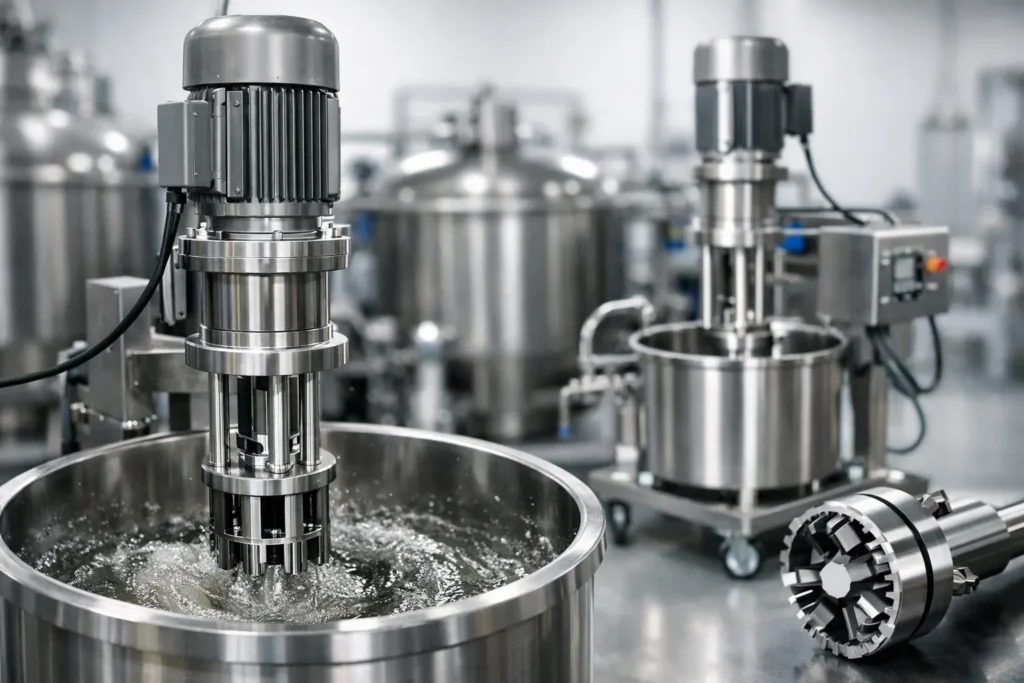
The best high shear mixers create intense mechanical and hydraulic forces that reduce particle size, break agglomerates, disperse powders, and produce stable emulsions or fine suspensions. In industrial terms, that usually means a rotor-stator system designed to move product through a narrow workhead gap at high tip speed.
But performance is only one part of the decision. A mixer can generate excellent shear and still be the wrong choice if it is difficult to clean, oversized for the batch, undersized for viscosity, or poorly matched to your vessel geometry. The best unit is the one that reaches your target result repeatedly, at production scale, within your operating and budget constraints.
For food, pharma, cosmetics, chemicals, and bio-based products, that also means considering sanitary construction, cleanability, vacuum capability, explosion-proof requirements, and integration with the rest of the line. In many cases, the smartest purchase is not the most aggressive mixer. It is the most balanced one.
Batch high shear mixers are often the first place manufacturers look, and for good reason. They are versatile, widely understood, and effective for many liquid-liquid and powder-liquid processes. In a standard batch setup, the rotor-stator head works directly inside the vessel and recirculates product through the mixing zone.
This design works well when you need flexibility across recipes, moderate batch volumes, and strong operator visibility during development or changeover. It is common in sauces, creams, gels, coatings, detergents, and pharmaceutical liquids.
The trade-off is scale. As vessel size increases, flow patterns, turnover time, and ingredient addition strategy matter more. A batch mixer that performs well at small scale may need vessel optimization, baffles, bottom-entry placement, or auxiliary agitation at larger volumes.
Inline high shear mixers are often the best choice when throughput, repeatability, and process control are the priority. Product is pulled into the mixer, processed through the rotor-stator zone, and discharged back to the tank or downstream process.
This setup can offer tighter control over residence time and often improves consistency in recirculation systems or continuous production. It is especially effective when incorporating powders into liquids, finishing emulsions, or reducing fisheyes and undispersed material.
Inline systems can also simplify scale-up because the shear event is more defined than in a purely batch configuration. The trade-off is system complexity. Pumping behavior, feed method, viscosity changes, and line pressure all matter, so the mixer must be selected as part of the full process, not as a standalone component.
When air entrainment is a quality problem, vacuum high shear mixers move to the top of the list. They are widely used in cosmetics, pharmaceuticals, adhesives, pastes, and other products where foam, oxidation, visual defects, or inaccurate fill weights create production headaches.
A vacuum-capable system can improve powder induction, reduce entrapped air, and support smoother finished texture. It can also help with deaeration during and after mixing. For sensitive formulations, that can make a visible difference in product quality and shelf stability.
The trade-off is cost and process discipline. Vacuum systems require tighter vessel design, sealing, instrumentation, and operator control. They are worth it when air management is central to product performance, not when vacuum is simply a nice feature to have.
Bottom-entry high shear mixers are valuable when batch turnover is difficult to achieve with a top-entry unit or when vessel geometry favors upward circulation. They are common in sanitary processing and can be highly effective for emulsification and powder incorporation.
In-tank rotor-stator mixers, whether top-entry or bottom-entry, can also be paired with anchor agitators, sweep mixers, or scrapers for viscous products. That combination is often the best answer for creams, ointments, gels, and heavy suspensions where shear alone is not enough to move the batch.
Tip speed gets a lot of attention, and it matters, but it is not the whole story. Rotor-stator design, gap geometry, number of stages, pumping rate, product viscosity, and batch turnover all affect real mixing performance. Two machines with similar horsepower can produce very different results.
Particle size reduction targets are another key benchmark. If your process requires true homogenization or very fine droplet size, a standard high shear mixer may be only part of the solution. In some applications, it is ideal for premixing and dispersion, while a separate homogenizer handles the final reduction step.
Heat generation should also be evaluated early. High shear mixing can raise temperature quickly, especially in viscous systems or long recirculation cycles. That may help dissolve or hydrate ingredients, but it can also damage heat-sensitive actives, change viscosity, or affect flavor and color.
Cleaning is often underestimated during equipment selection. If the process involves allergens, regulated ingredients, potent compounds, or frequent changeovers, clean-in-place capability and hygienic construction may be just as important as shear intensity. The best mixer in production is the one your team can run, clean, and return to service without losing half a shift.
Material behavior should drive the decision. Powders that float, clump, or hydrate on contact need a different strategy than simple liquid blending. Viscous products may require support agitation. Shear-sensitive ingredients may need shorter exposure or a less aggressive workhead.
Batch size range matters too. If you run one vessel at 30 percent fill one day and 95 percent the next, turndown capability becomes important. A mixer that only performs well at one fill level will create inconsistency across campaigns.
Utility and plant constraints should be reviewed before finalizing the design. Electrical classification, ceiling height, available floor space, vessel access, controls integration, and washdown requirements all affect what is practical. Procurement teams know this well, but it still gets missed when selection is driven only by lab results.
Future production plans deserve attention. If you expect higher viscosity products, larger batch sizes, or more demanding dispersion requirements next year, buying only for the current process can be expensive. The best value often comes from a mixer platform that can be configured for both current and future workloads.
One common mistake is choosing solely by horsepower. More power does not automatically mean better dispersion. If the rotor-stator design, batch turnover, and ingredient addition method are wrong, extra power may simply add heat and operating cost.
Another mistake is treating all emulsions as the same. Oil phase ratio, surfactant system, viscosity curve, and ingredient sequence all influence mixer performance. A machine that works well for one lotion may struggle with another that looks similar on a spec sheet.
A third mistake is separating the mixer from the process. The vessel, agitator, powder induction method, vacuum system, controls, and discharge arrangement all affect results. Industrial buyers usually get the best outcome when the system is engineered around the application rather than dropping a generic mixer into an existing setup and hoping for the same result at scale.
That is where an experienced equipment partner adds value. Companies such as PerMix work across high shear mixing, homogenizing, vacuum processing, and full vessel system design, which matters when the application is more complex than a simple batch blend.
Start with the end result. Define the required particle size, droplet size, viscosity target, batch time, temperature limit, and cleaning standard. Then match the mixer type to the job, whether that means batch, inline, vacuum, bottom-entry, or a combined system.
Run trials if the application is at all demanding. Lab tests are useful, but pilot-scale work often reveals what the formula does when powders are added faster, viscosity rises earlier, or heat accumulates over a longer cycle. That is where many equipment decisions become much clearer.
Ask hard questions about maintainability, lead time, spare parts, controls, and scale-up logic. The best high shear mixers are not just fast in a demo. They are dependable in daily production, serviceable by your team, and built to support years of process consistency.
If you are evaluating high shear mixing equipment, focus less on broad claims and more on application fit. The right machine should solve a measurable production problem, not create a new one after installation.

Stay Connected