Industrial Mixers
PerMix News & Updates
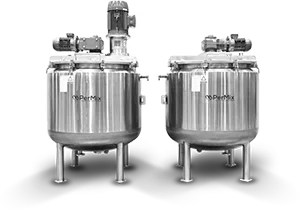
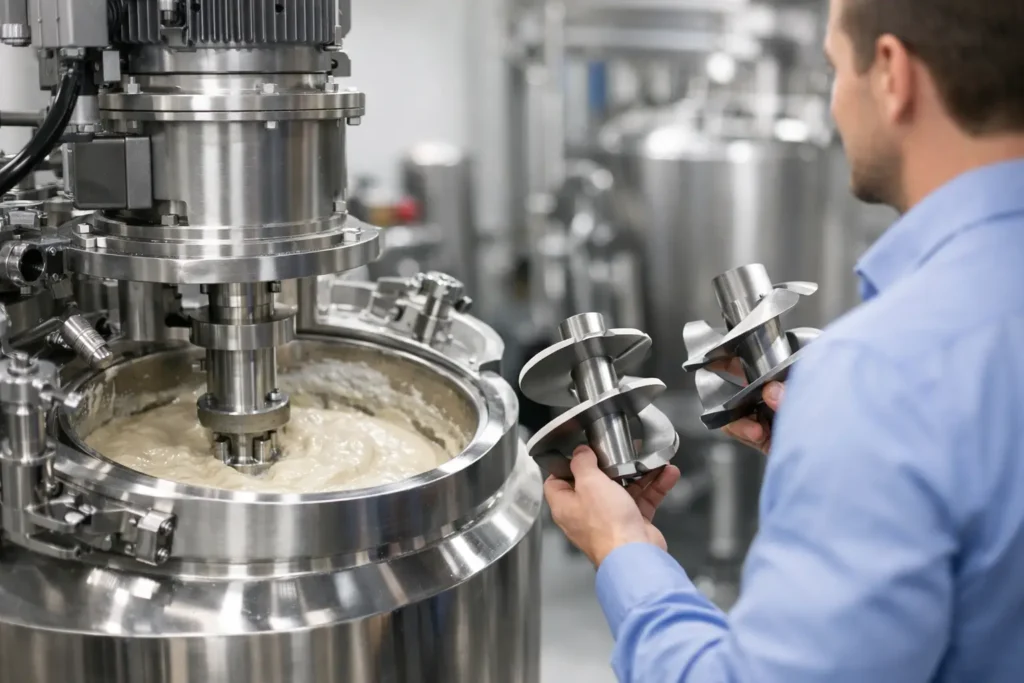
When a batch stops moving, production problems show up fast. A high viscosity mixer is not just a mixing tool for thick materials – it is a process-critical machine that determines whether your operation gets repeatable quality, acceptable cycle times, and stable throughput or loses time fighting buildup, dead zones, heat rise, and inconsistent discharge.
Thick products do not behave like free-flowing liquids. Adhesives, sealants, silicone compounds, putties, gels, creams, ointments, battery pastes, wet granulations, heavy slurries, and dense food formulations each place different demands on the mixer. That is why equipment selection cannot be reduced to tank size and motor horsepower alone. The right choice depends on viscosity range, rheology, batch size, shear target, temperature sensitivity, cleaning requirements, and how the material changes during the process.
A high viscosity mixer has one primary job: keep material moving efficiently even as resistance rises. In practical terms, that means generating enough torque to turn thick masses, creating a mixing pattern that reaches the full batch, and doing it without damaging the product or overloading the drive.
This is where many mixing projects succeed or fail. Some products need aggressive kneading to break agglomerates and incorporate powders into a dense base. Others need controlled folding with minimal aeration. In regulated industries, the mixer may also need sanitary construction, vacuum capability, jacketed temperature control, and a discharge method that does not leave a high-value product trapped in the vessel.
For plant teams, the real question is not simply, Which mixer can turn? It is, Which mixer can deliver a stable process window day after day at production scale?
Viscosity is a useful starting point, but it does not tell the whole story. Two materials with similar measured viscosity can behave very differently in the mixer. One may be shear thinning and become easier to process once motion begins. Another may be yield-stress dominant and resist movement until enough force is applied. A third may trap air easily or become temperature sensitive during prolonged mixing.
That is why experienced equipment selection looks at more than a single number. Material behavior over the full batch cycle matters. So does the order of ingredient addition. A product that begins as a low-viscosity liquid and ends as a stiff paste may need a different machine than a product that starts and stays dense throughout the cycle.
For many industrial applications, the critical factors include how quickly powders wet out, whether lumps must be broken down, how much wall cleaning action is needed, and whether discharge must be assisted mechanically. These details directly affect labor, batch time, scrap rate, and scale-up risk.
Not every high viscosity mixer is built on the same mixing principle. The best fit depends on the material and the process objective.
Sigma mixers are a strong choice for very heavy products that require kneading and intensive working action. Their twin blades move dense material through overlapping zones, making them well suited for rubber compounds, putty, gum base, heavy dough, and similar formulations. When the product resists flow and needs forceful mechanical working, sigma technology often provides the best performance.
The trade-off is that sigma mixers are application-specific. They excel with very thick masses, but they are not the best answer for every cream, gel, or semi-fluid paste. Batch discharge and cleaning design also deserve close attention during selection.
Planetary mixers are widely used when the process needs full-batch coverage, good wall and bottom sweeping, and flexibility across a range of viscosities. They are common in adhesives, sealants, battery materials, pharmaceuticals, cosmetics, and food formulations. Single and double planetary designs can combine slow-speed folding with high-speed dispersion, which is valuable when solids must be incorporated into a viscous base.
This style is especially useful when product consistency changes during the cycle. It can also be configured with vacuum and jackets for deaeration and temperature control. For many manufacturers, that versatility makes planetary designs one of the most practical investments in high-viscosity processing.
Where the process calls for heavy-duty mechanical energy rather than simple blending, kneader-type mixers remain a proven option. These machines are chosen for applications where the batch behaves more like a mass to be worked than a fluid to be circulated. They can handle extreme resistance, but the right geometry and blade configuration are critical.
The wrong kneader can create long cycles, uneven mixing, or cleaning difficulty. The right one can dramatically improve incorporation, homogeneity, and throughput.
The most effective way to select a high viscosity mixer is to work backward from the process result you need. Start with the finished product specification, then examine what the mixer must accomplish to get there.
Batch size is one obvious factor, but usable working capacity matters more than nominal vessel volume. Thick materials do not always mix efficiently at every fill level. Some machines perform best within a narrower working range, particularly when wall contact and folding patterns drive performance.
Shear is another major consideration. More shear is not automatically better. In some formulations, it improves dispersion and shortens cycle time. In others, it changes particle structure, raises temperature, damages texture, or pulls in unwanted air. A good selection process identifies where shear helps and where it becomes a liability.
Temperature control often becomes more important as viscosity rises. Thick products can build heat quickly because more mechanical energy is required to move them. If the product is heat sensitive, or if viscosity changes sharply with temperature, jacket design and heat transfer become central to mixer performance.
Discharge cannot be treated as an afterthought. A mixer may perform well during blending and still create losses if product remains stuck in the vessel or requires excessive manual removal. For expensive materials, sanitary products, and high-throughput lines, discharge efficiency has a direct effect on yield and labor cost.
The same high viscosity mixer will not be ideal for every industry. In food production, sanitation, cleanability, and gentle product handling may rank above aggressive shear. In chemicals and adhesives, torque, solids incorporation, and vacuum capability may take priority. In pharmaceuticals and personal care, validation support, finish quality, containment, and repeatability may drive the decision.
Material additions also matter. If powders are added into a viscous base, the mixer must wet them out quickly and avoid dry pockets. If the process includes fragile inclusions, the machine must preserve them. If air entrainment causes downstream defects, vacuum mixing may be necessary rather than optional.
This is where custom engineering earns its value. Standard equipment may handle the viscosity range, but customized blade geometry, vessel proportions, drive sizing, seals, controls, or discharge design often make the difference between acceptable performance and excellent performance.
A mixer that works in the lab or pilot room does not always translate directly to plant production. High-viscosity systems are especially sensitive to geometry, torque loading, heat transfer, and residence patterns. A small unit may appear to mix well simply because the operator can intervene or because the batch size masks inefficiencies.
At production scale, those weaknesses become expensive. Cycle time expands. Batch temperature drifts. Dead zones show up. Discharge slows down. Operators compensate manually, and consistency suffers.
That is why scale-up should be approached as an engineering exercise, not just a larger purchase order. Equipment suppliers with broad mixer families and application experience can compare technologies and recommend the design that fits the real process, not just the starting assumption. For industrial buyers, that reduces risk before capital is committed.
A serious mixer supplier should ask detailed process questions. They should want to know the viscosity profile, solids loading, density, abrasiveness, temperature limits, cleanability standards, batch size range, cycle time target, and discharge expectations. If those questions are not being asked, the recommendation may be too generic.
You should also expect realistic discussion of trade-offs. The best high viscosity mixer for shear development may not be the easiest to clean. The best design for vacuum deaeration may carry a higher upfront cost. The fastest batch cycle may require more complex controls. Good engineering support means identifying these realities early so the equipment aligns with production goals and budget.
PerMix approaches these projects with that broader view – matching mixer design to application behavior, process requirements, and long-term operating value rather than forcing one machine type into every thick-product application.
The best buying decision usually comes from a simple principle: choose the mixer that fits how your material actually behaves in production, not how it looks on a data sheet. That is how thick products become stable, scalable processes instead of constant operator battles.
Stay Connected