Industrial Mixers
PerMix News & Updates
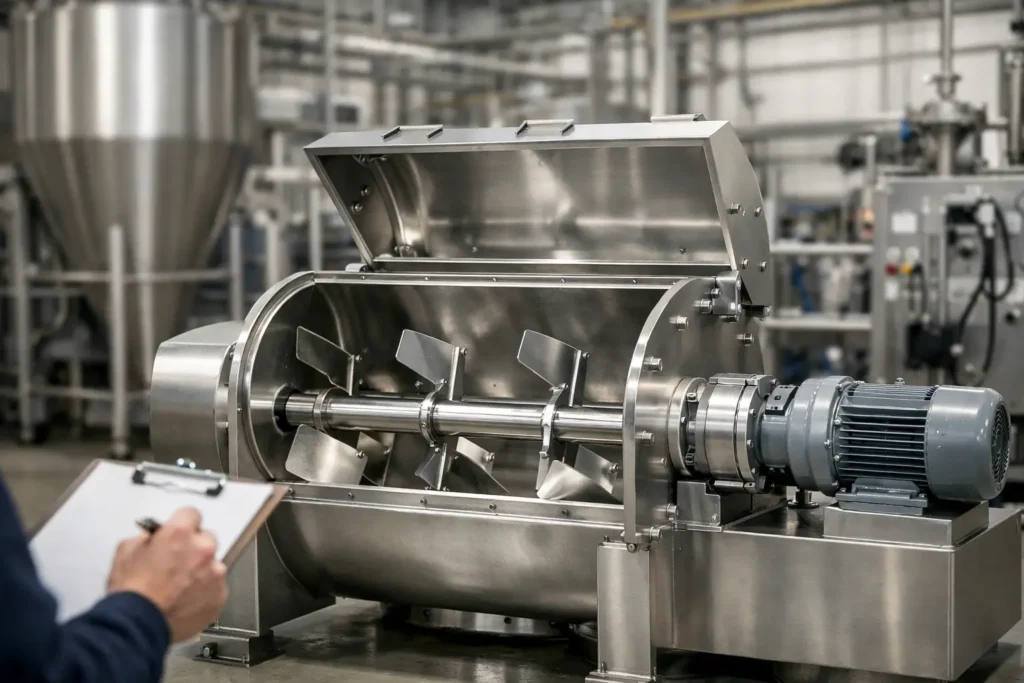
Food grade powder mixers that look right on paper can still create waste, long cycle times, and inconsistent batches once it hits the plant floor. That usually happens when the equipment is selected around capacity alone instead of actual powder behavior. In food production, the difference between a smooth-running line and a constant source of rework often comes down to how well the mixer matches the product.
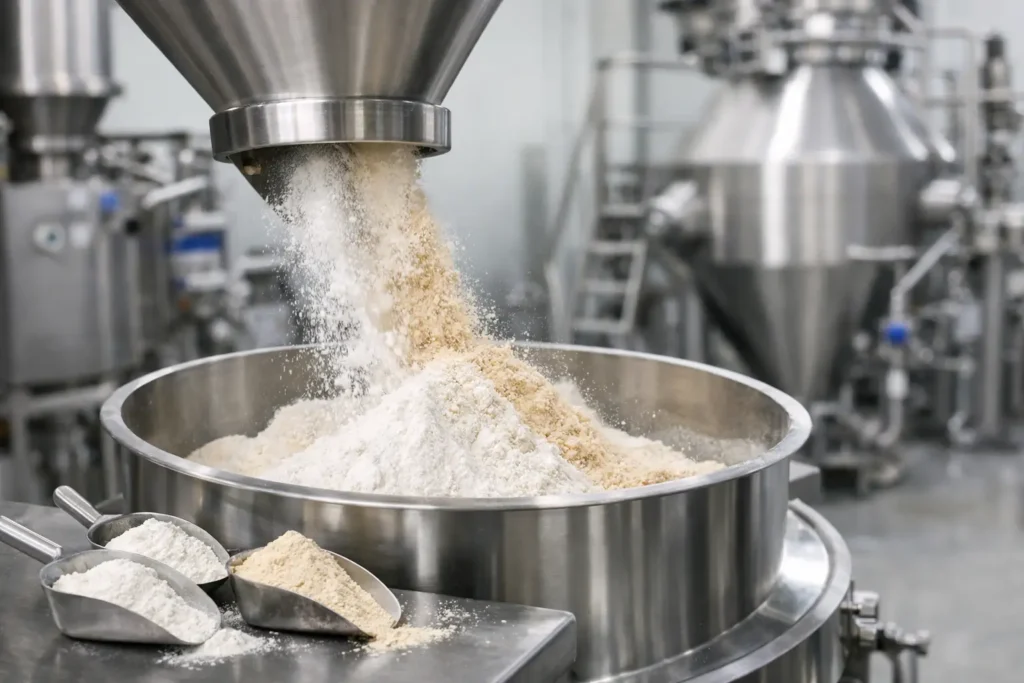
Food powders are rarely simple. A dry soup base, protein blend, bakery premix, seasoning, beverage powder, or functional ingredient system can contain particles with different sizes, densities, fat content, and flow characteristics. Some free-flow cleanly. Others bridge, smear, segregate, or form soft agglomerates as soon as minor ingredients are introduced.
That is why powder mixers should be evaluated as process solutions, not just machines. The mixer has to create the required level of homogeneity without damaging fragile particles, heating sensitive ingredients, or slowing production with difficult cleaning steps. It also has to support how the powder moves before and after mixing, including feeding, liquid addition, discharge, transfer, and packaging.
In practice, the key variables are straightforward but critical. Bulk density affects how quickly materials blend and whether they segregate during discharge. Particle size distribution influences dispersion of micros and actives. Fat content changes flowability and can make a dry blend behave more like a cohesive mass. Moisture sensitivity may require enclosed processing or tighter environmental control. If liquid addition is part of the formula, the system must distribute it evenly without creating wet lumps or dead zones.
There is no universal best mixer for food powders. The right choice depends on the product, batch size, throughput target, sanitation standard, and downstream requirements.
Ribbon mixers remain a strong option for many food applications because they offer efficient convective mixing at a practical cost. They are commonly used for spice blends, baking mixes, dry beverage powders, and general premixes where a consistent, repeatable blend is the main objective.
They perform well when powders are relatively free-flowing and the process does not demand aggressive dispersion of difficult minor ingredients. They can also handle controlled liquid addition in many applications, though results depend on spray design, ingredient load, and product stickiness. If the formula contains high fat levels or tends to smear on contact surfaces, a ribbon mixer may need specific design adjustments or may not be the best fit.
Paddle mixers are often selected when the product benefits from lower shear and a gentler mixing action. They can work well for fragile particulates, instant mixes, and applications where preserving particle integrity is important.
Compared with more aggressive designs, paddle mixers can reduce product degradation while still achieving good uniformity. The trade-off is that some difficult formulations may require longer cycles or more careful process tuning, especially when very small additions need to be dispersed throughout a large batch.
When the powder is cohesive, the formulation includes liquids, or the process requires faster and more energetic mixing, plow mixers are often the better answer. Their mechanical action creates fluidized product movement, which can improve blend speed and help distribute fats, oils, flavors, or binders more effectively.
This matters in food plants producing seasoning systems, fortified blends, and formulas where dust control and ingredient incorporation are constant issues. Choppers can also be integrated when deagglomeration is needed. That said, higher-intensity mixing is not ideal for every product. Sensitive materials may break down, and overprocessing can change particle presentation in the finished product.
Many mixing problems start with a reasonable but incomplete assumption. A product may have been blended in a ribbon mixer at pilot scale, so the production team expects the same result at higher volume. Then the larger batch shows streaking, segregation, or poor liquid distribution.
Scale changes the process. Fill level, residence time, agitator speed, spray placement, discharge design, and even the order of ingredient addition affect the result. The safest path is application review backed by material testing. That is how processors confirm blend uniformity, cycle time, fill rate, liquid absorption, and discharge behavior before committing capital.
For food manufacturers, testing is also where sanitary design details become easier to justify. A unit that costs less upfront may require longer cleanup, more manual intervention, or more changeover time between allergen-sensitive products. Over time, those losses are often more expensive than the initial purchase price.
In food processing, mixer performance is not only about blend quality. It is also about cleaning access, surface finish, seal design, discharge geometry, and how reliably the system supports validation and inspection.
A poorly designed mixer can hold residue in corners, around shaft seals, under spray bars, or at discharge points. That creates downtime and increases risk, especially in plants managing allergen control, flavor carryover, or strict customer audit standards. Sanitary construction should match the real cleaning regime of the facility, whether that means dry cleanout, manual washdown, or a more demanding hygienic standard.
This is where engineered details matter. Tool-free access, proper weld finish, minimal crevices, clean discharge, and well-designed covers are not cosmetic upgrades. They affect uptime, labor, product recovery, and regulatory confidence. For many processors, a mixer that is easier to clean is also the mixer that is easier to keep in production.
A large share of food powder applications are not purely dry. Oils, flavors, colors, lecithin, sweeteners, and functional additives are often introduced during mixing. This changes the selection criteria immediately.
The system needs to apply liquids at the right rate, in the right location, with proper atomization. Too much liquid too quickly can form clumps. Too little mixing energy can leave localized concentration zones. Too much energy can create buildup on the vessel wall or damage the product.
This is why liquid addition should be treated as part of the mixer design, not an accessory added later. Spray assemblies, pump control, nozzle selection, and agitator action must work together. In some applications, jacketed vessels or vacuum capability may also be worth considering, especially when temperature control or moisture management affects product quality.
A mixer does not work alone. Feed hoppers, conveying method, weighing, screening, downstream transfer, and packaging all influence whether the process performs consistently. A well-selected mixer can still underdeliver if the upstream feeding system floods the batch unevenly or if the discharge setup causes segregation before packaging.
That is why the best food powder mixing systems are designed around the full process path. Ingredient loading should be efficient and repeatable. The batch should discharge fully and predictably. Transfer should protect the blend from separation. Controls should support recipe management, operator consistency, and production visibility.
For growing manufacturers, flexibility matters too. A system should fit today’s formulas without limiting future expansion. If new products may require liquid addition, tighter sanitation, or different batch sizes, that should be part of the engineering discussion early. The lowest-cost option is not always the best value if it forces a redesign in two years.
The strongest equipment decisions usually come from a small set of practical questions. What does the powder actually do under agitation? How sensitive is the product to shear, heat, or overmixing? Does the formula include micros, fats, or liquids? What level of cleanability is required between runs? How fast must the system cycle to support production targets?
Those questions are more useful than asking which mixer type is most popular. Popularity does not solve a difficult blend. Fit does.
For operations leaders and engineers, this is where an experienced manufacturing partner adds real value. Broad equipment availability matters, but application knowledge matters more. A supplier that understands powder behavior, sanitary design, and production economics can narrow the field quickly and recommend a system that supports both process performance and budget discipline. That is the standard PerMix is built to meet.
The right mixing system should make the plant more predictable – not more dependent on operator workarounds. When the equipment is matched to the material, production gets easier, quality gets steadier, and growth becomes much simpler to support.

Stay Connected