Industrial Mixers
PerMix News & Updates
A batch can look fine from the top and still be failing underneath. Dry powder floating on the surface, fisheyes hiding below the liquid line, dusting at the feed point, and long mix times all point to the same issue: the dispersion step is not under control. If you need to understand how to disperse powders into liquids in a production environment, the answer is not just more mixing. It is matching powder behavior, liquid properties, and mixer design to the process.
In industrial manufacturing, powder dispersion is where many downstream problems begin. Poor wet-out can lead to lumps, inconsistent viscosity, underperforming active ingredients, rework, and longer cycle times. In sanitary and regulated industries, it can also create validation concerns and batch-to-batch variation that is expensive to tolerate.
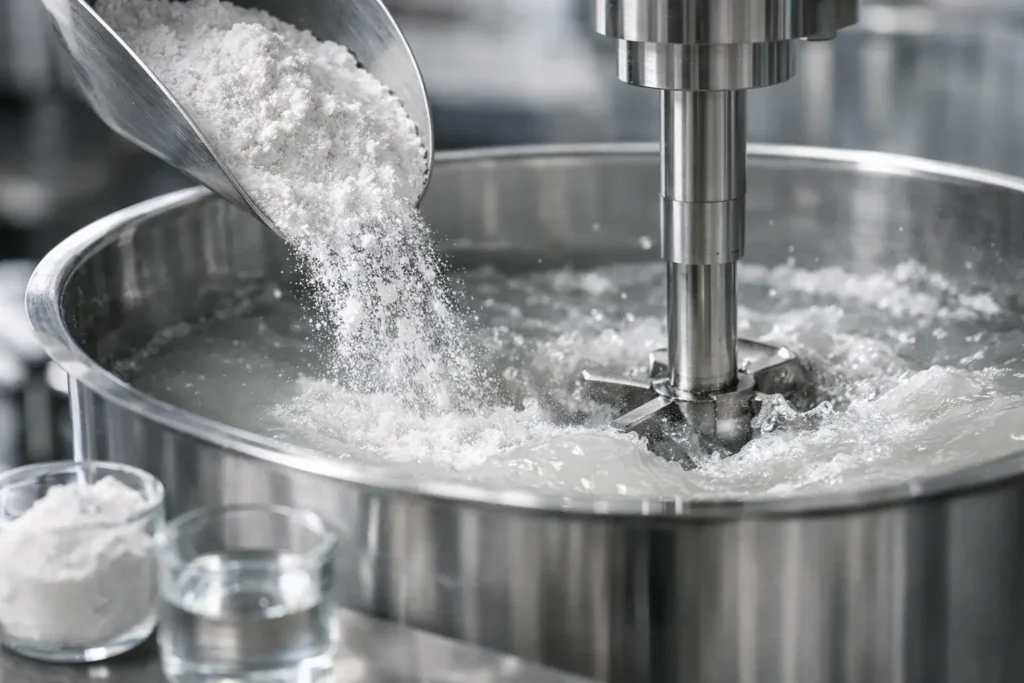
Powder dispersion sounds simple until you look at the mechanics. A dry particle has to contact the liquid, break through the liquid surface, become wetted, and then separate from neighboring particles before agglomerates form. Each of those steps can fail for a different reason.
Some powders trap air and resist wetting. Others dissolve too quickly on the outside, forming a gel layer around a dry core. Fine, low-density powders may float and raft on the surface. Cohesive materials may enter the vessel as clumps and stay that way unless enough shear is applied in the right zone.
That is why two products with similar formulas can behave very differently in the mixer. Protein powders, gums, silica, starches, carbomers, titanium dioxide, and specialty chemicals all require different approaches. The right process depends on particle size, bulk density, solubility, surface chemistry, and the viscosity of the liquid phase.
The most reliable approach is to control three things at the same time: the liquid flow pattern, the powder feed rate, and the shear level at the point of addition. If one of those is off, the process slows down fast.
Start with the liquid side. The vessel should have enough circulation to pull material away from the addition point and keep solids from collecting at the surface or settling on the bottom. In a simple tank, that may mean an agitator with proper impeller selection and baffling. In more demanding applications, it may require a high shear mixer, inline rotor-stator system, or a recirculation loop designed specifically for powder induction.
Then control the powder addition rate. Adding powder faster than the liquid can wet and disperse it is one of the most common causes of fisheyes and lumps. Operators often try to recover by increasing speed after the fact, but once agglomerates form, breaking them down takes far more time and energy than preventing them in the first place.
Finally, apply shear where it matters. High RPM alone does not guarantee good dispersion. The key is localized shear in the wetting zone, where powder first contacts the liquid. A poorly positioned mixer can spin the batch aggressively while still allowing powder to float, clump, or bypass the active mixing zone.
Viscosity is usually the first limiting factor. Low-viscosity liquids can circulate well, but they may not pull in floating powders efficiently without the right vortex or induction method. High-viscosity liquids can suspend solids once incorporated, but initial wet-out becomes harder because circulation is reduced.
Powder properties are just as critical. Fine powders tend to agglomerate more easily because of their high surface area. Hydrophobic materials resist wetting. Hygroscopic powders may cake before they even reach the liquid. Low-density materials often require special feeding and induction methods to avoid dusting and surface buildup.
Temperature also changes the game. Heating can reduce liquid viscosity and speed hydration or dissolution, but it can also create surface gelling for some ingredients. In food, pharma, and specialty chemical applications, temperature windows are often narrow, so the dispersion method has to work within strict process limits.
Order of addition matters more than many plants expect. A powder that disperses cleanly into water may fail completely if added after thickeners, oils, or salts. The same formula can produce different results depending on when each ingredient enters the vessel.
There is no universal mixer for every powder-liquid application. The best choice depends on whether the goal is wet-out, deagglomeration, hydration, dissolution, emulsification, or a combination of these steps.
For basic blending in low- to medium-viscosity liquids, an agitator in a properly designed vessel may be enough if the powder wets easily and addition is controlled. This is the lower-cost route, but it works best for forgiving materials.
For harder-to-wet powders, a high shear mixer is often the better answer. Rotor-stator systems create intense shear that breaks agglomerates and improves wetting speed. They are widely used for gums, thickeners, proteins, pigments, and pharmaceutical excipients where consistency matters and batch time has a direct production cost.
For dusty, lightweight, or difficult powders, powder induction systems offer a major process advantage. Instead of dumping material into an open vortex, these systems draw powder directly into a high-velocity liquid stream. That improves wet-out, reduces airborne dust, shortens batch times, and gives operators much better control.
Vacuum mixing can also be valuable, especially when trapped air is part of the problem. If powders tend to float because of entrained air, or if the finished product must be low in foam and voids, vacuum processing can improve both dispersion and final quality.
This is where application engineering matters. A food slurry, a cosmetic gel, and a chemical suspension may all involve powder addition, but they should not be treated as the same process. At PerMix, that distinction drives equipment selection because the wrong machine can add cost without solving the actual dispersion problem.
The most common mistake is treating all powders as if they behave the same. Plants often standardize on one tank and one mixer for multiple products, then wonder why one SKU runs cleanly and another requires extended mixing, manual intervention, or rework.
Another issue is feeding powder too quickly. Fast charging may look efficient, but if it overloads the wetting zone, overall cycle time usually increases. The batch spends more time breaking down lumps, and quality becomes less predictable.
Underestimating vessel design is another costly error. Poor impeller placement, lack of baffling, dead zones, and incorrect liquid levels can all reduce circulation and leave powder stranded. In many cases, the mixer itself is not the only problem. The whole system layout needs review.
Many plants also use more shear than necessary or too little where it counts. Too much shear can damage sensitive ingredients, affect particle size distribution, or generate heat that changes the product. Too little shear leaves agglomerates intact. The right answer depends on the formula and the required end state.
If batch performance is inconsistent, start by identifying the exact failure point. Is the powder floating, clumping at entry, gelling on contact, or settling after dispersion? Each symptom points to a different correction.
Then evaluate the liquid phase at the moment of addition. Check viscosity, temperature, and circulation pattern before the powder enters. A process that works at lab scale with manual addition may fail at production scale because the fluid dynamics change significantly.
Next, review how the powder is introduced. Controlled feeding, eductor-based induction, or enclosed transfer can make a major difference compared with manual dumping. This is especially true for lightweight or dusty materials where operator technique creates variation from batch to batch.
After that, look at shear intensity and residence time. If agglomerates survive the first pass, the system may need a higher shear zone, better recirculation, or a staged addition method. In some formulations, splitting the powder charge into multiple additions produces a cleaner result than one large dump.
Pilot testing is often the fastest way to reduce uncertainty. It reveals whether the issue is equipment type, process sequence, or material behavior. For plants scaling up or introducing new formulations, this step can prevent expensive trial-and-error on the production floor.
Sometimes the process problem starts upstream or downstream. Powder storage conditions may be causing caking. Particle size distribution may be too broad for the current system. The formulation itself may require a dispersant, preblend, or different addition sequence.
That is why experienced manufacturers look at powder dispersion as a system question, not just a mixer question. Equipment matters, but so do feeding method, vessel geometry, material handling, controls, and product rheology.
If you are working on how to disperse powders into liquids more efficiently, the real objective is not simply to eliminate lumps. It is to shorten cycle time, improve repeatability, protect product quality, and build a process that scales. When those pieces line up, the mixing step stops being a bottleneck and starts delivering the production performance your plant actually needs.
The best powder dispersion process is the one that fits your material, your throughput target, and your quality standard on day one and still makes sense when production demand grows.

Stay Connected