Industrial Mixers
PerMix News & Updates
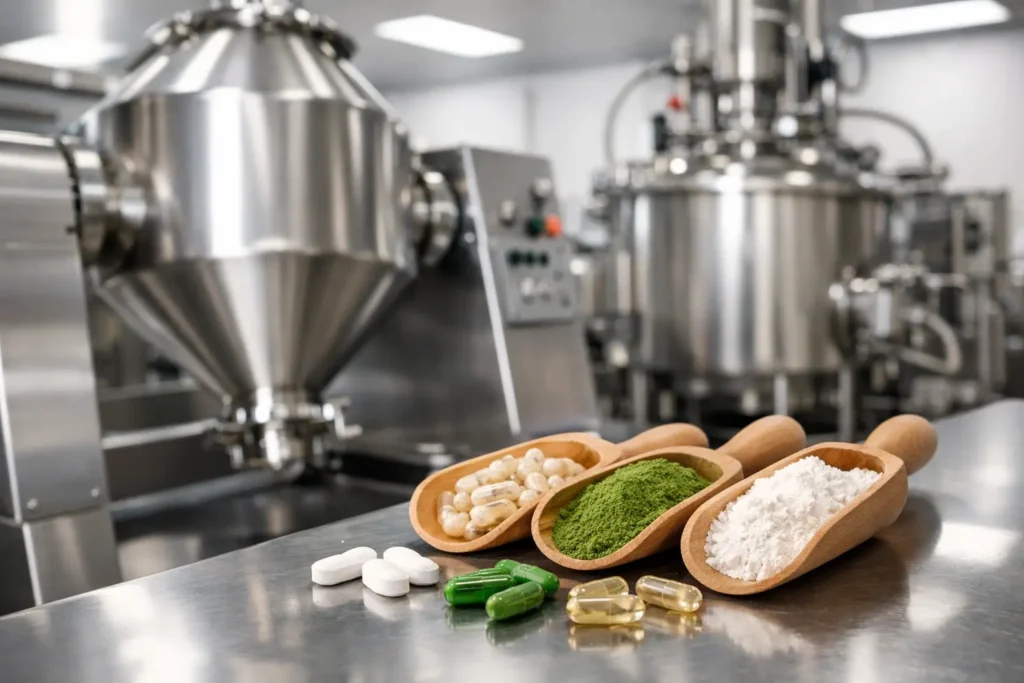
A blend that looks uniform in a pilot batch can fall apart fast at production scale. Nutraceutical blending equipment has to do more than turn powders over. It has to manage ingredient density differences, low-dose actives, fragile particles, dust control, liquid addition, and sanitation requirements without slowing the line or creating inconsistent product.
That is why equipment selection in nutraceutical manufacturing is less about buying a mixer and more about matching process demands to the right blending technology. The best result is not simply a machine that mixes. It is a system that delivers repeatable homogeneity, practical throughput, and clean changeovers under real plant conditions.
Nutraceutical formulations create a different set of blending challenges than commodity powders. A plant may be combining vitamins, minerals, botanical extracts, proteins, sweeteners, excipients, flavors, and flow aids in the same process area. Those materials rarely behave the same way.
Some powders are free flowing. Others bridge, pack, smear, or segregate. Fine active ingredients may need precise distribution at very low inclusion rates. Granules can fracture if handled too aggressively. Hygroscopic materials can pick up moisture and change flow behavior during the run. If oils or other liquids are added, the process becomes even more sensitive to mixer design, spray location, and residence time.
For most manufacturers, the core performance target is simple: every batch has to meet specification without rework. In practice, that means the blending equipment must support predictable movement of the full batch mass, not just high tip speed or short cycle times on paper.
The right mixer depends on the material and the production goal. There is no single design that is best for every nutraceutical application.
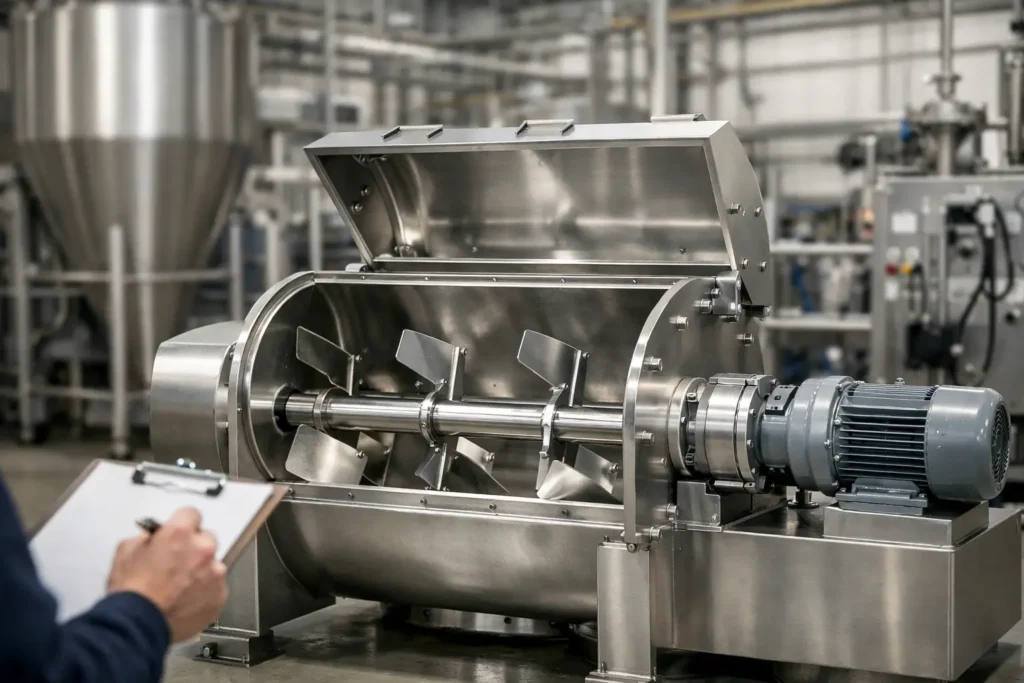
Ribbon blenders are often a strong fit for dry powder blends that require good batch uniformity and cost-effective throughput. Their counter-flow action moves material both radially and laterally, which makes them useful for many vitamin, mineral, and dietary supplement formulations.
They are especially practical when the blend is relatively free flowing and the process does not require extreme shear. They can also support light liquid addition when properly configured. The trade-off is that very cohesive materials or extremely low-dose actives may need more careful validation, and some sanitary designs require added attention to discharge geometry and cleanability.
Paddle blenders are commonly selected when the product needs a more gentle mixing action. If the batch contains fragile granules, agglomerates, or particles that should not be broken down, paddle designs can reduce degradation while still producing strong blend uniformity.
They also perform well in applications where liquid addition is required but overworking the product is a concern. The main consideration is that gentle handling should not be confused with lower performance. For the right application, it is the more effective process choice because it preserves product structure while maintaining distribution.
Plow mixers are often the better option when materials are more cohesive, when liquid addition is heavier, or when process intensification is needed. Their mechanical action creates a fluidized mixing zone that can improve dispersion and shorten blend times for harder-to-handle formulations.
This design can be particularly useful for nutraceutical products with challenging bulk density differences or ingredients that tend to clump. The trade-off is that it introduces a more energetic process. For heat-sensitive or friable materials, that extra intensity needs to be evaluated carefully.
Some nutraceutical blending applications benefit from vacuum capability or a fully enclosed system. This matters when dust containment, oxidation control, solvent handling, or integrated liquid incorporation are part of the process requirement.
Vacuum blending can also improve wetting and deaeration in certain formulations. In regulated production environments, a closed design can support both operator safety and product integrity. These systems are typically more application-specific, so they should be engineered around the material behavior rather than selected from a generic standard.
A surprising number of equipment decisions are made too early around capacity alone. Batch size matters, but it is only one piece of the picture.
Fill level is critical. A mixer that performs well at one percentage of working volume may not deliver the same result when underfilled or pushed to the upper end of capacity. If your production schedule includes multiple SKU sizes, the operating range should be part of the purchase decision.
Ingredient introduction is another major factor. If micro-ingredients are added manually, feed location and sequence can change blend consistency. If liquids are sprayed into the batch, nozzle design, droplet size, and mixer exposure pattern become process-critical. The equipment should support the formulation strategy, not fight it.
Discharge is often overlooked until a line starts losing yield. Poor discharge geometry leaves hold-up in the trough, creates segregation at unload, or adds cleaning labor between batches. For high-value nutraceutical products, those losses add up quickly.
Cleanability directly affects uptime, quality, and compliance readiness. Nutraceutical facilities are often managing allergen risk, flavor carryover, botanical residue, and strict product identity requirements. A machine that blends well but cleans poorly will become a production bottleneck.
That is why sanitary details matter. Weld quality, internal finish, shaft seals, access doors, spray systems, and dead-zone reduction all influence cleaning performance. Depending on the product line, dry cleaning may be preferred for faster changeover, while washdown capability may be necessary for stickier or oil-containing formulations.
The right answer depends on the plant’s operating model. A high-mix environment with frequent SKU changes may prioritize accessibility and reduced product retention. A larger campaign-based operation may place more weight on throughput and automated cleaning support. Good equipment selection accounts for both.
Many nutraceutical manufacturers first encounter blending issues during growth. A formulation that performed acceptably in a small development mixer may segregate in a larger production unit. Blend time can shift. Liquid distribution can change. Particle handling may become more aggressive than intended.
Scale-up works best when the mixer is selected with process similarity in mind, not just bigger geometry. Agitator design, peripheral speed, fill ratio, and batch turnover pattern all influence whether a result can be reproduced at commercial volume.
This is where engineering support matters. Experienced equipment suppliers look beyond nominal mixer category and evaluate how the product behaves across batch size, loading sequence, and operating conditions. That approach reduces the risk of buying a machine that fits the floor plan but misses the process target.
Off-the-shelf equipment can be the right answer for some standard products, but nutraceutical manufacturing often benefits from customization. Ingredient variability, room constraints, explosion protection needs, sanitary requirements, and downstream integration all shape the final specification.
Custom options may include intensifier choppers, jacketed vessels, load cells, vacuum capability, specialized spray bars, sanitary valve configurations, dust-tight charging systems, and automation packages. None of those features are useful just because they exist. They matter when they solve a production problem, improve consistency, or reduce operating cost.
That is the difference between buying on brochure features and buying on engineered fit. A lower-priced standard mixer that requires constant operator workarounds is rarely the budget-friendly choice over time.
The best purchasing discussions usually start with the product, not the machine. What are the ingredient characteristics? What is the acceptable blend uniformity target? Is the process batch or continuous? Are there fragile components, liquid additions, dust hazards, or cleaning constraints? How often will formulations change?
It also helps to ask what success looks like one year after installation. For some plants, success means shorter cycle times and more output per shift. For others, it means less rework, lower labor demand, or better consistency across multiple SKUs. The right nutraceutical blending equipment should support the actual business objective, not just the initial purchase specification.
Manufacturers that take this approach usually make better long-term decisions. They invest in equipment that fits the material, the operator, the cleaning program, and the growth plan. That is exactly where an experienced mixing partner adds value. Companies such as PerMix build around that reality with broad mixer options, application-specific engineering, and practical attention to performance, price, and reliability.
If you are evaluating a new blending line or replacing an underperforming mixer, start with the process problems you need solved. The right equipment choice tends to become much clearer when the conversation is grounded in batch behavior, plant demands, and what your production team has to achieve every day.

Stay Connected