Industrial Mixers
PerMix News & Updates
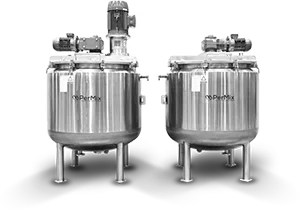
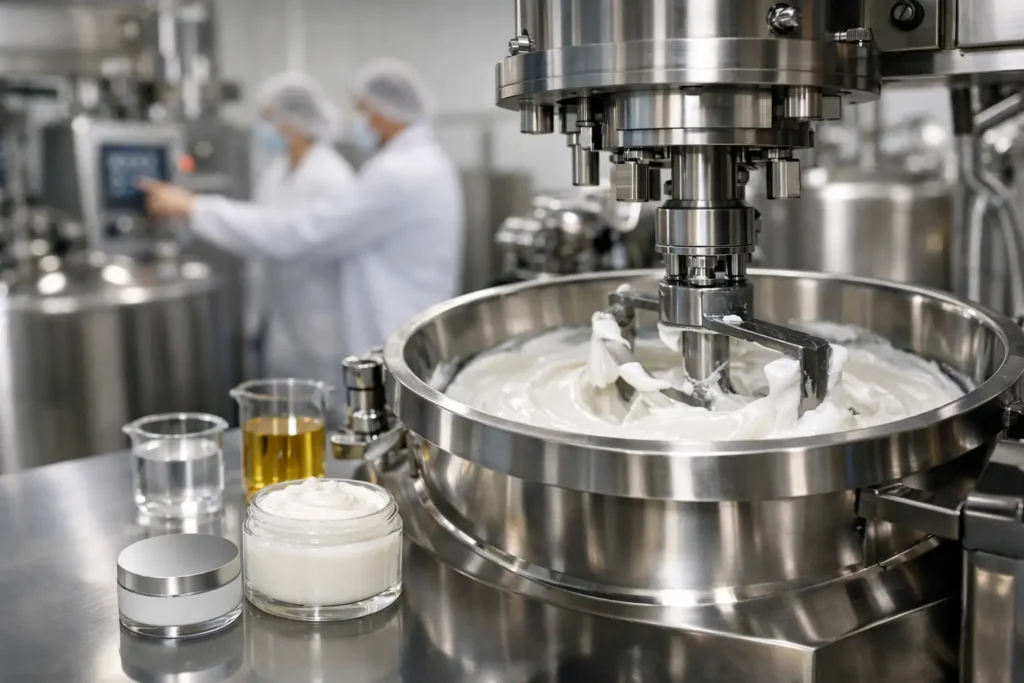
A cosmetic cream manufacturing mixer is not selected by batch volume alone. A 500-gallon system may produce a clean, stable lotion at one viscosity and struggle with a high-solids body butter, a wax-rich night cream, or a sunscreen base at the same working volume. The difference lies in how the machine manages shear, circulation, vacuum, heat transfer, ingredient incorporation, and discharge across the complete batch cycle.
For cosmetic manufacturers, the mixer is a process-critical asset. It determines whether the finished product has the intended texture, gloss, viscosity, particle distribution, air content, and batch-to-batch consistency. It also influences labor requirements, cycle time, cleaning performance, yield, and the practical ability to scale a successful laboratory formula into commercial production.
Cream production typically involves more than simple blending. Water-phase and oil-phase ingredients must be heated, combined, emulsified, cooled under controlled conditions, and finished with temperature-sensitive materials such as fragrances, preservatives, active ingredients, or botanical extracts. Powders, gums, polymers, waxes, pigments, and high-viscosity structuring agents each create different processing demands.
The equipment must generate enough shear to reduce droplet size and form a stable emulsion, while maintaining sufficient bulk movement to prevent temperature gradients, dead zones, and localized overprocessing. Too little shear can leave an unstable emulsion, visible agglomerates, or inconsistent texture. Excessive shear can damage sensitive ingredients, incorporate heat unnecessarily, change rheology, or create an appearance that does not match the product specification.
Air management is equally significant. Entrained air can cause foaming, oxidation, inconsistent fill weights, poor surface appearance, and longer downstream settling times. Vacuum processing removes air from the batch and can improve powder wet-out and ingredient draw-in. However, vacuum is not a universal answer. The vessel, seals, powder addition method, evaporation risk, and operating sequence must all be engineered around the formulation.
For many creams, lotions, gels, and emulsified personal care products, a vacuum emulsifying mixer provides the most complete process platform. This configuration commonly combines a swept-surface agitator for bulk circulation and heat transfer with a high-shear homogenizer for emulsification and dispersion.
The anchor or scraper agitator moves product from the vessel wall into the active mixing zone while continuously cleaning the heated or cooled surface. This is especially valuable for viscous products and formulations containing waxes, fatty alcohols, or rheology modifiers that can build up on the vessel wall. The result is more uniform temperature control and a lower risk of scorched or partially melted material.
A bottom-entry or inline high-shear homogenizer creates intense localized shear. It is typically used during the phase combination and emulsification stage, when droplet-size reduction has the greatest effect on stability and sensory properties. Homogenizer speed and run time should be established through process trials, not assumed from the motor rating alone.
For difficult formulations, a multi-shaft system may be more appropriate. A high-speed disperser can improve polymer and powder incorporation, while a separate low-speed agitator manages bulk turnover. Double planetary or sigma-style mixing may be considered for very high-viscosity creams, anhydrous balms, clay masks, and paste-like products where conventional flow patterns become ineffective.
The best cosmetic cream manufacturing mixer begins with a detailed understanding of the material and process. Viscosity is a necessary starting point, but it is only one variable. Many cosmetic products are non-Newtonian: their apparent viscosity changes with shear rate, temperature, time, and formulation history. A product that flows readily during heating may become difficult to circulate as it cools or after a polymer fully hydrates.
A proper engineering review should examine the target batch size, minimum and maximum fill levels, expected viscosity range, density, solids loading, particle sensitivity, and required finished-product texture. It should also identify whether ingredients are added as liquids, powders, premixes, melts, or pastes.
Powder addition deserves particular attention. Carbomers, cellulose gums, clays, starches, titanium dioxide, pigments, and actives can form stubborn agglomerates when added directly to liquid without adequate wetting and dispersion energy. A powder induction system can pull powders into the liquid stream under vacuum or recirculation, reducing dust exposure and improving incorporation. Yet the correct approach depends on the powder. Some materials benefit from rapid induction, while others require controlled dosing to avoid fish eyes, excessive foaming, or premature gel formation.
A vessel jacket is not simply an accessory. Thermal performance directly affects throughput and finished quality. If heating is too slow, waxes may not melt consistently and production time increases. If cooling is too slow, a batch occupies the vessel longer than planned, delaying the next campaign. In some formulations, the cooling profile also determines crystal structure, viscosity development, and final appearance.
The thermal utility must be matched to the process. Steam, hot water, thermal fluid, chilled water, and glycol systems offer different temperature ranges and control characteristics. A highly viscous cream transfers heat less efficiently than a thin lotion, making scraper contact, agitation pattern, jacket design, and vessel geometry important engineering decisions.
The full process sequence should be mapped before equipment is specified. A typical batch may involve charging water, heating the aqueous phase, melting and preparing the oil phase, adding emulsifiers, combining phases, homogenizing, applying vacuum, cooling, adding heat-sensitive ingredients, final deaeration, and discharge. A mixer that performs well during emulsification but creates a bottleneck during cooling or discharge does not deliver the production performance the plant needs.
A common scale-up error is copying laboratory mixing speed to production scale. Tip speed, power per unit volume, shear-zone residence time, recirculation rate, vessel geometry, and thermal surface area do not increase proportionally with batch volume. A successful 20-liter development batch can behave very differently in a 1,000-liter production vessel.
Scale-up should preserve the process outcomes that matter: emulsion stability, viscosity profile, droplet size, texture, color uniformity, air content, and cycle time. In many cases, the production process needs a revised operating sequence rather than merely a larger version of the laboratory procedure.
Pilot trials are particularly valuable when the formulation includes high wax content, demanding sensory requirements, difficult powders, or actives with narrow temperature limits. They allow the manufacturer to define the proper agitation speed, homogenization duration, vacuum level, addition rate, and cooling profile before committing to commercial equipment.
The most advanced mixing head cannot compensate for poor cleanability, ineffective discharge, or difficult maintenance access. Cosmetic producers should evaluate the mixer as a complete sanitary production system.
Material of construction is usually 316L stainless steel for product-contact surfaces, with surface finish selected according to the formulation and cleaning requirements. Sanitary piping, drainable geometry, hygienic valves, properly designed spray devices, and clean-in-place capability can reduce changeover time and improve process control. Products containing pigments, fragrances, silicones, waxes, or high levels of oils may require more demanding cleaning validation than a simple water-based lotion.
Discharge performance is also frequently underestimated. High-viscosity creams can remain in the vessel, piping, and valve body if the outlet is undersized or poorly positioned. Product hold-up reduces yield and makes cleaning harder. A well-designed bottom discharge, appropriate transfer pump, and short, fully drainable piping route help protect both yield and batch repeatability.
Automation should support the operator rather than add unnecessary complexity. Recipe control can manage temperatures, mixing speeds, vacuum levels, timed additions, and batch records. Load cells provide accurate ingredient charging. Process sensors can help establish repeatable endpoints. The right level of automation depends on production volume, number of SKUs, validation requirements, and the manufacturer’s tolerance for manual intervention.
The most effective equipment decision is based on process data, not a generic mixer type. Manufacturers should expect an engineering discussion about formulation behavior, operating sequence, utilities, cleaning method, capacity targets, plant layout, and future expansion. If a supplier recommends a machine before understanding how the cream is made, the recommendation is incomplete.
PerMix approaches cosmetic processing as an integrated engineering challenge: mixing, emulsification, vacuum deaeration, powder induction, thermal control, discharge, and automation must work together. That approach gives manufacturers a clearer path to stable product quality and dependable production output.
The right mixer does more than create a cream that passes today’s quality check. It gives the production team a controlled, repeatable process that can support new formulations, larger campaigns, faster changeovers, and the performance expectations of a growing cosmetic brand.
Stay Connected