Industrial Mixers
PerMix News & Updates
A mill that produces the required particle size in a laboratory can still become a production bottleneck, generate excess heat, or create costly cleaning delays at plant scale. Knowing how to select milling equipment means evaluating the material, the required product result, and the complete process around the mill – not comparing horsepower or screen sizes in isolation.
For manufacturers handling powders, granules, crystals, agglomerates, dried materials, and formulated products, milling directly affects product consistency, downstream mixing performance, dissolution, appearance, packaging behavior, and yield. The correct equipment selection begins with process data and ends with a system that performs reliably under actual production conditions.
The first question is not which mill to buy. It is what particle size distribution the process must achieve and how tightly that result must be controlled.
A target average particle size alone is rarely sufficient. Engineers should define the allowable coarse fraction, fines generation, particle shape expectations, and batch-to-batch repeatability. A product that requires deagglomeration may need only gentle screen milling, while a hard crystalline material requiring substantial size reduction may demand impact milling, pin milling, or another higher-energy process.
The relationship between product specification and milling energy matters. More aggressive milling can reduce particle size, but it can also create excessive fines, alter bulk density, increase dust loading, or affect flow characteristics. In food, pharmaceutical, chemical, and specialty material applications, those changes can influence downstream blending, tableting, coating, filling, or final product performance.
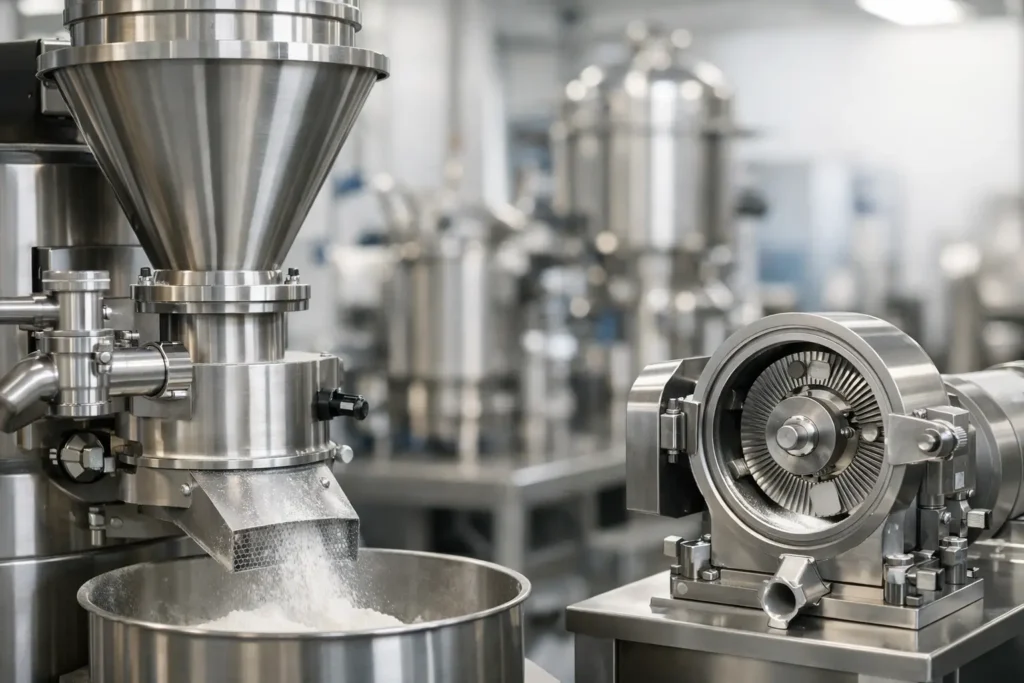
Different milling technologies solve different particle-processing problems. A conical mill is often selected for controlled sizing, delumping, and conditioning of powders or granules. It can provide a relatively gentle process and is commonly used where predictable screen-controlled sizing is more valuable than extreme particle reduction.
A hammer mill or impact mill can process tougher materials and achieve more aggressive reduction, but its higher energy input may produce more fines and heat. Pin mills are effective for many dry materials that require fine grinding, while specialized systems may be necessary for brittle, fibrous, elastic, sticky, oily, heat-sensitive, or abrasive products.
Material behavior must be verified, not assumed. Particle hardness, friability, moisture content, oil content, hygroscopicity, temperature sensitivity, bulk density, and tendency to smear or build up on internal surfaces all influence the appropriate mill design. A mill that handles a free-flowing dry powder efficiently may perform poorly with a slightly moist material that compacts at the screen or adheres to the rotor.
Equipment selection should be based on representative production conditions. This requires more than sending a product name and a desired capacity to a supplier. A meaningful engineering evaluation includes the incoming particle size range, product temperature, moisture range, feed consistency, bulk density, required discharge condition, and expected operating schedule.
Capacity should be defined as sustained production throughput, not the highest rate briefly achieved during a demonstration. For example, a mill may process 2,000 pounds per hour with a clean, free-flowing feed but operate at a lower stable rate when connected to real upstream equipment, dust collection, conveying, and downstream packaging. The specified capacity must reflect normal material variation and the plant’s required uptime.
Feed method is especially important. Milling performance can become inconsistent when product enters the chamber in surges, bridges in a hopper, or receives inadequate flow control. Loss-in-weight feeders, screw feeders, rotary valves, vacuum conveying, and gravity feed arrangements each affect the consistency of material presentation to the mill. The mill and feeder should be engineered as one process section.
A batch operation may prioritize flexibility, fast product changeover, and easy inspection. A continuous manufacturing line may place greater value on feed-rate control, automated operation, inline particle management, and integration with conveying or downstream blending systems.
The best choice depends on production objectives. A highly flexible facility producing many formulations may accept a lower throughput in exchange for faster cleaning and simpler validation. A dedicated high-volume line may justify automation, larger material handling equipment, and a mill designed for sustained continuous duty.
PerMix approaches milling as part of an integrated process solution because particle size reduction is often connected directly to mixing, powder induction, drying, granulation, material transfer, and final packaging. Optimizing the mill alone can shift the restriction elsewhere in the line. The goal is to improve total manufacturing performance.
Every milling process introduces energy. Depending on the mill design, screen configuration, rotor speed, and material, that energy can become heat. For heat-sensitive ingredients, waxes, polymers, nutraceuticals, food materials, and certain chemical formulations, temperature rise may reduce quality or change the material’s physical behavior.
If heat is a concern, engineers should evaluate milling intensity, residence time, airflow, jacketed equipment options, chilled feed, cryogenic processing, and operating speed. Lowering speed may protect the product, but it can also reduce throughput or limit achievable particle size reduction. This is a process trade-off that should be tested with the actual material.
Dust generation is equally significant. Fine powders can create housekeeping issues, worker exposure concerns, product loss, cross-contamination risk, and combustible dust hazards. The selected system may require local dust collection, sealed transfer connections, negative-pressure operation, contained discharge, explosion protection, or inert processing, depending on the material and facility hazard analysis.
Containment requirements should be established early. Retrofitting seals, glovebox interfaces, dust collectors, or explosion isolation after a mill has been purchased can increase project cost and compromise maintainability. For regulated or potent products, containment is not an accessory – it is a core equipment requirement.
For food, beverage, pharmaceutical, nutraceutical, and high-purity chemical manufacturing, cleanability can be as important as milling performance. Product-contact surfaces should be compatible with the formulation and cleaning method. Stainless steel grade, internal finish, gasket materials, screen design, access doors, and discharge geometry all affect the time and labor required for changeover.
A mill designed for fast access can reduce downtime significantly in multi-product operations. Tool-less screen changes, removable rotors, clean-out-of-place access, and designs that minimize powder traps help operators inspect and clean the equipment thoroughly. In other applications, a clean-in-place system may be justified, but it must be designed around the product and validated cleaning requirements.
Avoid treating sanitary construction as a generic checkbox. A polished finish does not solve a poor internal geometry, and a mill that looks clean externally may still retain material in hard-to-reach locations. The correct standard is whether the equipment can be cleaned, inspected, and returned to service consistently within the plant’s actual operating window.
Abrasive products can quickly wear screens, rotors, pins, hammers, liners, and other internal components. The result may be a gradual loss of milling consistency, increased metal contamination risk, unplanned downtime, and higher spare-parts consumption.
For abrasive mineral powders, pigments, catalysts, ceramics, and similar materials, wear-resistant construction should be considered during initial specification. The right solution may involve hardened components, specialized alloys, coatings, replaceable liners, or a mill technology that reduces contact wear. Material testing can reveal whether standard construction is adequate.
Maintenance access also affects long-term cost. Operators need safe, practical access to screens, rotors, bearings, and seals. A lower purchase price does not create value if routine maintenance requires excessive disassembly, extended downtime, or specialized labor. Reliability decisions should account for operating hours, spare-parts availability, cleaning frequency, and the financial impact of lost production.
Milling trials provide the most reliable path from assumptions to a defensible equipment decision. A properly structured trial should use representative material and evaluate more than final particle size. Record throughput, power draw, temperature change, fines generation, screen condition, product yield, cleaning observations, and any evidence of buildup or feed instability.
When possible, test the material across its realistic operating range. A product with variable moisture or incoming particle size may perform very differently from one lot to another. The selected process should provide acceptable results under normal variation, not only with ideal material.
The strongest milling specification is one that connects measurable requirements to the full production system: target particle distribution, capacity, feeding, containment, sanitation, controls, discharge, and maintenance. That engineering discipline turns a mill from an isolated machine into a dependable part of the manufacturing process.
Before approving a milling investment, ask whether the proposed equipment will still deliver the required product quality when feed conditions vary, production schedules tighten, and cleaning time matters. That is the standard that protects throughput, consistency, and long-term operating cost.
Stay Connected