Industrial Mixers
PerMix News & Updates
A mixer that produces an acceptable blend in a test batch can still become the limiting step in full-scale production. Segregation after discharge, long blend times, poor liquid distribution, residue buildup, and difficult cleaning often reveal that the original equipment choice did not match the material behavior. The plow mixer vs ribbon blender decision should therefore begin with the formulation, required process intensity, and operating objectives – not vessel capacity alone.
Both machines are established solutions for batch powder blending. Both can produce uniform mixtures when properly sized and operated. Their internal mixing actions, however, are fundamentally different. That difference affects how each machine handles free-flowing powders, cohesive materials, fragile particles, liquid additions, batch variability, and downstream requirements.
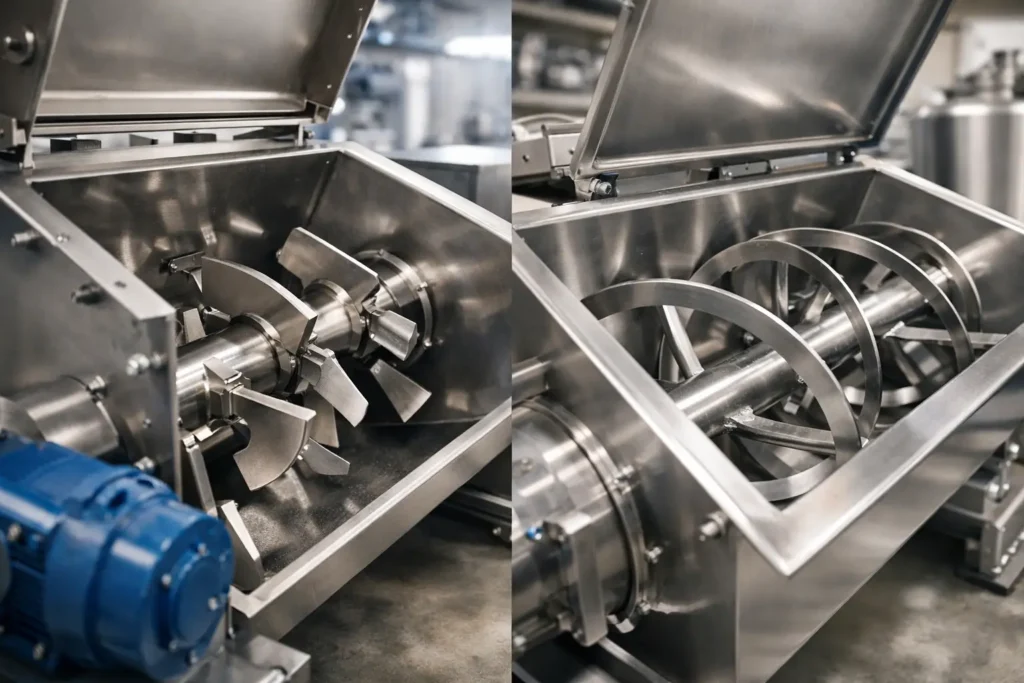
A ribbon blender uses helical inner and outer ribbons rotating on a horizontal shaft. The ribbons move material in opposing axial directions while also creating radial turnover. This controlled, comparatively gentle circulation makes the ribbon blender an efficient choice for many dry, free-flowing powder blends.
A plow mixer, also commonly called a plough mixer, uses plow-shaped mixing elements mounted on a horizontal shaft. As the shaft rotates, the plows lift and project material into a mechanically fluidized mixing zone. The resulting three-dimensional movement combines rapid particle exchange with high shear zones near the tools and vessel wall. Optional high-speed choppers can be added when the application requires deagglomeration, liquid dispersion, or breakup of soft lumps.
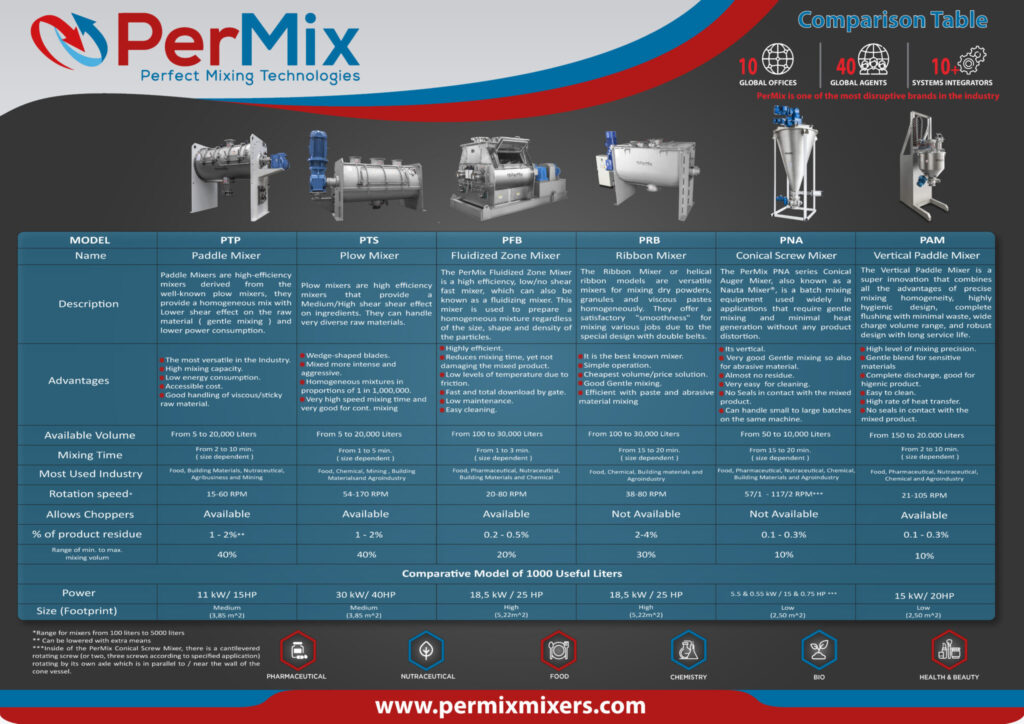
Neither design is automatically better. A ribbon blender is often the practical, cost-effective answer for straightforward blends. A plow mixer becomes more compelling when material behavior creates a greater process challenge or when one machine must perform more than dry blending.
Ribbon blenders are widely used because they provide reliable batch blending with a simple mechanical arrangement. For free-flowing powders of reasonably similar bulk density and particle size, they can achieve good uniformity with moderate energy input. Typical applications include dry food ingredients, premixes, seasoning blends, chemical powders, mineral products, and many animal nutrition formulations.
The gentle action is also an advantage where particle integrity matters. If the product contains fragile granules, flakes, or other particles that must retain their shape, excessive mechanical force can create fines and change the product’s downstream behavior. A properly operated ribbon blender can reduce this risk relative to a more intensive mixing system.
Ribbon blenders are particularly attractive when the production requirement is clear: blend dry ingredients, discharge efficiently, and repeat the batch. Their generally lower mechanical complexity can support an economical capital decision, especially for applications with limited liquid addition, low tendency to form agglomerates, and no need for aggressive dispersion.
That fit has limits. A ribbon blender can struggle when materials bridge, compact, coat the vessel, or differ significantly in density. It may also require longer blend times when a small-dose ingredient must distribute throughout a large batch. Adding liquid is possible, but the result depends heavily on spray placement, addition rate, powder absorption characteristics, and the formulation’s tolerance for localized wetting.
Before specifying a ribbon blender, determine whether the blend includes cohesive powders, sticky ingredients, wide particle-size variation, or low-level additives that are difficult to distribute. Also examine whether the product will separate during discharge, conveying, or packaging. A uniform sample taken from the mixer does not always prove that the entire production process is stable.
A plow mixer is designed for applications that need more intensive particle movement. Its fluidized mixing action can improve distribution in formulations containing ingredients with dissimilar bulk densities, varied particle sizes, or difficult flow characteristics. It is frequently selected for chemical powders, construction materials, specialty food systems, detergents, fertilizer blends, mineral products, and process formulations that require both blending and conditioning.
The plow mixer is especially useful when liquids must be introduced into a dry matrix. With appropriately engineered spray nozzles and operating parameters, the dynamic material bed can expose more particles to the liquid addition. This can reduce the risk of wet balls and localized concentration compared with a less intensive mixing pattern. The actual outcome still depends on liquid viscosity, addition percentage, nozzle design, spray pressure, and the powder’s absorption rate.
High-speed choppers expand the operating range further. They can break soft agglomerates, disperse minor liquid additions, and support processes such as powder wetting or light granulation. Choppers are not a universal requirement. For a simple dry blend, they can add maintenance and energy use without providing meaningful value. For a formulation prone to lumps, they may be the difference between a repeatable batch and an ongoing quality issue.
The trade-off is that plow mixers typically involve higher installed power, greater mechanical complexity, and a more application-specific design exercise. Their intensive action may not be appropriate for very fragile products. For manufacturers buying on first cost alone, these factors can look unfavorable. For manufacturers managing batch time, quality losses, rework, and product inconsistency, the higher capability can provide a stronger economic case.
The correct comparison should be based on measurable production requirements. Start with the complete material profile: bulk density, particle-size distribution, moisture content, flowability, friability, cohesiveness, temperature sensitivity, and electrostatic behavior. A powder that looks free-flowing in a laboratory container may behave very differently at production scale after storage, pneumatic conveying, or exposure to humidity.
Next, define what mixing success means. Is the target coefficient of variation? Is it a uniform active ingredient concentration? Is it the elimination of visible streaks, lumps, or wet spots? Is it a required batch time that supports a downstream packaging line? Specifications should be tied to a sampling plan, because validation samples must represent the batch rather than only the easiest points to access.
Discharge is part of mixing performance. A mixer that blends well but retains material in corners, leaves residues on tools, or discharges unevenly can undermine batch repeatability. Valve geometry, mixer orientation, product flow path, and the receiving equipment all deserve engineering attention. This is particularly important for allergen-controlled food production, pharmaceutical-adjacent applications, and formulations with expensive active ingredients.
Cleaning requirements can also change the answer. Ribbon blenders have a relatively open internal arrangement, but cleanability depends on ribbon geometry, shaft seals, access doors, weld finish, and the product’s tendency to adhere. Plow mixers require equally careful attention to plow arrangement, choppers, seals, and access for inspection. Where frequent product changeovers are required, the equipment should be designed around the actual cleaning method, whether dry cleaning, washdown, clean-in-place, or manual access.
A common specification error is choosing a mixer based only on total vessel volume. Usable working volume varies by material and operating method. Overfilling can reduce particle movement and leave dead zones. Underfilling can prevent the mixing elements from engaging the material correctly. The required batch size should be evaluated against the machine’s effective operating range, not its nameplate volume.
Batch cycle time includes charging, mixing, liquid addition, sampling, discharge, cleaning, and preparation for the next batch. A ribbon blender with a longer actual blend time may still be the best choice if it integrates efficiently into the process. Conversely, a plow mixer may justify its cost when faster mixing or combined blending and deagglomeration removes a separate process step.
Scale-up deserves the same discipline. Mixing mechanisms do not scale in a perfectly linear manner. Material fill level, rotational speed, tip speed, and liquid addition geometry must be evaluated at the intended production condition. Pilot trials using representative ingredients are often the most reliable way to reduce specification risk before capital commitment.
The mixing principle is only one part of the final solution. Material of construction, surface finish, shaft sealing, bearing arrangement, drive design, discharge valve, safety interlocks, controls, and automation should align with the process environment. Abrasive minerals, corrosive chemicals, sanitary food ingredients, explosive dusts, and high-value specialty formulations each create different design requirements.
For example, an abrasive application may require wear-resistant contact surfaces and maintenance access that protects uptime. A hygienic application may require polished welds, sanitary seals, and a discharge design that minimizes product hold-up. A formulation with volatile liquids or dust hazards may require containment, venting, inerting, or an appropriately rated electrical design. These are process decisions, not optional accessories.
PerMix approaches mixer selection by connecting equipment geometry and operating conditions to the manufacturer’s measurable objectives: uniformity, throughput, cleaning efficiency, reliability, and total cost of ownership. That engineering approach prevents a standard machine from being forced into a nonstandard process.
The most productive next step is to run representative material through a defined test protocol and evaluate blend uniformity, liquid distribution, discharge, residue, and cycle time together. The best mixer is the one that performs consistently across the full production cycle – not simply the one that looks strongest on a specification sheet.

Stay Connected