Industrial Mixers
PerMix News & Updates
A lotion that looks stable in a one-gallon development vessel can separate after its first 2,000-gallon production run. That is why the best emulsifier for lotions is not simply the ingredient with the strongest laboratory result. It is the emulsifier system that delivers the required droplet size, viscosity, skin feel, preservative compatibility, and shelf stability within the realities of an industrial manufacturing process.
For manufacturers of cosmetic, personal care, pharmaceutical, and topical products, emulsifier selection must be evaluated alongside batch size, heating and cooling profile, ingredient addition sequence, vacuum capability, and available shear. Formula chemistry and process engineering are inseparable when repeatable lotion quality is the objective.
Most conventional lotions are oil-in-water emulsions. Fine oil droplets are dispersed through a continuous water phase, producing a product that spreads easily, rinses cleanly, and can be formulated across a wide viscosity range. The emulsifier lowers interfacial tension between oil and water and forms a protective layer around dispersed droplets to reduce coalescence.
However, no single emulsifier is best for every lotion. The correct choice depends first on the oil phase. Esters, natural oils, silicones, hydrocarbons, waxes, UV filters, fragrances, and active ingredients each influence the required hydrophilic-lipophilic balance, often called HLB. An emulsifier system that stabilizes a light moisturizer may be unsuitable for a high-oil body cream or a silicone-rich sunscreen base.
The target product profile matters just as much. A premium facial lotion may require a light, elegant after-feel and low soaping during rub-out. A medicated topical product may need higher viscosity, improved active suspension, and compatibility with a restricted preservative system. A value-focused body lotion may prioritize reliable stability, economical raw materials, and high throughput.
At production scale, process conditions introduce another layer of selection. Some emulsifiers require sustained heating to melt and hydrate correctly. Others are sensitive to excessive shear, electrolyte concentration, pH variation, or a rapid cooling cycle. The best laboratory formula is not commercially useful if the required process window is too narrow for normal plant operation.
Nonionic emulsifiers are widely used in lotion manufacturing because they generally offer broad compatibility and good tolerance to pH variation. Ethoxylated emulsifier systems, commonly paired with fatty alcohols, can produce stable and economical oil-in-water lotions with a familiar texture. Their performance depends on the complete system, including the co-emulsifier, oil phase composition, and cooling conditions.
Self-emulsifying waxes can simplify formulation and manufacturing by combining a primary emulsifier with structuring components. They are often practical for standard lotions because they support consistent processing and body. Still, emulsifying wax is a category rather than one universally identical material. Different grades can contain different components and behave differently during scale-up. Manufacturers should qualify the specific grade rather than assuming one supplier’s material can replace another without reformulation.
Polyglyceryl-based emulsifiers are commonly selected for formulations positioned around milder or more naturally derived ingredient profiles. They can provide excellent performance, but they may require more precise balancing with fatty alcohols, gums, or other stabilizers. Depending on the system, they can also demand tighter control of temperature, shear, and oil-phase composition.
Polymeric emulsifiers can build viscosity and improve stability at relatively low use levels. These materials are useful for low-oil lotions, cold-process concepts, and formulations where a light sensory profile is needed. Their limitations often appear in the presence of electrolytes, certain actives, or pH conditions outside their preferred operating range. They can reduce the need for high levels of waxy structuring agents, but they do not eliminate the need for proper dispersion and deaeration.
For water-in-oil lotions, silicone emulsifiers and low-HLB emulsifier systems are often more suitable. These products have a different sensory profile, barrier performance, and processing behavior than oil-in-water lotions. Applying an oil-in-water selection rule to a water-in-oil formula is a common source of instability.
A productive emulsifier selection program begins by defining what the lotion must do, not by choosing an ingredient from a supplier list. Establish the oil-phase percentage and composition, required viscosity, target pH, active ingredients, preservative package, fragrance level, package type, and expected storage conditions. This establishes the technical limits of the formulation before pilot testing begins.
Sensory requirements should be written as measurable development targets wherever possible. Terms such as “light,” “rich,” and “non-greasy” are helpful, but they are not sufficient process specifications. Development teams should also identify spreadability, rub-out behavior, residue, absorption time, and the acceptable viscosity range after aging.
A lotion designed for a pump bottle may tolerate a lower viscosity than a lotion intended for a jar. A product exposed to hot warehouse conditions requires a different stability margin than a product stored under controlled conditions. Packaging, logistics, and market claims affect the correct emulsifier system as directly as the oil phase does.
Even an appropriate emulsifier can fail when it is processed incorrectly. Stable emulsions require the oil phase to be dispersed into sufficiently small and consistent droplets. That requires controlled energy input, not simply maximum mixer speed.
A typical hot-process lotion batch heats the water and oil phases to the temperature required to melt waxes and activate the emulsifier system. The phases are combined under controlled agitation, then subjected to high shear to establish the emulsion. During cooling, the batch must remain adequately mixed to prevent settling, localized cooling, or uncontrolled viscosity development.
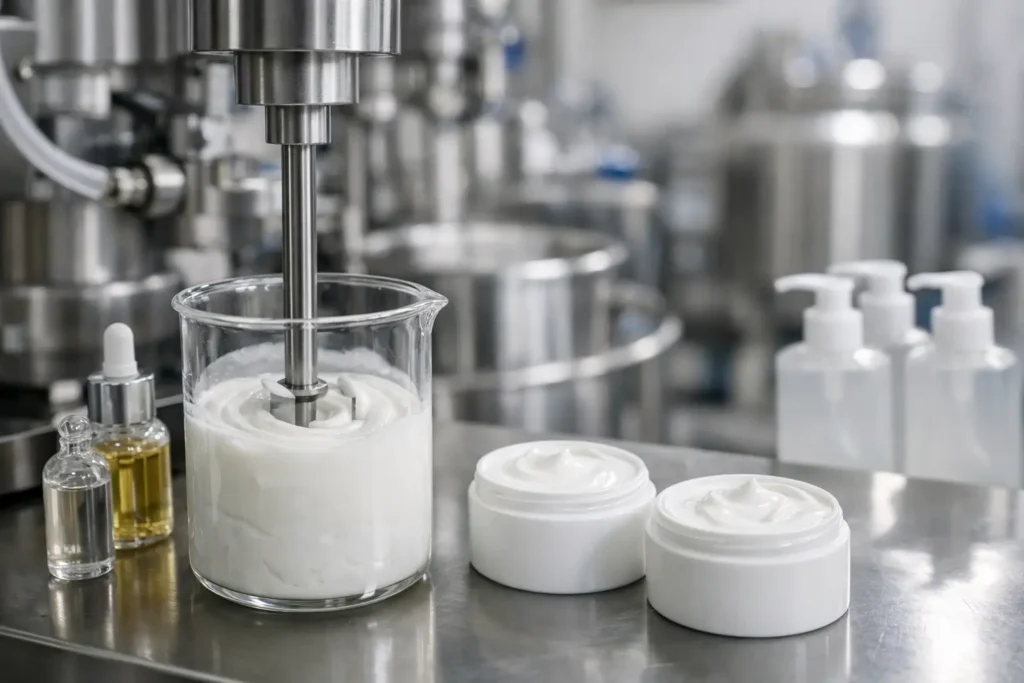
Rotor-stator high-shear mixers and in-line homogenizers are commonly used to reduce droplet size efficiently. The right configuration depends on batch volume, viscosity development, recirculation capability, and required production time. Excessive shear can entrain air, damage sensitive ingredients, or produce an undesirable texture. Insufficient shear can leave broad droplet-size distribution and create a higher risk of separation during storage.
Vacuum processing is often valuable for industrial lotion production because it removes entrained air and improves finished-product appearance, density control, and filling performance. It can also support powder induction and reduce the risk of undispersed thickeners or polymers. The equipment should be designed around the actual viscosity curve of the product, particularly if viscosity rises sharply during cooling.
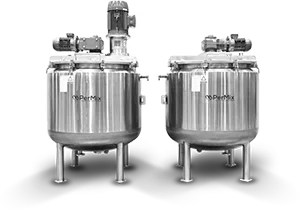
For complex or high-viscosity emulsions, a multi-shaft vacuum mixer can combine anchor agitation, high-speed dispersion, homogenization, heating, cooling, and deaeration in one controlled vessel. PerMix engineers these systems around material behavior and operating objectives rather than treating emulsification as a one-speed mixing requirement.
A stable batch at release is only the beginning. The selected emulsifier system should be tested through accelerated aging, freeze-thaw cycling where appropriate, centrifugation, viscosity monitoring, pH monitoring, and visual evaluation. Droplet-size analysis provides additional evidence when the formulation is sensitive or the product carries a long shelf-life expectation.
Manufacturers should also test batches made at different points within the permitted operating range. A formula that succeeds only when an operator follows a narrow temperature and mixing sequence is vulnerable to normal production variation. Better process design produces a wider, more manageable operating window.
Scale-up trials should record addition rates, phase temperatures, homogenization time, mixer speed, vacuum level, cooling rate, and final batch characteristics. This data turns a formulation into a controlled manufacturing process. It also makes troubleshooting faster when a raw material, season, equipment loading, or production schedule changes.
The best emulsifier for lotions is usually a balanced system, not a standalone answer. It must match the formulation’s oil phase and claims, while also working with available mixing energy, thermal control, batch size, cleaning requirements, and operator practices.
A technically sound selection reduces separation risk, batch rework, fill-weight variation, and customer complaints. It can also shorten cycle time by allowing predictable heating, emulsification, cooling, and deaeration. For industrial manufacturers, that is the real standard: an emulsifier and process combination that produces the same lotion quality, batch after batch, at the required capacity.
Stay Connected