Industrial Mixers
PerMix News & Updates
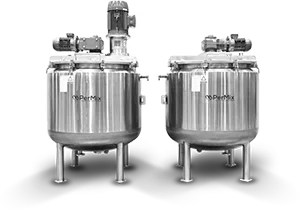
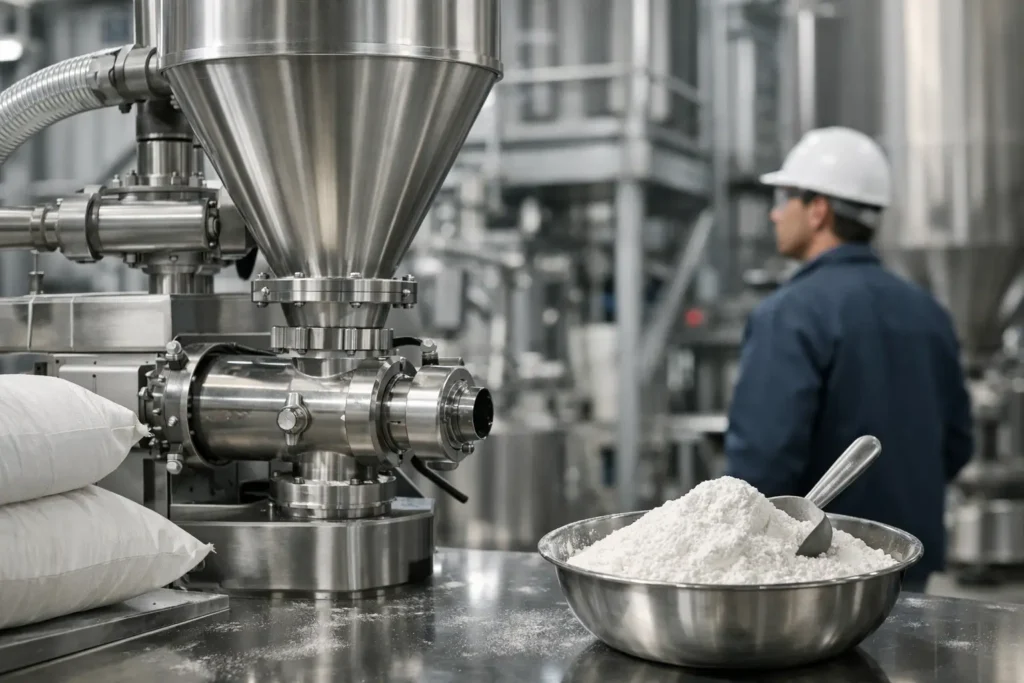
A powder blend can meet specifications in a pilot test and still fail on the production floor. The difference is rarely explained by mixer volume alone. This industrial powder mixing system guide addresses the full process: material behavior, feeding, liquid addition, discharge, controls, cleaning, and the equipment selection decisions that determine whether a blend remains consistent at scale.
For manufacturers, the objective is not simply to mix powder. It is to produce a uniform, repeatable product at the required throughput while controlling labor, waste, cross-contamination, maintenance, and operating risk. That requires an engineered system built around the actual formulation and production conditions.
Industrial powder mixing performance begins with material characterization. Two products that appear similar in a product description can require entirely different mixing methods because their particles behave differently under shear, movement, moisture, and compression.
Particle size distribution, bulk density, shape, cohesiveness, moisture content, and flowability all influence blend behavior. Wide density differences can promote segregation. Fine, cohesive powders may form agglomerates or cling to vessel surfaces. Fragile granules may be damaged by an overly aggressive mixing action. Hygroscopic materials may require controlled humidity, sealed transfer, or vacuum handling to prevent caking.
The formulation also matters. A 99:1 blend of base powder and active ingredient is not equivalent to a 50:50 blend. Low-dose ingredients demand a validated addition method and sufficient distributive mixing to prevent concentration variation. If a liquid binder, flavor, oil, or color is introduced, droplet distribution and wetting become part of the process requirement.
Before specifying equipment, document the process inputs: batch size range, target cycle time, particle properties, ingredient proportions, acceptable variation, required temperature control, cleaning standard, and discharge destination. This information makes it possible to select a system based on production performance rather than a generic equipment category.
There is no universal best mixer. The right design depends on whether the product needs gentle blending, high-intensity dispersion, rapid cycle times, liquid incorporation, or processing under vacuum or heat.
Ribbon mixers use inner and outer helical ribbons to circulate material in opposing directions. They are a practical choice for many free-flowing powders, dry blends, and formulations requiring economical batch production. Their large working volume and straightforward construction can make them effective for high-capacity applications.
However, ribbon mixers are not automatically the best choice for every powder. Very cohesive materials, fragile particles, or formulations requiring intensive dispersion of small additions may benefit from a different mixing action. Discharge valve design is equally important, since retained material at the bottom of the trough can affect yield and cleaning efficiency.
Paddle mixers create a fluidized mixing zone with relatively gentle mechanical action. They are commonly selected for powders, granules, and blends where fast mixing and product integrity must be balanced. Their geometry can also support liquid addition through spray bars when the application requires uniform coating or agglomeration control.
Plough mixers provide more intensive mechanical movement. Their plough-shaped elements lift and throw material into a mechanically fluidized zone, producing rapid mixing and strong dispersion. High-speed choppers can be added when agglomerate breakdown or wet granulation support is required.
This higher energy input is valuable for difficult blends, but it should be justified by the product need. More intensity can increase heat generation, particle attrition, and power consumption. An engineered selection weighs those trade-offs against the required blend time and uniformity.
Conical mixers are often suited to gentle blending, smaller batch volumes, products requiring complete discharge, and facilities where cleaning and containment are critical. Their low-shear action can protect delicate particles, although cycle times may be longer than with more intensive horizontal designs.
Continuous mixers are appropriate when upstream and downstream processes run continuously and the formulation can be fed accurately in a steady state. They can reduce footprint and eliminate batch-to-batch waiting, but they demand reliable loss-in-weight feeding, strong controls, and a clear understanding of residence time distribution. Continuous processing is not a shortcut around formulation development.
A mixer is the center of the process, not the entire process. Poor ingredient handling can defeat the performance of an excellent mixing chamber.
Minor ingredients should not be manually added into a large batch without a defined method. Premixes, micro-ingredient feeders, weigh hoppers, and automated recipe controls improve consistency by controlling both the amount and sequence of addition.
For continuous operations, feeder accuracy is especially critical. A well-designed continuous mixer cannot correct a feeder that drifts or bridges. Difficult powders may require agitators, vibration, conditioning devices, or hopper geometries designed to promote mass flow. Feeding equipment must be tested with the actual material, not only specified from a data sheet.
When adding oils, flavors, binders, or other liquids, nozzle selection, spray pattern, pressure, and location affect final product quality. Large droplets or poorly positioned nozzles can create wet lumps, local over-concentration, and wall buildup.
A properly engineered system introduces liquid into an active mixing zone where it can be distributed immediately. For applications with meaningful thermal or moisture sensitivity, jacketed vessels, temperature monitoring, vacuum capability, or controlled drying stages may be necessary.
A fast mixer provides limited value if discharge creates a bottleneck. The outlet must clear material efficiently without segregation, bridging, or unacceptable residue. Valve selection should account for powder flow characteristics, pressure requirements, cleaning needs, and the level of containment required.
Downstream screw conveyors, vacuum conveying systems, sifting equipment, mills, and packaging lines must be sized to accept the mixer discharge rate. The system should also prevent demixing after blending. Long transfer distances, free-fall drops, vibration, and pneumatic conveying can separate particles by size or density if not engineered carefully.
Blend uniformity should be a measurable acceptance criterion, not a visual judgment. The right sampling plan depends on the formulation, batch size, risk level, and regulatory environment. Samples must be drawn from meaningful locations and analyzed with a method capable of detecting the variation that matters.
Mix time studies establish the operating window. Under-mixing creates concentration variation, while excessive mixing can cause segregation, degradation, heat buildup, or unnecessary cycle time. The target is not the longest possible mix. It is the repeatable minimum time that consistently meets specifications under normal operating conditions.
Scale-up deserves special attention. A larger mixer changes bed depth, surface area, fill level, peripheral speed, power demand, and particle travel paths. Matching a pilot mixer’s RPM at production scale does not reproduce its mixing physics. Capacity increases should be supported by process trials, representative material testing, and defined performance criteria.
Sanitary design and maintainability are production requirements, not optional upgrades. Food, pharmaceutical, nutritional, and specialty chemical manufacturers may require polished contact surfaces, clean-in-place capability, accessible internals, validated cleaning procedures, and designs that minimize dead zones.
Safety requirements vary by material and facility. Combustible dust risk may call for explosion venting, suppression, isolation, inerting, grounding, and controls designed for the applicable hazard classification. Toxic or potent powders may require contained charging, sealed discharge, dust collection, and operator protection measures. These requirements must be defined early because they influence vessel construction, seals, instrumentation, and plant layout.
Reliability also depends on practical details: bearing arrangement, seal design, gearbox serviceability, access doors, replacement part availability, and control diagnostics. A lower initial equipment price can become expensive if cleaning takes too long, seals fail frequently, or operators cannot access the equipment safely.
Automation should support the process, not add complexity without benefit. At a minimum, recipe control can manage ingredient sequencing, mix time, mixer speed, liquid addition, discharge interlocks, and batch records. For critical applications, load cells, torque monitoring, temperature measurement, feeder feedback, and historian data provide a clearer view of process performance.
The most useful controls identify abnormal conditions before they become rejected product. A change in mixer torque may indicate a raw material shift, overfilling, unexpected moisture, or mechanical wear. A feeder deviation may reveal bridging before an entire batch is compromised. Good automation turns those signals into actionable operating information.
PerMix approaches powder processing as a complete engineering problem: the material, mixer, feeding method, controls, discharge path, and operating target must work together. The correct system is the one that can demonstrate repeatable performance with your actual formulation, production rate, cleaning standard, and plant constraints. Begin with a representative process evaluation, then build the equipment specification around the results.
Stay Connected