Industrial Mixers
PerMix News & Updates
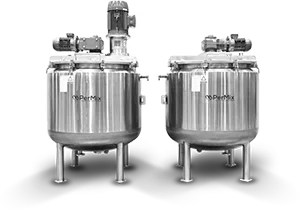
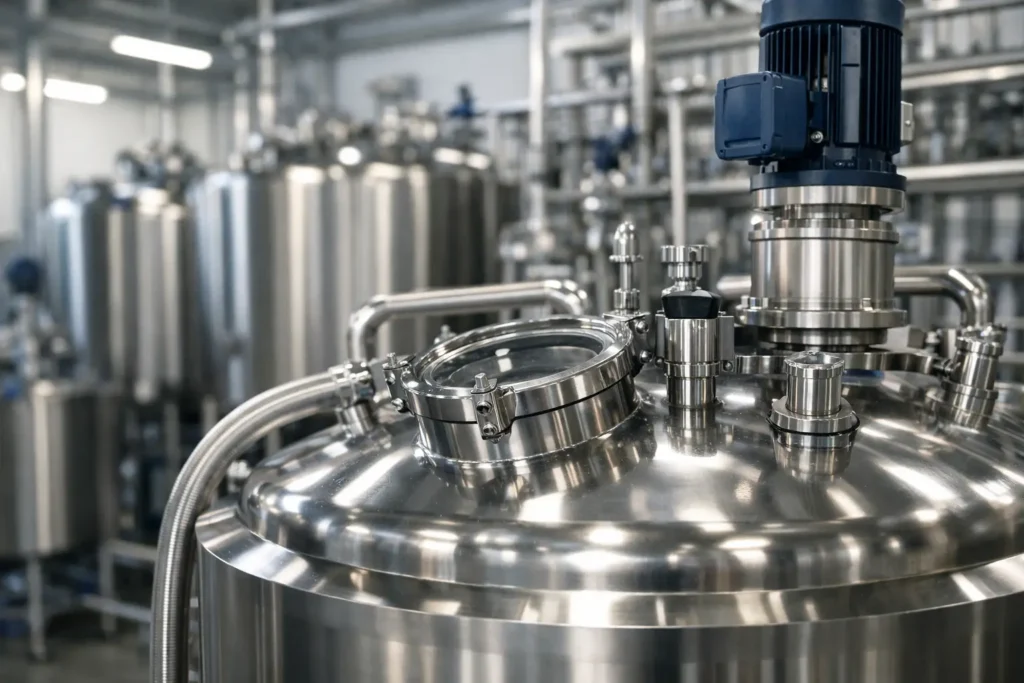
A vessel can be fabricated from high-quality stainless steel and still create a sanitation risk. Product hold-up at an outlet, a non-draining spray shadow, an inaccessible seal, or an improperly finished weld can compromise cleaning performance long before the vessel reaches production. Sanitary vessel design requirements must therefore be defined as process requirements, not treated as a cosmetic material upgrade.
For food, beverage, pharmaceutical, nutraceutical, cosmetic, and high-purity chemical manufacturers, the objective is clear: build a vessel that protects the product, cleans predictably, operates reliably, and supports documented compliance. The correct specification depends on the material being processed, the cleaning method, the operating conditions, and the level of validation required.
The most effective sanitary vessel designs begin with a complete understanding of the process. Engineers should define product viscosity, solids loading, particle size, batch volume, temperature range, pressure and vacuum conditions, cleaning chemistry, allergen or active ingredient risk, and required changeover frequency before selecting the vessel geometry or internal components.
A low-viscosity beverage base may require highly polished contact surfaces, fully drainable piping, and dependable clean-in-place coverage. A high-solids nutritional paste may also require a more aggressive agitator, jacketed thermal control, a large sanitary discharge valve, and cleanable shaft sealing. Both applications may be called sanitary, but their vessel requirements are not interchangeable.
This is why a standard tank specification often produces expensive compromises. A vessel must support how the product behaves during charging, mixing, heating, cooling, discharge, and cleaning. If a process retains product in corners or below an agitator, the vessel is not truly sanitary in operation, regardless of its material certificate.
Type 304 stainless steel can be suitable for many non-corrosive food applications, while Type 316L stainless steel is commonly specified where chlorides, acids, aggressive cleaning agents, or pharmaceutical-grade requirements demand greater corrosion resistance. Material selection should consider both the product and the full cleaning cycle.
The vessel shell is only one part of the material decision. Wetted agitator components, valves, nozzles, instruments, gaskets, spray devices, and piping must be compatible as well. A corrosion-resistant shell does not solve a sanitation problem created by an unsuitable elastomer seal or a rough internal valve cavity.
For high-purity service, material traceability, heat numbers, mill certifications, and controlled fabrication records may be essential. The required documentation should be established during specification, not requested after fabrication is complete.
Surface finish affects more than visual quality. A smoother wetted surface reduces the opportunity for product residue, biofilm, and cleaning chemicals to collect in microscopic irregularities. The appropriate roughness average, or Ra, depends on the industry, product sensitivity, and governing customer or regulatory standard.
A lower Ra value is often appropriate for pharmaceutical, biotech, and high-purity applications, but specifying the lowest available finish for every vessel can add cost without improving process performance. The better approach is to set a measurable finish requirement for all product-contact areas and identify where mechanical polishing, electropolishing, or passivation is needed.
Welds require equal attention. Internal welds should be continuous, smooth, properly blended, and free of pits, cracks, undercut, excessive discoloration, and crevices. In critical applications, orbital welding procedures and boroscope inspection may be justified to verify inaccessible weld quality.
A sanitary vessel must drain completely under its intended installed conditions. This principle affects vessel bottom geometry, outlet location, nozzle orientation, piping slope, valve selection, and skid leveling. Product or cleaning solution left in a low point can support microbial growth, contaminate the next batch, or create inconsistent concentrations during rinse verification.
Cone-bottom and dished-bottom configurations can both be effective when designed around the product and discharge requirements. The key question is whether the vessel drains fully without manual intervention or trapped liquid behind an internal feature. This becomes especially important in CIP systems, where residual rinse water can dilute the next cleaning step or remain in dead legs.
Dead legs are branches or cavities where flow is limited and cleaning solution may not effectively reach all surfaces. Their allowable geometry depends on the applicable hygienic standard and risk profile, but the practical goal remains the same: eliminate stagnant areas and ensure every wetted surface can be cleaned and drained.
Common problem areas include instrument ports, sample valves, sight glasses, spray ball connections, flush ports, agitator seal housings, and poorly selected valve manifolds. An engineer should review each penetration as part of the cleaning path, not merely as an attachment to the vessel wall.
Internal hardware also matters. Support brackets, baffles, agitator hubs, heating coils, and dip tubes can interrupt spray coverage and trap material. If an internal component is necessary for mixing or thermal performance, it should be shaped and positioned to promote cleaning access and drainage.
A clean-in-place system cannot be designed effectively after the vessel is complete. Spray devices must be selected based on vessel diameter, internal geometry, product soil, required impact, cleaning flow rate, pressure, temperature, and the presence of internal obstructions.
Static spray balls are appropriate for some free-rinsing applications. Rotary spray devices may be necessary where heavier residues require higher mechanical action. More force is not automatically better, however. Excessive flow or pressure can increase utility consumption, overload the return system, and fail to improve cleaning in a vessel with poor internal geometry.
CIP validation should demonstrate coverage, repeatability, and final rinse results under actual operating conditions. Water trials can identify obvious shadows, but they do not replace testing with representative product soils and defined cleaning chemistry.
Sanitary vessels must withstand the mechanical demands of the process without creating hygienic liabilities. Pressure and vacuum ratings, jacket design, agitation loads, thermal expansion, seismic requirements, support structure, and fatigue cycles should be evaluated together.
Vacuum service is frequently underestimated. A vessel that handles modest internal pressure may still require substantial reinforcement to resist collapse during vacuum drying, deaeration, or CIP return conditions. Likewise, an agitator for a viscous product imposes torque and bending loads that affect the vessel head, shaft support, seal arrangement, and structural design.
The mixing system must also be hygienically integrated. Agitator shafts, gearboxes, mechanical seals, bearings, and flush systems should be selected for reliable operation and serviceability. A seal that is difficult to inspect or clean can become the limiting factor in a sanitary process.
At PerMix, sanitary mixing vessel design is approached as an integrated process system. Mixing intensity, heat transfer, vacuum capability, discharge behavior, and cleaning performance must work together because each one affects product quality and production uptime.
The applicable sanitary standard depends on the market and product category. Food and beverage equipment may be designed around 3-A principles, while pharmaceutical and biotech systems may follow ASME BPE practices and customer-specific validation protocols. FDA requirements, cGMP expectations, local pressure vessel codes, and customer quality systems may also apply.
Standards should not be copied into a specification without determining how they apply to the actual process. A pilot-scale cosmetic vessel and a sterile pharmaceutical production reactor have different documentation and inspection needs. Over-specification adds avoidable cost. Under-specification creates qualification delays, retrofit work, and risk.
A complete vessel package may include general arrangement drawings, process and instrumentation diagrams, weld maps, material certificates, surface-finish records, pressure test documentation, passivation records, component data sheets, and factory acceptance test procedures. For validated facilities, the factory acceptance test should verify more than rotation and leak-tightness. It should confirm the agreed operating, control, and cleaning functions before shipment.
The most costly errors often appear reasonable during purchasing. Selecting a vessel solely by working volume can leave inadequate headspace for foaming, powder addition, or agitation. Specifying a polished tank without addressing valves, seals, and internal attachments can leave the real contamination risks untouched.
Other recurring mistakes include assuming every product can be cleaned with the same spray device, ignoring vacuum conditions, selecting an outlet too small for viscous discharge, and treating automation as separate from sanitary design. Level probes, load cells, temperature sensors, control valves, and recipe controls all influence how consistently the vessel can be cleaned and operated.
The correct balance is application-specific. Some facilities need fully automated CIP sequences and extensive validation records. Others need a practical, manually cleaned vessel with excellent access, quick disassembly, and a finish suited to the product. Both can be sanitary when designed around the actual production method.
A sanitary vessel should make the right operating practice easier, not depend on operators overcoming design limitations. When process conditions, mechanical loads, cleaning strategy, and documentation are engineered together before fabrication, the result is more than a compliant vessel. It is a production asset built to protect product quality, shorten changeovers, and perform reliably through years of service.
Stay Connected